DINoSAUR

NAMES
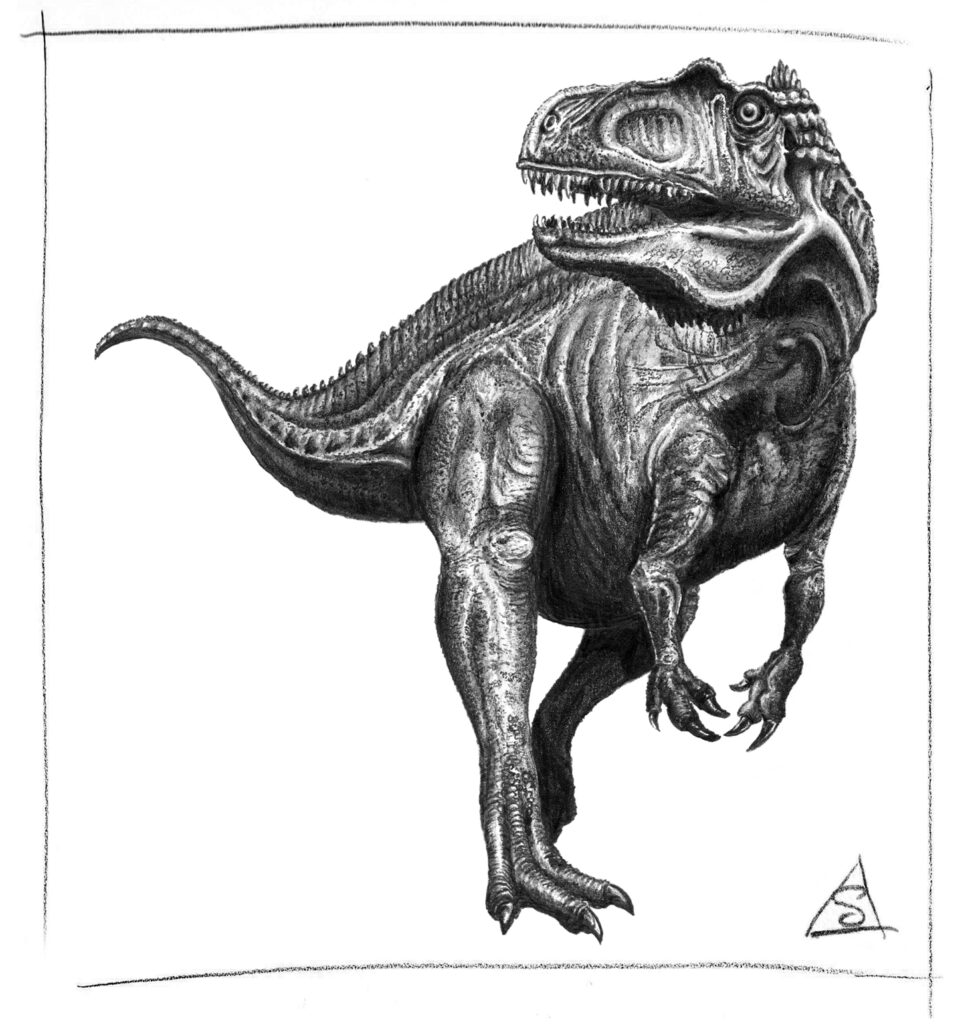
Dinosaur names are typically italicised, with the genus name also given a capital letter. In order to identify them correctly, they should be written along with their species name, too. For example, Tyrannosaurus rex (note only the genus is capitalised, the species gets a lowercase first letter, rex being merely a type of Tyrannosaur – albeit the one everyone knows).
Within a novel, italics tend to be more commonly used to provide emphasis to the narrative (although I did stick with the tradition of italicising ship names because there are so few). There are so many recurring animal names within this story that I thought emphasising them all might confuse the narrative. Therefore, I gave each animal name a capital letter instead. I apologise to the purists but hope you will understand why I made this decision.
THE CREATURES
Buitreraptor gonzalezorum probably lived in the Cenomanian or even Turonian stages of the Cretaceous, a little later than the setting for DINOSAUR. The fossils found in South America came from rock strata laid down approximately 94 million years ago. Research continues, but there are as yet few known Dromaeosaurids from the southern hemisphere (at the time of publication). Some palaeontologists believe their ancestors may be traced all the way back to the early Jurassic, before the breakup of Pangaea and this would explain their worldwide dispersal in later times. Although my chronology is slightly off, I wanted to include at least one real animal from Earth’s past to fill this niche. This fast, intelligent, fighting little creature will more fully make its introduction later in the series.
TRAITS
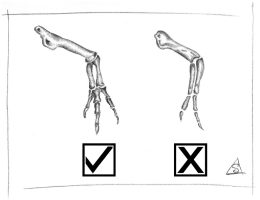
The arctometatarsalian condition has, as far as I know, never actually been found amongst the carcharodontosaurids, although it is a feature that has evolved more than once, apparently. Tim speculates about the possibility of new animals that may have this trait, but also uses the potential speed and/or long distance running capability this condition was believed to imbue, to scare Woodsey into being quiet for a few moments.
LOCATIONS
The locations of fossilised Mapusaurus roseae remains suggest they may have lived in more northerly latitudes than Giganotosaurus carolinii. However, so comparatively few fossils of these magnificent dinosaurs exist that this might simply be lucky accident, as the land may well have been traversable. I included both animals within the region around the landing site of the New World to increase the peril faced by the crew.
Also, because each was such an extraordinary creature, how could I possibly choose between them? It is likely that their hunting territories would have been many miles apart, although every territory intersects somewhere, so it is possible they could have met. Naturally, the forest fire that threw them together in this story was merely a narrative device, but who knows, maybe a large-scale conflagration could have set them on a collision course, at least once, in those long-gone days. It seems more likely they would have avoided one another where at all possible in reality, of course, but such a clash of the titans is almost irresistible for an author.
When I wrote that passage, I hoped to ‘trap’ the reader in the cab of the stranded excavator and surround them with these terrifying predators. For this reason, I introduced the hapless driver very late in the narrative – however, the concept of ignoring an emergency recall in order to get a job finished, and thus avoid the necessity of going back to it, was simply me imprinting my past experience of working on building sites upon a fantasy world!
If a meteorite was going to smash into Birmingham at 7pm, at 5pm, someone on a scaffold somewhere would almost certainly be saying, “Yeah, but we can have this finished by six and get the money in!”
For all the people who have to work, through it all, no matter what – I salute you!
Thank you so very much for reading,
Stephen
RevEnge

FEATHERS
There is a huge amount of effort going into researching this subject at the moment. It seems likely that many species had at least some form of feathers. Perhaps all dinosaurs did; the final answer seems to be up for grabs at the moment. Even the reasons for having feathers may have differed wildly between the species – maybe even between a species, at differing points throughout the animals’ lives (for example, the larger the animal, the less its requirement for insulation – in fact, above a certain size, overheating would be more likely).
Although I have introduced a few species with feathers, notably Buitreraptor, I have largely hedged around the subject for two reasons. Firstly, information on the subject is being gathered and is changing at a prodigious rate – and I did not want something so obvious as the look of the dinosaurs to become immediately out of date (this is a major problem faced by anyone writing about dinosaurs at the moment. Most books have to be updated three or four times just in the time it takes to write them!). Secondly, many people have a cherished view of what a dinosaur, particularly the larger and more popular clades, should look like.
In terms of the story, this does not really matter or affect events, and as this work is purely for entertainment, I leave the subject open and hope that each reader will enjoy ‘clothing’ these incredible animals in the way they prefer. Feathers or scales – please imagine them as you will.
TIMELINE
As previously stated in my notes at the back of book one, Buitreraptor lived a little later than the setting for these stories, perhaps in the Cenomanian or even Turonian stages of the Cretaceous Period.
There are few dromaeosaurids yet known in Patagonia during this period, so I chose this little animal rather than make one up. Tyrannotitan lived a little earlier than the setting for REVENGE, possibly in the Aptian stage of the Cretaceous Period.
I included this great animal for three reasons: Firstly, to give the great Mapusaurus and Giganotosaurus a rest after their exhausting efforts following the stampede in book one; animals that size would probably have hunted vast territories, perhaps even hundreds of square miles, so this would seem logical.
Secondly, there is no conclusive evidence, as far as I am aware, to categorically prove or disprove the group behaviour of the large theropod carnivores. It may be that they grouped together at certain times of year, or to bring down great prey, but were otherwise solitary; or they may have grouped together for mutual benefit when young, only to become more solitary when grown. Research continues and it is truly fascinating. With regards to my story, as the mapusaurs and giganotosaurs worked in packs (possibly due to a springtime breeding cycle), I thought it would be nice to describe another, similar animal with a lifestyle at the opposite end of the spectrum – a ‘lone wolf’, if you will.
Thirdly, I am a writer of stories, and with a name like Tyrannotitan, how could I possibly resist?
Thank you so very much for reading,
Stephen
AlLEgiance

CREATURES
Ornithocheirus and Anhanguera were vast flying reptiles (pterosaurs), and related. Size estimates for Ornithocheirus are still disputed, but range anything up to 12m across the wing – although other researchers believe they may have been little more than half that size and very comparable to Anhanguera in that respect also. Both animals probably lived a little earlier than the setting for ‘Allegiance’ – perhaps as much as 10 million years further back, hence Tim’s comment, “Ornithocheirus, or one of his relatives.” Ornithocheirus remains have been found in Britain and Anhanguera in north-eastern Brazil (either side of the fictional island where our heroes discover them off the west coast of Africa).
For animals that fly and eat fish, it must be a palaeontologist’s nightmare to guess where they were actually from! I chose to feature Ornithocheirus because it is so well known from the BBC’s Walking With Dinosaurs series. Sometimes it’s nice to be able to provide an actual face to a name! Although a flying pair do feature on the cover of the next novel in the New World Series, ‘Reroute’ (Oops! Spoiler alert!).
Cronopio (the little critters that savaged Henry’s trousers) were small mammals. Probably no larger than terriers, one of the palaeontologists who discovered them described Cronopio as bearing a marked resemblance to ‘Scrat’ – the cute and immensely industrious little chap that chased the ever-elusive acorn in the film Ice Age.
The idea that they behaved in a very dog-like manner was a complete liberty on my part, for the sake of the story – but then, if those ancient mammals had come across a pack of wild humans, maybe they would have developed a symbiotic relationship and, dare I say it, become friends in an age of deadly reptiles?
STAND OFFS
I try to stay away from gladiatorial contests among the dinosaurs. As stated on previous occasions, large predators, then as now, may have made a lot of noise when defending their territories, but would most likely have avoided direct conflict with one another. Injury could so easily mean death. However, a few scraps must have happened down the years – what a tremendous piece of good fortune that one such occurred while a couple of our heroes just happened to be crossing the river, so we got to see it!
Ekrixinatosaurus was a relative of the much more widely known Carnotaurus sastrei. As depicted in my amateurish sketch at the head of chapter 8, its arms were almost completely vestigial and probably useless. Subsequently, not being able to reach to cover his ears was a really cheap gag, but sometimes you just have to go with the classics. However, what I really like about this animal is its size. Unlike the behemothic Mapusaurus or Oxalaia, Ekrixinatosaurus was small enough to easily follow you through a forest and would likely have had the stamina to go all day – nowhere to hide – shudder.
THE BAD GUYS
Talking of shudders, the fanatical Emilia Franke’s ship, the Heydrich, was named after Reinhard Heydrich, one of the main architects of the Holocaust. Considered one of the worst of a very rotten bunch within the Nazi leadership, it is fair to say that few have left such a trail of murder and chaos in their wake – millions dead. Even Hitler took this man very seriously, describing him as “the man with the iron heart”. Fortunately, in 1942 he got what he deserved. History crucially remembers these monsters in order to provide future generations with a chance at stopping the next one. In the past they have tended to rise from a world where the vast majority of people are afraid, or simply consider it wise or easier, to hide their real thoughts from view. Within his Cicero Trilogy, Robert Harris wrote a lovely little piece where Cicero says something to the effect of ‘we only have the knowledge of our own lives, but if we read history, we can call on the wisdom and knowledge of generations’.
The ‘Schutzstaffel’ was more commonly known as the infamous ‘SS’, a major paramilitary organisation under Adolf Hitler and the Nazi Party.
The Eisernes Kreuz (Iron Cross) was a medal for valour and service to one’s country (in Germany). Unfortunately, it is commonly tainted with association to the Nazi movement (the Nazi iron cross can be differentiated by the swastika emblem at its centre), but the honour goes back much further; in fact all the way to the Napoleonic era, and was awarded to some very courageous men and women who were most certainly not Nazis. The idea of Heinrich Schultz identifying himself with such an icon seemed entirely in keeping with the deluded self-importance of his character – the man was not even German!
The German people are, and have always been, clever and industrious. The Nazis are in no way synonymous with them. However, when it comes to writing ‘bad guys’ for the purpose of fiction, they don’t come much ‘badder’ than the Nazis, do they? After all, where would our much beloved Indiana Jones have been without them?
Thank you so very much for reading,
Stephen
REroute

THE CREATURES AND THEIR LOCATIONS
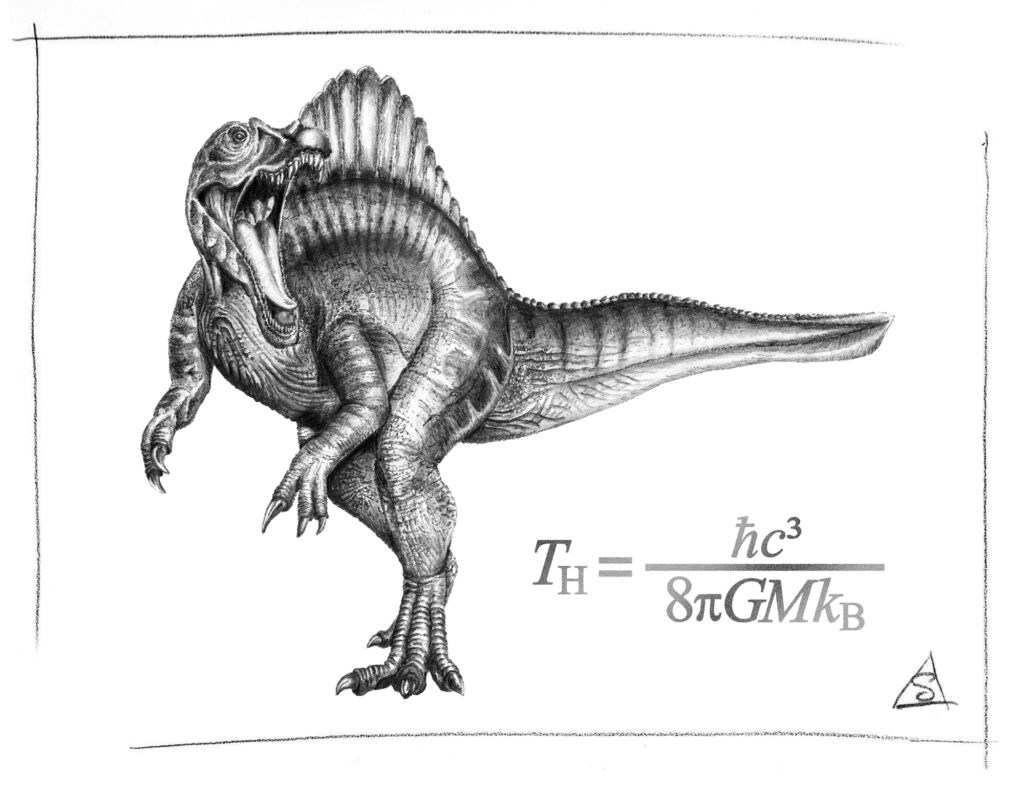
There were several spinosaurids around during the Cretaceous, Spinosaurus aegyptiacus being, of course, the most well-known thanks to a very popular film franchise! (To everyone with any knowledge of Tyrannosaurs, I still feel your pain!) In Patagonia, we also met Oxalaia quilombensis and Irritator challengeri. Some palaeontologists have postulated that Oxalaia may actually have been the same species as Spinosaurus, despite the thousands of miles and the beginnings of the Atlantic Ocean between them. Others state differences in the skull and snout – even in the density of the bones and probable musculature. Some believe Oxalaia was probably bipedal, like the ‘old’ Spinosaurus from the JPIII film.
These animals certainly seem to be the subject of intense debate currently. This story describes them as separate species because they are incredibly exciting creatures to write (or wrong) about. With regards to the true identities and appearances of these wonderful animals – I’m not touching that with a ten-foot pole! Instead, I chicken-heartedly hide under the comfort blanket of ‘fiction’ – that way I can tell naysayers to get a life, while secretly agreeing with them!
On our trip to Cretaceous Britain, we also meet Sigilmassasaurus brevicollis, another spinosaurid. Smaller than Spinosaurus, this was still a very large predator – as Aito Nassaki had a hand in finding out… (I can hear everyone groaning at that one, sorry).
Although discovered in North Africa, I theorise that these creatures ‘island-hopped’ due to their aquatic nature, eventually finding themselves on the ‘tropical’ landmass that would one day be Britain (it seems some things do change).
Carcharodontosaurus saharicus gave its name to the family ‘Carcharodontosauridae’ which also includes South America’s mighty Giganotosaurus carolinii and Mapusaurus roseae. Carcharodontosaurus was another Tyrannosaurus rex sized predator from North Africa, and was also discovered by Ernst Stromer during his time in Egypt, along with the famous Spinosaurus aegyptiacus and another large theropod predator named Bahariasaurus ingens.
The Allied bombing of the Old Academy, Munich, during spring 1944, destroyed Stromer’s finds, along with the type specimen for Bahariasaurus. Since then, arguments have been made for its inclusion within the Carcharodontosauridae, Tyrannosauroidea, Ceratosauridae and Megaraptora families!
We await more research and more lucky finds to get to the heart of this – maybe someone will put forward an argument for it being a fish? In the meantime, I think that a 12m long, fast, comparatively lightweight killer (approx. 4 tons) could make a nice but deadly addition to this series in the future.
Rugops primus, like South America’s Ekrixinatosaurus, was an Abelisaurid and a relative of the better known, but much later, Carnotaurus sastrei. Thought to be a North African scavenger, Rugops lived around the same time as the giant Carcharodontosauridae named above. This chap was probably around 4-6m in length and 500-750kg in weight with a comparatively weak jaw. As if it didn’t have enough problems in a land of truly huge and vastly more powerful predators, its vestigial arms would also have been fairly useless, AND its name means ‘wrinkle face’ – poor sod! However, like its cousin, Ekrixinatosaurus, Rugops was small enough to follow you through the trees – so you probably wouldn’t call him that to his wrinkled face!
CHARACTER TRAITS & ACCENTS
I receive quite a few comments from readers who love the way the characters speak with their own accents (and some hate mail on the subject, as well!) Personally, I believe it brings them off the page a little, while often providing some in-built humour, too.
However, with the 16th century characters, I’ve taken a few liberties (once again). Although communication would not have been impossible, anyone who has ever read Shakespeare knows that the dialect can, at times, be very difficult to understand, so much has the English language changed.
To that end, I’ve gone for a ‘feel’ of antiquity with the English and Scots dialects, trying where possible to remain true to the period but hopefully without making the characters’ words indecipherable – I apologise to the purists and once again hide under my comfort blanket of fiction.
Here – have a smiley face :o)
As far as I know, Elizabeth Tudor (soon to be Elizabeth I) was not in Northumberland during 1558. Most likely she was still ensconced within Hatfield House in Hertfordshire. However, Mary was often advised to have her half-sister removed from the succession (and the world). Elizabeth’s life hung by a thread on several occasions, especially during her youth, when her continued existence was often at the whim of another. Choosing between family or faith would probably be easy for most of us now, but for Mary it must have been the sorest of trials. She had little affection for her sister, as Elizabeth’s mother, Anne Boleyn, had supplanted her own mother, Catherine of Aragon, leading to her downfall. Worse, Elizabeth was a healthy, robust, soberly dressed Protestant (in her youth) – at a glance, everything the dressy, Catholic queen was not.
However, one wonders whether Mary showed a side to her character at odds with her popular nickname ‘Bloody Mary’, by allowing her half-sister to live against her own interests. Especially at a time when state-sanctioned murder was not uncommon (though it was often known by other names, so as to pass muster according to the standards of Tudor political correctness). Her dilemma over bolstering the Catholic cause for the sake of England and her personal beliefs, or the sparing of her Protestant sister, must have been – to use an appropriate idiom – a heavy cross to bear. This fictional tale sees events altered by the arrival of the New World. However, I have tried to ingratiate my story within a semi-realistic framework of events from the period.
A BIT OF HISTORICAL CONTEXT
Historically, there was more than one Lord de Soulis. Sir William de Soulis (or Soules), the last, was actually Lord of Hermitage Castle in the Scottish Borders between 1318 and 1320. This was during the reign of Robert the Bruce and more than two centuries before the setting for this book. Regardless, I chose to include him because he was an extraordinary, ready-made ‘bad guy’.
Allegedly, he entered into a deal with Edward II of England to get rid of the Scottish King – he was certainly arrested for treason. However, the legend of Sir William de Soulis is probably more interesting than the reality. Either way, he seems to have been an extremely unpleasant fellow, even by medieval standards. Legend has it that William de Soulis was physically a large, powerful man, with prominent canine teeth and a predilection for extreme cruelty. He was almost universally loathed, or so the story goes, and talking of stories, many circulated that he was also a practitioner of the dark arts. His proclivity for taking young children from the countryside around Hermitage Castle and using them in evil rituals seems most unpleasant!
Apparently, De Soulis would summon his familiar, one ‘Robin Redcap’, during his rituals. According to British folklore, a redcap is a type of evil goblin, often tied to ruined castles in the borderlands. These chaps are known for the killing of travellers and local residents alike, so they can refresh the bloodstains on their hats – as the name Redcap suggests. The legend has it that if the bloodstains dry, the redcap dies. Redcaps were reputedly very quick and powerful. This series will always have dinosaurs at its heart, but even from inception, I always wanted to bring the story forward to include the 16th century borderlands and elements of the Hermitage Castle ‘horror story’. It seemed natural to write a dark spirit with a powerful attraction towards such a reputation – like the one created when Baines blew up a satellite in a Nazi pilot’s face – especially with a creature like De Soulis meddling with things he shouldn’t and opening the door.
Robin Rotmütze (redcap in German) tied in nicely with the legend of De Soulis and Hermitage Castle, and was too good to miss. Once summoned by De Soulis, the Robin Redcap of legend inspired terror in the lands around Hermitage, committing many atrocities. To escape a redcap, one must quote a passage from the Bible at it, whereupon it loses a tooth. (I wonder if Redcap regains his power if he remembers to put it under his pillow?)
Of course, it’s easy to mock superstition from the street-lit modern century, but William de Soulis seems to have been as dark as the thing he allegedly conjured. The story has it that in AD1320 he attempted to abduct a young woman belonging to the Armstrong clan. Her father tried to prevent it and De Soulis killed him where he stood. Alexander Armstrong, Laird of Mangerton, calmed the lynch mob poised to hang De Soulis, advising him to leave while he still could, but leave the girl behind. Alexander Armstrong was the social inferior, and being saved by such a personage clearly hurt De Soulis’ pride. Rather than show gratitude, he began to hate Armstrong, eventually inviting him to a feast at Hermitage Castle. Upon Armstrong’s arrival, De Soulis stabbed him in the back. As stated, De Soulis really died in the dungeons of Dumbarton Castle, later in AD1320, and after accusations of treason. However, his legend seems to have become entwined with the fate of his ancestor, Sir Ranulf de Soulis, more than a century earlier.
I won’t give away details of Sir William’s future here, as it will be revealed in Book 5, REMAINS. I will simply end by saying that the sketchy evidence regarding the 12th and 13th century family seems to sit, at least partially, where history meets legend. However, depraved cruelty, treason and black magic are all recorded. De Soulis did not live in the Tudor age, but he did exist, and his story is so incredible that I just couldn’t resist working him into a timeline, so innocently and apologetically screwed up by James Douglas et al.
Reiver families ruled the Scottish Borders at that time, engaging in cattle rustling, murder and slaving. They were legendarily tough, as were their ponies. The Maxwells really did feud with the Johnstones throughout the period. More of this in Book 5, but their stories became the stuff of song, literature, and of course, legend. The name of Natalie Pearson’s dog ‘Reiver’ was inspired by the Reivers, entwined with the Scottish Borders themselves – the original home of the border collie.
Moving forward through our ‘real’ history, Nazi Headquarters, ‘The Brown House’ (so named because of the colour of their early uniforms) in Munich, was destroyed by Allied bombing in October of 1943. The museum housing Ernst Stromer’s dinosaur fossils discovered in Egypt between 1911-14, ‘The Old Academy’, was also bombed by the Allies in April of 1944, and was indeed just a short walk from The Brown House.
Hitler really did live for a time at Prinzregentenplatz 16. Initially having the rent paid by his publisher, this was still a big step up from the much poorer circumstances he endured during the 1920s. His dream as a youth was to study fine art, but he was rejected by the Academy of Fine Arts, Venice, twice. However, he did eke out a meagre living between selling watercolours and general labouring. By 1939 he was in a position to buy Prinzregentenplatz 16 outright.
However, looking at his early life, it’s a little difficult to see the monster he became – the man who killed, or caused the deaths of, almost fifty million people.
The New World’s landing in the 16th century has clearly created some very worrying ripples in the timeline from the Schultzes’, shall we say, unique perspective. The man Heidi moved mountains to track through time, is a struggling artist and vegetarian, a nobody. Can history be forced to repeat itself? Or can she find a way to make things even worse?
Oh, and by the way “Alright or wha’?” means hello in Wales. Although technically more commonly used in South Wales, rather than Gwynedd in the north, a hundred years from now I postulate there will be less of a linguistic divide. In truth, I just love Jones’ (and Gleeson’s) penchant for saying irreverent things that are wildly out of context. Within a world of dinosaurs and science/historical fiction (or ‘sci-hi-fi’ – I’ll have to remember that one!) that actually makes sense to me.
Thank you so very much for reading,
Stephen
rEmains

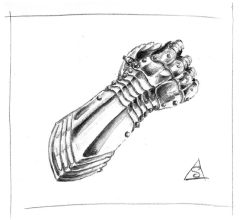
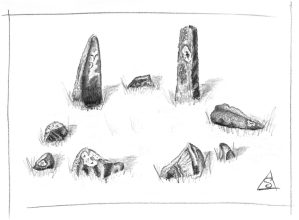
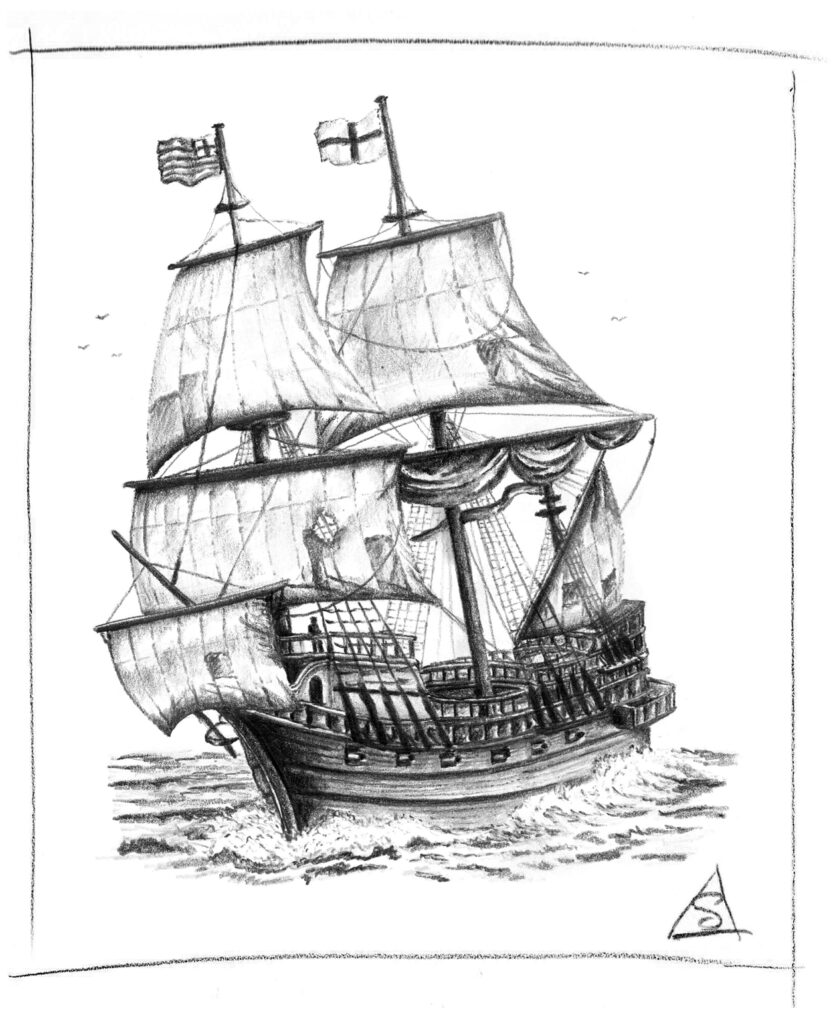
THE CREATURES & THEIR ORIGINS
Once again, I have included several dinosaurs within this book (shocker, I know), many of which I discussed briefly in previous notes. Like Carcharodontosaurus saharicus and the famous Spinosaurus aegyptiacus, some of them were also discovered by Ernst Stromer during his time in Egypt. I mentioned one of them in the notes at the back of the last book, another large theropod predator named Bahariasaurus ingens.
The Allied bombing of the Old Academy, Munich, during spring 1944, destroyed Stromer’s finds, along with the type specimen for Bahariasaurus. It is still unclear exactly which theropod family this animal belonged to. However, we can estimate that it grew to perhaps 12m in length and would have been a much lighter animal than Carcharodontosaurus saharicus, perhaps half the weight by similar length, and this fuels the imagination. How fast was it? How did it hunt?
While we wait for the science to catch up on these questions, I’ll look forward to writing more about Bahariasaurus ingens in the next book, CURSED.
The pack of Rugops primus, about to spring their trap on Devon, Aito and Jansen, were also mentioned in my notes for REROUTE; however, I’m not sure Sarcosuchus imperator got the paper and ink it deserved. Of the same family as the giant crocodile featured in some of the earlier books, Sarcosuchus imperator was one of the largest crocodiles known to science. With each jaw measuring at least 2m, it really did have a maw a grown man could walk into – if he’d really had enough!
Deltadromeus agilis was (possibly) yet another huge and terrifying theropod carnivore from North Africa. I add the ‘possibly’ only because some palaeontologists think the remains of this animal may actually have been a smaller Bahariasaurus. It seems entirely likely and believable that animals sharing a time and place might show similarities, even share ancestry, but as diggers are yet to find a head for either, the argument remains unresolved. For myself, Deltadromeus agilis was an irresistible force – an animal possibly the size of Allosaurus, but built more like a raptor – come on!
However, my personal exuberance aside, the hapless Ouranosaurus nigeriensis that crossed paths with Deltadromeus in the story, were understandably less enthusiastic. Ouranosaurus nigeriensis was a hadrosauriform, related to both the famous Iguanodon bernissartensis and the duck-billed dinosaurs. Despite being herbivorous, the row of neural spines along much of the ouranosaurs’ backs and tails created ‘sails’ similar in appearance to those of several of the predatory spinosaur family.
NAMES & ITALICS
Just a couple of editorial notes as I think of them: I stated previously about opting not to italicise the animal names in the main body of the story, hoping to avoid any confusing emphasis. Keeping all the capital letters in check is quite a job, too, as it happens – Tyrannosaurus vs. tyrannosaurs – see what I mean? (At this point, it would be remiss of me not to mention how hard my editor works to keep righting my wrong writing! Thank you.)
While on the subject of wrongs… in chapter 10, Video Nasty, Aito says, “The public records of everyone on this mission aren’t worth a damn.” This is such a common expression that I spelt damn after the original four-letter word. However, it is believed that the derivation actually comes from a small Indian coin called a ‘dam’ – I assume they weren’t worth very much. The phrase was possibly carried back to England by soldiers in the mid-18th century. ‘I don’t give a damn’ was an Americanism first recorded in the 1890s. Correcting this typo in the story made it look like a typo, ironically – so it was just a case of, ahem, damned if you do, damned if you don’t! (Sorry.) Mucking around with words leads us inevitably to Shakespeare.
As with REROUTE, I have once again tried to include a flavour of the Elizabethan era dialects, hopefully without the confusion. In reality, it’s fair to say that they would have been far more impenetrable to most of us moderners, as we would no doubt be to them. Can you imagine what they would make of emojis? Use of such glyphs would surely have been worthy of a burning at the very least! I remember one far-off day in English literature class, when the fourteen-year-old Stephen took his turn in reading Shakespeare to the class, including line numbers and all! I stopped reading when the rest of the class fell about laughing. I was completely baffled by this, until the teacher explained what I’d done. She was familiar with the condition where people walk in their sleep, but reading in one’s sleep was apparently all new to her! Unfortunately, that is all I recall about my introduction to the Bard. I’m sorry to admit that is a true story. I may also have poked a little fun at one of literature’s most important figures here, but most fourteen-year-olds probably feel the same. In any case, his reputation will far outlive my own, so he can get over himself! Here, have a smiley face, Shakey :o)
LEGENDS & LIBERTIES
For anyone interested in the story of Sir William de Soulis, legend has it that he was bound by specially crafted chains and taken off to Ninestane Rig, where he was wrapped in lead and boiled alive by the people under his ‘care’. The reason given for the chains was that his magic was so strong he could neither be bound by ropes nor cut by steel. The history tells it rather differently. As I mentioned in the last book, he was already long dead by Tudor times, but was such a beautifully crafted, semi-real villain, I just couldn’t resist! Anyone who has ever visited Hermitage Castle in the Scottish Borders will understand; such a dark, menacing place simply had to have an evil, black-magic-wielding lord in its past. Fleetingly back to the history, Sir William actually died in the dungeons of Dumbarton Castle.
It seems to have been common policy for the border lords of the time to consider whether their interests were best served by affiliation with the English or the Scots. In AD1320, it is believed that Sir William de Soulis (also spelt de Soules) was party to an English plot to kill Robert the Bruce, the Scots King. The scheme failed and he was rounded up with the other (presumably) guilty parties and taken to Dumbarton Castle where he died but, as far I can tell from the information available, was not executed. Dungeons were, after all, very unhealthy places to be, so this is probably not all that surprising. The legend that has stuck to him seems to come from a cross-pollination between Sir William’s own black reputation (even by medieval standards, he was a seriously bad man) and the sticky end suffered by his ancestor, Sir Ranulf de Soulis (or possibly Randolph), who was murdered by his servants in AD1207. The legend of De Soulis and his familiar, Robin Redcap, fit so perfectly into the Hermitage Castle story that I intend to write about them further, once the New World Series is complete.
I probably should have mentioned this in my notes at the end of the last book: Lord David Maxwell is a fictional character I invented to bring together the New World’s crew and the indigenous Scots. The Maxwell clan was real enough, however, although I believe they were still followers of the Catholic faith at the time when this story was set. They really didn’t get along with the Johnstones. Also around this time, the title of Lord Maxwell changed hands very quickly as several of the incumbents died in rapid succession. By 1558 it was the turn of John, the 8th Lord Maxwell who acceded at the age of two, following the death of his brother Robert at the age of four. Despite this, they were one of the most powerful families in southern Scotland during this time. David Lord Maxwell came to being because I needed a character who would be more radical and at odds with the Queen Regent – Mary of Guise – and of course, De Soulis.
To further foment confusion, there were also several Sir Walter Scotts, perhaps the most famous being the 18th century novelist so well known for Ivanhoe, Rob Roy, etc. The character in this story is loosely based on a young man who ended up being the first of the family elevated to the peerage – the 4th Baron of Buccleuch. The eldest son of Sir William Scott, he was the grandson of Sir Walter Scott, 1st of Branxholme, 3rd of Buccleuch. Our Sir Walter’s father predeceased his grandfather, making him the 4th of Buccleuch at the age of just three. A fighter from his childhood onwards, he grew up among the Border feuds and despite his youth played a prominent role in 16th century Scotland’s turbulent politics. In 1558 he was thirteen.
The Sir John Johnstone in this story was a largely fictional character, although there was a real John Johnstone alive at the time who would have been in his mid to late teens. However, that man was not knighted until 1584. Sadly, many of the Johnstone family records were destroyed in the burning of Lochwood Tower – courtesy of the Maxwells and the Armstrongs. When my fictional historian, Thomas Beckett, told the crew that the Scottish Borders of the 16th century were as dangerous as anywhere in the world at that time, he was probably correct.
HISTORICAL FIGURES
Elizabeth I needs little introduction the world over, I’m sure. In reality, she awaited the news of her sister Mary’s death at Hatfield House, roughly ten miles north of what is now known as Central London, on the 17th November 1558. Sir Nicholas Throckmorton did bring the news along with Mary’s ring. History took a left turn with the arrival of the USS New World, leaving me with two stories I wish to tie up outside the New World heptalogy. My intention is to include both in the coming title, REBIRTH, but we’ll see how the story develops – they may need a book each. Either way, I look forward to telling the story of how the infamous Geoff Lloyd inveigles his way into Elizabeth R’s inner circle – accidentally taking on the name of a famous adviser and turning the forever intriguing Tudor court upside down in the process.
Martin Bormann was head of Adolf Hitler’s Nazi Party Chancellery. He wielded immense power as private secretary to the Führer, not least by controlling the flow of information and access to Hitler himself. It is believed he fled the bunker after Hitler’s suicide, himself committing suicide soon after – possibly a preferable fate to being captured by the Russians. He was condemned to hang posthumously after the Nuremberg trials.
Fritz Todt was a construction engineer and senior Nazi Party member who directed the construction of the German autobahns and later became the Reich Minister for Armaments and Ammunition. From that position, he directed the entire German wartime military economy. Earlier in the war he was a general in the Luftwaffe, having earned an Iron Cross in the Luftstreitkräfte during the First World War. He died in a plane crash in 1942, possibly on Hitler’s orders, after trying to talk the Führer out of continuing the war with Russia.
The party members in this story are a softer bunch (possibly) because of Douglas’ meddling with historical events during the 16th century. Without the terror and destruction of the First and Second World Wars, what might such men have become? Would they still have tended towards evil? I have tried to portray them as men who had the potential to go either way, though of course, for Heidi Schultz that would never do.
I hope you enjoyed this episode of the New World Series. It was always my intention for dinosaurs to provide the main set dressing and a continuous theme for this series, but with books 4 and 5 providing an interval, and taking the USS New World on a different course through time, in order to change the future.
Now that stage is set, I look forward to taking you on the next leg of our heroes’ travels in book 6, CURSED, where poor Tim Norris seems to be having another roarfully bad time, as he finds himself with it all to do over again…
Thank you so very much for reading,
Stephen
cuRsed

DISCOVERIES IN EGYPT
Carcharodontosaurus saharicus, suffice to say, was another of the large theropod carnivores discovered by Ernst Stromer during his remarkable Egyptian excavations of 1911-14. Just to give a basic mind’s eye picture, it was broadly shaped and sized comparably to Tyrannosaurus rex, although not directly related. T rex joined the fossil record more than thirty million years later and was, overall, a stronger, more advanced and dangerous animal.
Rugops primus – it is perhaps worthy of note that no actual evidence exists to prove that they were social or moved about in packs – at least, not at the time of publishing. As Rugops was comparatively weak in the jaw, I took a liberty and made them hunt, or scavenge, in numbers. From a fictional storytelling perspective, I think this makes them a scarier proposition, too. If they really did go about in groups a dozen strong, they would have been a right handful!
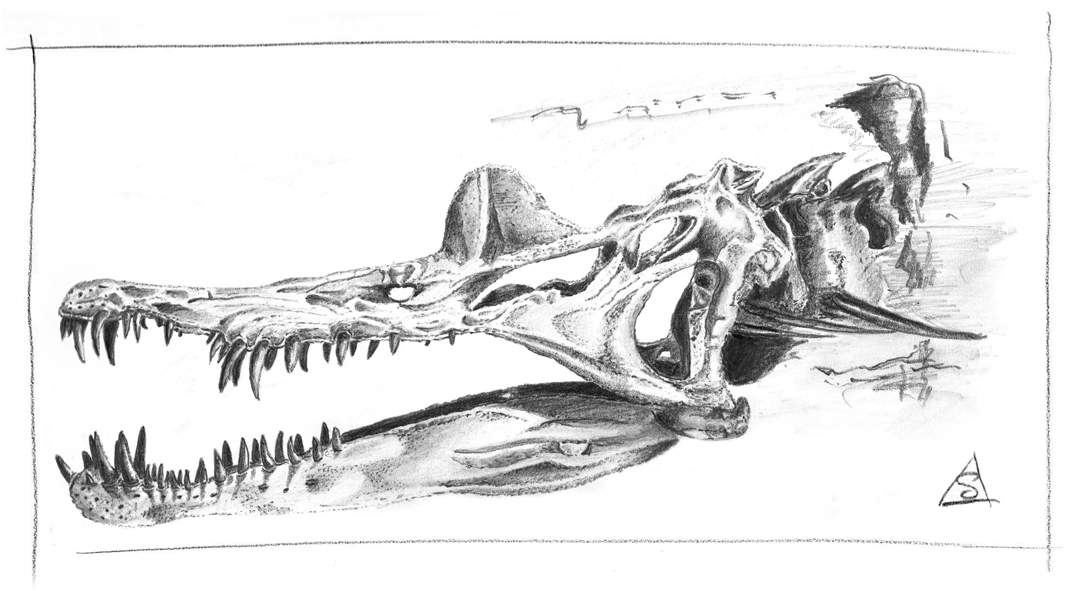
Spinosaurus aegyptiacus, a dinosaur that probably requires little introduction these days. Apologies if it seemed like ‘icon mashing’, but I just couldn’t resist draping one across a pyramid – two ancient fascinations for the price of one, with a later nod to Agatha Christie’s Death on the Nile, for good measure!
TITANOSAURS
Paralititan stromeri were large sauropod dinosaurs – sauropods were the long neck, long tail varieties. They were titanosaurs related to Argentinosaurus, and others, from earlier books in the series. They were probably a little smaller than Argentinosaurus, but still huge. Only fragmentary evidence exists for this once extraordinary species, so estimates vary wildly between 20-60 tons in weight and 20-32 metres in length. Hopefully a more complete specimen will be found in the future to fill in the gaps. Dispersed over several continents, the titanosaurs presumably shared common ancestors from before the breakup of Pangaea into the continents we recognise today. A process that began back in the Triassic Period, a hundred million years or more before the Cretaceous setting for this story. Again, as the name suggests, they were discovered and named by Ernst Stromer. He must have won the dino-lottery during those brief years of the early 20th century. Sadly, the majority of his finds, including the most complete remains yet discovered of the mighty Spinosaurus aegyptiacus, were destroyed in the Allied bombing of 1944. As the song says, ‘War – what is it good for? Absolutely nothing!’ Well, at least it stopped Hitler, eventually. Pity it didn’t end there.
Afromimus tenerensis, small and ostrich-like, this little creature was an ideal choice for a dinosaur-mimicking robot spy. Extremely fast and a relative minnow in the age of giants, it would have been easy to overlook. Afromimus was an earlier North African relative of the more famous Ornithomimus velox. They must have been graceful, bird-like creatures, as implied by the name.
Ouranosaurus nigeriensis I also mentioned in a previous book. However, aside from being an ancestor to the hugely successful duck-billed dinosaurs, who mainly came later, I find these creatures interesting in that they share such a similar (at least, superficially) sail on their backs with Spinosaurus. Ouranosaurus was herbivorous. (As you will no doubt have gleaned from this book, Spinosaurus wasn’t!) That both had a similar body plan and were from the same area raises the question of perhaps another common ancestor. Perhaps divergence came as a necessity of lifestyle – although Spinosaurus aegyptiacus was far larger and a whole lot meaner! The dorsal sail has long been pondered by experts, some believing it functioned as a thermoregulator for heating or cooling the blood – dogs use a similar process, instead passing blood through the pads in their paws to cool themselves down. (Quite often, the little darlings get too excited to drink cool water, even when they should, so cooling their paws on a cold surface or in a stream is a good idea if they’re overheating. Health and Safety Notice: DO NOT TRY THIS WITH A SPINOSAURUS!) Other scientists have suggested that such a skeletal construct may have supported a hump of muscle or fat rather than a sail, and like a camel, it might have been used for energy or fluid storage in times of scarcity or drought. There’s still just so much to learn about dinosaurs. We’ve barely scratched the surface, and I think that’s a large part of the fascination for so many of us – once you recover from how vast and dangerous some of the dinosauria were.
Sarcosuchus imperator. Again, closely related and contemporaneous with South America’s Sarcosuchus hartti from earlier books in the series, suggesting common ancestry. These giant crocodiles were easily large enough to dispatch an unsuspecting carnivorous Rugops, or herbivorous Ouranosaurus. Each prey animal growing to roughly seven metres long, the deadly Sarcosuchus would have possibly preyed on both – quite probably when they needed to drink, as crocodiles do today. Imagine, if you will, Sarcosuchus imperator hiding just below the surface, or maybe looking like a log floating downstream. Well over twice the length and many times the size of even the largest modern-day saltwater crocodile (Crocodylus porosus), they would have guaranteed that no one ever wasted time on idle chatter around the water cooler in Cretaceous Africa! It’s believed that the comparatively slender nature of the Sarcosuchus jaw would have made it impossible to ‘death roll’ its prey, as modern crocodiles do. Rather, the jaw structure leads palaeontologists to believe that Sarcosuchus hunted large prey, such as dinosaurs, killing with brute force rather than shaking them apart, like their modern descendants.
HISTORIC EVENTS & LOCATIONS
Geek alert: Name change from São Paulo to New World – São Paulo was the original name for the second Defiant, in Star Trek: Deep Space Nine – my homage (Starfleet’s famous engineer, Chief Miles O’Brien, hated the new carpets, too).
On the subject of ships, the 800-ton Spanish galleon, San Juan de Sicilia, really did explode and sink on November 5th, AD1588. (It’s unrelated, but perhaps ironic, that we celebrate Guy Fawkes Night [Bonfire Night] on November 5th in Britain, to commemorate the Gunpowder Plot of 1605, which didn’t actually go off!) The late 16th century, and especially 1588, was marked by turbulent North Atlantic storms. They’re believed to have been an effect associated with a period that has become known as the ‘Little Ice Age’. Despite the purposes of the Armada, far more sailors were killed by the weather than enemy action. Near the end of September 1588, the San Juan de Sicilia anchored off the west coast of Scotland, near the Isle of Mull, in Tobermory Bay. Though she was as yet undamaged, her crew were short of water and supplies. Her senior officer, Diego Tellez Enríquez, made a deal with a local Scottish lord, Lachlan MacLean of Duart. MacLean would provide the supplies the San Juan de Sicilia badly needed and Enríquez would provide armed men to help settle MacLean’s feuds with his neighbours. Enríquez was no fool – unwilling to trust a man who attacks his neighbours, he insisted on hostages to guarantee the Scottish lord’s good faith. The San Juan de Sicilia remained in Tobermory Bay for a little over a month, during which time Enríquez’s Spanish troops attacked and ravaged the islands of Rùm, Eigg, Canna and Muck, going on to lay siege to Mingary Castle on the mainland. At some point during this period, it was discovered, or assumed, that one of the merchants charged with the reprovisioning, John Smollet, was actually in the pay of Sir Francis Walsingham – Elizabeth I’s ‘spymaster’. The San Juan de Sicilia never actually set back to sea, for on November 5th she exploded while still at anchor, killing almost everyone aboard, including the hostages. The fifty or so survivors continued in service to MacLean until he finally had them shipped back to Spain a year later. Details of the ship’s destruction are sketchy, its actual reason, unknown – though the wreck still intrigues marine archaeologists to this day.
The Old Academy, Munich was destroyed by Allied bombing, as mentioned above. It was actually destroyed in the April of 1944, rather than the June explosion described in this story – it would have been nice to tie in exactly, but it just didn’t quite work with the timeline for the rest of the story.
The Nazis did indeed invade the Netherlands on May 10th, 1940, despite the Netherlands being neutral at the time. The occupation began comparatively softly, with trade deals from the hand wearing the velvet glove, but deteriorated throughout the war to a point where the population were starving by 1945. 70% of the Netherlands’ Jews were killed during the Second World War. Active resistance, which began with just a handful of fighters, grew throughout the occupation – perhaps unsurprisingly. From this came the idea for my ‘Order of the Silver Cross’ Nazi hunters, to honour the courage of those concerned. The Order in my books was not real, just a device I used to tie various characters to an overall thread throughout the story, but there certainly were real heroic groups who fought with whatever they had, to free their people from tyranny.
Reinhard Heydrich was one of the principal architects of the Holocaust. As previously discussed, he was a monster, arguably the worst of Hitler’s entire regime. Mortally wounded in Prague on May 27th, 1942, he was ambushed by Czech and Slovak soldiers sent by the Czechoslovakian government-in-exile, whose troops were trained by the British Special Operations Executive. Heydrich died from his injuries a week later, but the Nazi response, wreaked erroneously on villages thought to be linked to the attack, and a wider resistance, was terrible. Indeed, Heydrich probably deserves more ‘infamy’ than he actually receives. Hitler, looking for a pretext to invade Poland in 1939, tasked Heydrich, Himmler and Heinrich Müller with designing a false flag operation. The dastardly scheme they cooked up involved a fake attack on a German radio station at Gleiwitz on August 31st, 1939. Wearing Polish uniforms, 150 German troops carried out several attacks along the border with Poland. Heydrich masterminded the plan, giving Hitler his excuse to invade Poland and the rest, as they say, is history – although you might be forgiven for thinking it sounds familiar.
Josef Mengele is a name most will already be familiar with, I’m sure. He is also remembered under the quaint moniker of the ‘Angel of Death’ – more than just a Slayer song. His penchant for carrying out genetic experimentation on twins was revealed in a recent documentary that followed the life of a Holocaust survivor. He would use one for his sick experiments until that twin died – and these were often children – whereupon he would murder the other twin to compare their anatomies as part of his ‘research’.
Briefly following on from that, it’s so difficult to imagine such atrocities and yet… with war crimes practically accompanying our TV dinners right now, almost a century later, the original plot I had noted for this part of the story arc fast became unpleasant to write. It was just too ‘close’, as I mentioned in the preface at the beginning of this book.
That said, some people simply found themselves on the ‘wrong side’ because of where they were born. During the Second World War, Erich Alfred Hartmann, or ‘Bubi’ (roughly translated, ‘The Kid’), was a German pilot and the most successful fighter ace to date. History remembers him as a skilled pilot and an honourable serviceman, unlike the Nazis shamed above. A master of stalk-and-ambush tactics, he honed the technique of ambushing and firing at close range, rather than dogfighting. “Fly with your head, not with your muscles,” was the famous advice he passed on to new recruits, after a rude awakening which would have gotten him killed had he not been confined to barracks. During his time with the Luftwaffe, he flew 1,404 combat missions and engaged the Allies in aerial combat 825 times. He was credited with 352 kills: 345 Soviet and 7 American. Hartmann survived 16 crash landings, the causes being mechanical in nature, or damage due to impacts with flying debris from aircraft he himself had shot down. He was never brought down by direct enemy action. He was highly decorated and by 25th August, 1944, Hartmann had earned the coveted Knight’s Cross of the Iron Cross with Oak Leaves, Swords and Diamonds for 301 aerial victories – at that time, Germany’s highest military decoration. As discussed within this story, he was tried by Russia for war crimes against civilian targets, which he denied all his life. He seems to have been convicted for the costs to Russia in ‘expensive’ aircraft and for what must have been quite a dent to Russian pride – after all, he had shot down a lot of their planes. Apparently, the judge at his trial said his attempts to defend himself were “a waste of time.” He was initially sentenced to 20 years’ imprisonment, later increased to 25. He actually served 10 of those years, in various Soviet prisons and Gulags until his release in 1955. In 1997, the Russian Federation exonerated him of all charges during the democratic Yeltsin years. Sadly, this was a posthumous admission as Hartmann died in 1993. Of all his accomplishments, he was most proud of the fact that he never lost a wingman – although, technically, he did lose Major Günther Capito in 1943, who nevertheless lived on to fly again, until the end of the war. Now Erich Hartmann is cut off from his native 1944 Germany and ensconced aboard the New World, it will be interesting to see where he ‘flies’ next.
Thank you so very much for reading,
Stephen
coLlisIon


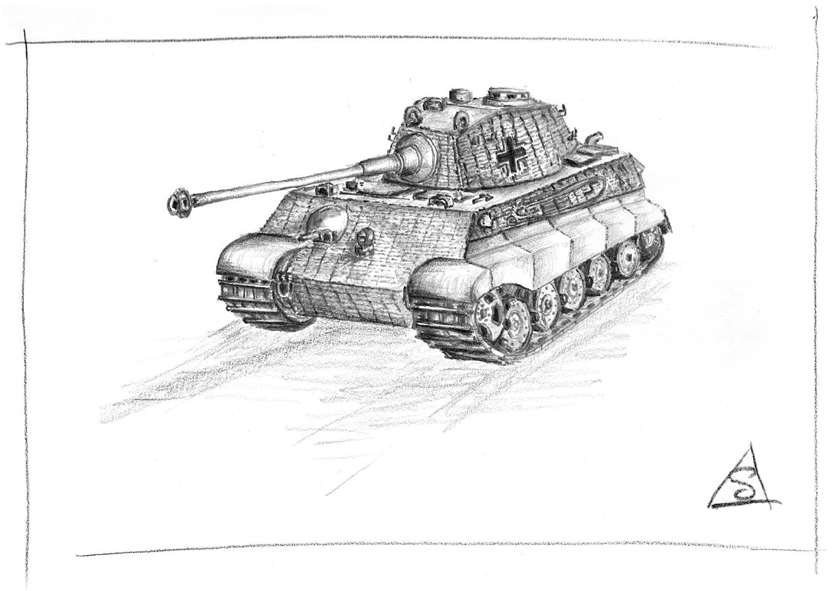
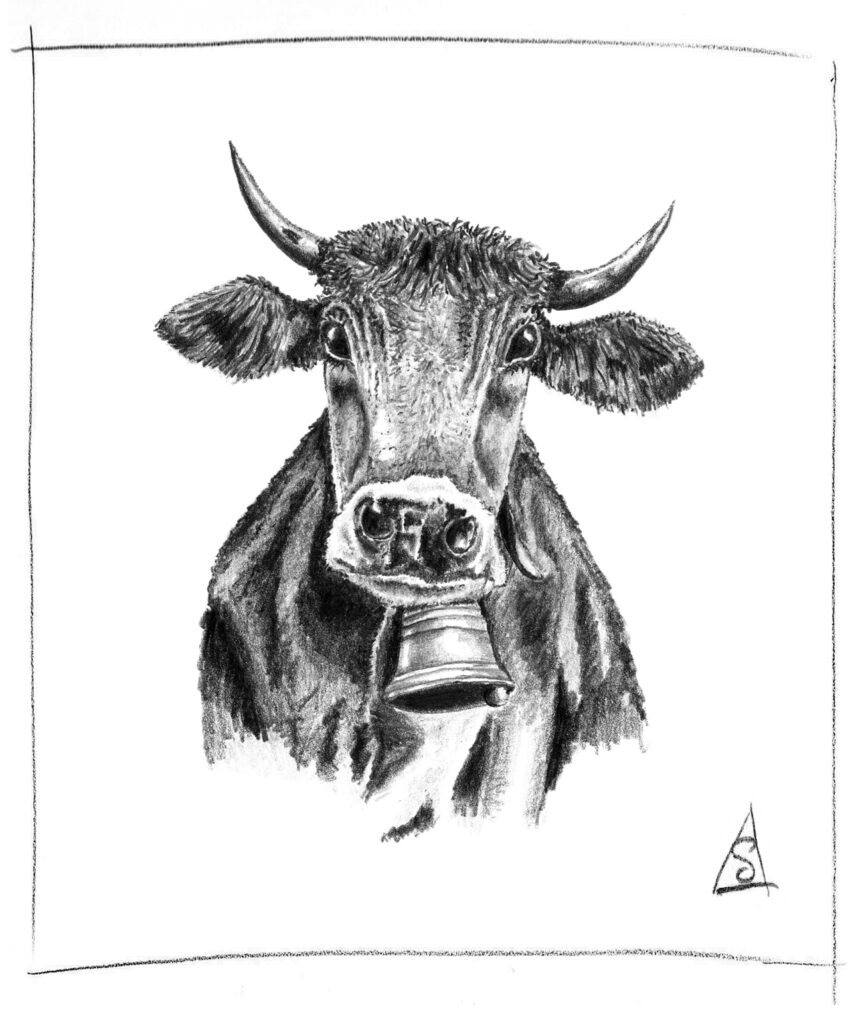
Firstly, Geoff Lloyd used the phrase ‘deaf as Drake’s gunner’, my respectful homage to the late, great Richard Carpenter, who wrote some of my favourite shows from the 70s and 80s. It’s remarkable how some things can influence and stick with you. I actually wrote that line thinking it was my own but something about it gnawed at me and then I realised where I’d heard it before. I could have changed it, of course, but I thought I’d explain it in my notes instead, so that anyone reading this might look into some of Carpenter’s work for themselves and maybe enjoy it as much as I did.
Secondly, I heartily recommend When Life Nearly Died by Michael J. Benton – a wonderful history of palaeontology from the 18th century onwards, which also seeks to establish the reasons for the end-of-Permian-Era extinction, 252 million years ago, and the greatest mass extinction of the Phanerozoic Eon of complex life on Earth (the last 542 million years, give or take a day or two). An excellent read for all those interested in the story of life (and death) on Earth. The Permian–Triassic boundary extinction probably took place over a protracted period, possibly even as long as 200,000 years. I had almost exactly 199,999.4 years less than that to write this book, so I hope readers will forgive any omissions or contractions on my part.
My last shout out, rather immodestly, is to my own Medieval Northumbria series. Inside Book 1, The Apothecaries (mentioned within my preface), you can read the other side of Heidi’s and Reid’s encounter with Harry-the-Cough and Matty in the darkened, wintry woods of medieval England. If you enjoy British comedy and/or historic fiction/fantasy, please give it a try. There will be at least two more books in that series to follow.
Right! THE DINOSAURS
This being the final instalment, I just had to bring back my favourites from the series – the active, sometimes nurturing, often vicious, always fascinating terrors of the mid-Cretaceous, Mapusaurus roseae, Carcharodontosaurus saharicus, Tyrannotitan chubutensis (Matilda), Spinosaurus aegyptiacus, Oxalaia quilombensis, and the petite nightmares, Buitreraptor gonzalezorum. I’ve explained a little about these magnificent creatures within the author’s notes sections of earlier books and hope their deadly reprises got the blood pumping for you again. Each became characters in their own right throughout the series, so there was little room to introduce new animals at this stage (although, for any dinosaur enthusiasts out there, my upcoming NEWFOUNDLAND will be full of similar creatures as well as many new ones). Obviously, in an action series we often imagine such animals at their very worst to work the plot, but I believe the important word there is ‘animals’ – not ‘monsters’. So often dinosaurs are portrayed that way. Some may have behaved in ways that would terrify us, almost certainly, but they were no more monsters than a tiger, or a cow for that matter, both of whom also have the capacity to dispatch a man easily – and do. I try to write opposing philosophies in my characters to reflect humanity, and hopefully to avoid tiresome single agendas, but it’s probably no secret that I’ve a deep respect for animals – may even have written about a few! I believe we can learn much from their behaviour, and if I occasionally anthropomorphise them, here and there, to aid the narrative or work out a piece of comedy, my aim has always been to show them simply doing their best to survive good days and bad, just like the rest of us.
Talking of animals, sometimes, when I offer one of my own furry friends a little treat or reward for being good, I often suspect they understand full well that by sharing such moments they’re rewarding me, too – also for being good, in their eyes. It’s so often true that it’s better to give than to receive, and we humans do like to feel important! They occasionally drive me up the wall, too, but the only time any have ever hurt me is when I’ve lost them, and those are scars I’ll never forget. They remind me what a damned good job they did, every day of their lives, making my life better. I’d hate to live in a world without animals.
Not that I’d want to be a dino-snack! Again, it’s a matter of respect, and returning to dinosaurs, I did manage to cameo Rebbachisaurus garasbae this time. Barrel-bodied, Rebbachisaurus was a diplodocid – twenty metres and twenty tons of long-necked, long-tailed sauropod majesty, related to the even longer but lighter, and far more famous Diplodocus longus (any who have visited the Natural History Museum in London may be familiar with ‘Dippy’, the full-sized reproduction of the late-Jurassic herbivore who lived fifty million years before Rebbachisaurus). Rebbachisaurus were specifically differentiated by unusually tall dorsal vertebrae along their high backs, giving them pronounced ridges that set them apart from most other sauropods, and even from other diplodocidae cousins. The idea of Rebbachisaurus and the relatively tiny, three-ton Ouranosaurus nigeriensis joining forces to survive the nuclear wasteland was sweet, if sad. For all my fellow animal-lovers out there, fear not! Both made it safely back to their herds in the north, after Heidi and Captain Bessel rudely broke into the narrative and whisked us away to 1940s Germany, taking the granddaddy of all carcharodontosauridae with them!
NOT A DINOSAUR!
The other animal I introduced to this story was an outlier, living many millions of years before the mid-Cretaceous and even the dinosaurs themselves in the late Permian Period, 259-252 million years ago. Inostrancevia latifrons was the largest gorgonopsian to live in Laurasia (the northern half of the supercontinent, Pangaea). They must have been truly frightening predators. Larger than Bengal tigers, with massive heads and wickedly large sabre-teeth in their powerful jaws, Inostrancevia, and gorgonopsians generally, were part of the synapsid clade, a major group of the tetrapods that include mammals. Consequently, they were far more mammal-like than the later dinosaurs, and are believed to be part of our own very distant mammalian ancestry. Whether they did indeed have any fur is as yet unclear, but to give an idea of what it would be like to meet one, I suggest watching the very first episode of the British TV show, Primeval, with Douglas Henshall (2007). The writers called the creature Gorgonopsid, but it’s essentially the same beast. You really wouldn’t want to bump into one while taking a stroll one day!
That’s almost it for the animals – just my last old favourite to mention: Sigilmassasaurus brevicollis the spinosaur, and terror of Crater Lake. I had the idea of a throughline between that bad-tempered beastie in Cretaceous Britain and Nessie, several books ago. The idea of an animal surviving untold millions of years in a Scottish loch, a mere 10,000 years old (created by the last ice age) is, of course, perfectly ridiculous – and you could argue that my idea about a time-travelling interloper, laying eggs and raising her progeny to survive a couple of thousand years, isn’t much better, but I couldn’t resist! (NB: I’m not currently sponsored by VisitScotland, but remain open to a retrospective bribe). Naturally, if someone produces convincing new evidence proving the existence of the Loch Ness Monster after this book goes to press, I reserve the right to retract my ‘perfectly ridiculous’ comment and take on an air of smugness, while pretending that I knew all along – please arrange interviews through my publisher and agent; I have history in making up stories 🙂
BRITAIN IN THE TUDOR AGE…
There’s so much back and forth in this book, that I thought I’d try to go through the notes semi-chronologically where possible, and so, moving forward (a long way) to England’s Tudor period, we meet some interesting new characters beginning with the Cout of Kielder…
The heath-bell blows where Keeldar flows,
By Tyne the primrose pale;
But now we ride on the Scottish side,
To hunt in Liddesdale.
Gin you will ride on the Scottish side,
Sore must thy Margaret mourn;
For Soulis abhorr’d is Lydall’s lord,
And I fear you’ll ne’er return.
(excerpt from The Cout of Keeldar, by John Leyden)
That cheery little snippet just about sums up the fate of Sir William de Soulis’ enemies, of whom the Cout o’ Kielder was reckoned one of the greatest of many (as the legend goes). A giant Englishman and Tynedale baron, who allegedly died in the early years of the 14th century – possibly late 13th. As mentioned in previous author’s notes, I brought De Soulis forward to the middle 16th century so that I could include such an authentically historic supervillain within my tale of Hermitage Castle and the Borders (I write a little more about De Soulis and Geoff Lloyd, and their Yuletide antics, in GHOST – part of my New World Extra series).
Information about the cout is sketchy and often contradictory, but it seems he was lauded as a brave young hero type, much admired for his physical size and prowess. While out with a group of friends on a hunt, and who knows what sort of larks, he ignored the local legend about tempting fate when riding anticlockwise, or widdershins, around the Kielder stone (probably the medieval equivalent of reading from the book of the dead in a basement, or repeatedly saying Beetlejuice).
Protected by magic armour (stay with me) he did indeed tempt fate. The rest is history, or more probably, legend. The friends were caught trespassing by De Soulis and invited to Hermitage Castle. Despite De Soulis treating the nobles respectfully, offering them Border hospitality, they began to suspect that he actually intended murder – that seemed to be just how he rolled. Strong and powerful, the cout fought off De Soulis and escaped with his comrades on horseback. De Soulis must have found that irritating, because he and his men pursued them immediately. Enter our friend Robin Redcap. De Soulis’ tame demon helpfully explained that the Cout’s magic armour would not in fact protect him in running water. Doubtless this was sage advice; after all, very few swimmers favour doing the breaststroke in mail! While trying to cross Hermitage Water – the river that ran through Liddesdale and alongside Hermitage Castle itself, and still does to this day – the cout stumbled and fell into a place where the river pooled (a place now known as Drowning Pool). Unable to climb out, the cout was held down by De Soulis’ men with their ‘lang spears’ until he drowned. There’s a grave just outside the small chapel a short walk from Hermitage Castle, marked The Cout o’ Kielder (spelt Keilder on the marker). Against that backdrop, I hope Douglas’ burial of a Mapusaurus thigh bone so that it could be found two millennia later sounds almost plausible. However, modern cynicism aside, these Border tales are a wonderful part of British history and legend, and are not so different from the historic/horror/fantasy fiction we write and consume today. I love them.
FUNNY? WEIRD? IRONIC? IT’S ALL JUST HISTORY!
Moving on, I briefly introduced a chap named Captain Fear-God Barebone into this story (we’ll hear more of him in REBIRTH – or a longhand title might be Geoff Lloyd Saves the World – coming soon). My character is not to be confused with the real ‘Fear-God Barebone’, a minor 17th century poet and brother to Anabaptist** preacher ‘Praise-God Barebone’, who became a London councillor and member of Oliver Cromwell’s Appointed Assembly – a body that became known as Barebone’s Parliament (probably ironically) – almost a century later, after the civil war. He was imprisoned after the Restoration (the return of Charles II), but was later released to live into old age. The only connection between my character and the man is his name – and what a name. It almost paints a thousand pictures! Ideal for the type of chap I had in mind. The reason I mention this curiosity in my notes is because the Barebone family penchant for uniquely descriptive names didn’t stop with Fear-God. His brother, Praise-God Barebone, had at least two children. Are you ready for these? Jesus-Christ-Came-Into-The-World-To-Save Barebone and If-Christ-Had-Not-Died-for-Thee-Thou-Hadst-Been-Damned Barebone – I kid you not. Unfortunately, the latter became known simply as ‘Damned Barebone’. For some reason, he wasn’t fond of that moniker, and went by Nicholas instead – parents, honestly! Still, he must have taken the fear of hellfire seriously enough, because he went on to found London’s first fire insurance company and fire brigade. Having read about these men, I simply had to have a Barebone for my story. Isn’t history wild and wonderful?
**In the broadest of strokes, Anabaptists believe that baptism by water should take place when one is old enough to choose one’s faith. Even when baptised as an infant, they are re-baptised upon reaching an age of maturity, if not actually majority. In Reformation England, such beliefs could be dangerous, dependent on the prevailing orthodoxy of the time and who happened to be on the throne. Most notably, during the Reformation of the 16th century, common folk were encouraged to read the word of God for themselves. Up until then, literacy had been mostly an elite privilege; even many churchmen were illiterate. Whatever anyone’s views about religion, it’s hard to overstate the importance of being encouraged to read – a truly pivotal moment in human history sadly, and yet thankfully, so often taken for granted today.
FUTURE TECHNOLOGY, OR SOMETHING ELSE?
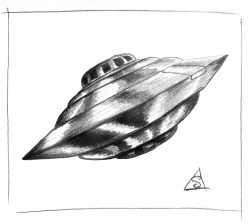
While on the subject of wild and wonderful, this book alludes to a hearing with Congress on the subject of UFOs – or UAPs, as they’re often termed (unidentified anomalous phenomena) – and the existence of alien technologies that may be in the possession of the US military at Area 53 (I went with Area 51 because it’s more widely known and so required no explanation). Once again, I feel the need to repeat: I kid you not. What I found astonishing, possibly even more so than the discussion itself, was how little the world seemed to care. Have things really become so bizarre over the last few years that real-life aliens are now humdrum? I have no answer to that, but here is a transcript from the news channel that broadcasted it live on the 26th July, 2023.
The U.S. House Committee on Oversight and Accountability heard explosive testimony Wednesday, not only about the mysterious craft that was beyond any known technological capabilities but also eyewitness accounts by former US military personnel.[/caption]
The hearing entitled ‘Unidentified Anomalous Phenomena: Implications on National Security, Public Safety, and Government Transparency’ heard from: Ryan Graves, Executive Director of Americans for Safe Aerospace; Commander David Fravor (Ret.), Former Commanding Officer United States Navy; and David Grusch, Former National Reconnaissance Officer Representative, Unidentified Anomalous Phenomena Task Force, Department of Defense.
Grusch testified that both he and his wife witnessed ‘non-human**’ entities doing harm to humans that he described as ‘very disturbing’.
Graves testified that he had a pilot tell him he almost hit a UAP during take-off: ‘One of these objects was completely stationary… It was right where all the jets were going on the eastern seaboard. The two aircraft flew within 50 feet of the object.’
Upon talking to the pilot after he landed, Graves said he found him with his ‘mouth open’ and that the pilot told him that ‘he almost hit one of those darn things’. Graves said the pilot described the object as a ‘dark cube inside of a clear sphere’.
Source: Global News
Is any of that real? Or true? Can it be true? Is it a hoax? Who knows? It all sounds rather surreal, and that’s putting it mildly. Whether ‘the truth is out there’ remains uncertain, but the full hearing is out there on the Internet – you decide.
** I assume they didn’t mean animals.
VOLCANISM
Finally, I come to something a little more tangible – volcanoes. The events here straddle some of the time periods described above, so I thought I’d just tag it on the end. Apologies if the chronology makes anyone twitch. The enormous volcanic event during the Oligocene Epoch of the Palaeogene Period, roughly thirty million years ago, really did happen and really did spew billions of tons of magnetite up from the mantle to create the strongly magnetic Bermuda Triangle – so we can hang on to that. Although, as I type the name ‘Bermuda Triangle’ after discussing UFOs, I feel like I’m disappearing down an entirely different but strangely similar rabbit hole! (Author’s Notes is where I usually attempt to tie the story to real facts and events and discuss any deviances; however, on this occasion, I think reality may have upstaged my fiction.) I’ll try again. The Permian–Triassic extinction, 252 million years ago, definitely happened. Almost everything on Earth died, therefore please note: creating a link between that event and the Oligocene eruption, the way Hiro Nassaki did, would probably not be a good thing… so with that, I’ll end by saying ‘don’t try any of this at home’ and most importantly of all, thank you so much for reading the New World series. It’s been a wonderful journey for me as an author and I hope you’ve enjoyed it.
Until the next time…
Thank you so very much for reading,
Stephen
Rookstone

Readers of my stories will have spotted that I love castles and ancient places, I’m sure, but Chillingham will always be one of my favourites. Stuffed with memorabilia from all over the world, there’s always something you didn’t notice the last time you visited, but my personal fascination is with the castle itself. So many of its rooms feel like its ancient owners have just popped out for something and might return at any minute. Perhaps I’m being fanciful, but it’s almost as though they’re still there, in the air.
Its place in British border history cannot be doubted, but Chillingham is also a favourite haunt for ghost hunters, no pun intended, and people interested in the supernatural. Most Haunted visited there on their first investigation (after the pilot episode). That was also the first time I saw Chillingham, and I just had to visit. In this story, Stan the cameraman’s idea to ditch Brandon Porkpie and move into paranormal investigations, while fictitious, is my little homage to Karl Beattie and the Most Haunted team who brought ghost hunting to the mainstream. Regardless of any controversy, I thought they were great shows and perfect Halloween fare. You have to love anyone willing to terrify themselves witless, while you sit in a comfy chair in front of the television with the lights low, eating pizza. Obviously, this story is a work of fiction, and all the characters within it are also purely fictitious, but I did borrow some of the history from Chillingham Castle’s long heritage to flesh out the plot – dates of construction, crenellation, etc. Needless to say, my Greys of Rookstone bear no factual resemblance to Chillingham’s residents, other than by name. Although Chillingham does have spiral stairs, as I described in the story, some of the towers’ main staircases are in straight flights with a quarter-turn at each corner. They’re beautifully constructed and impressive. I made them all spirals in the story to reduce confusion with the already complex layout of the castle. The south tower may actually be the oldest – and possibly most haunted – the one named for Edward I. Again, I changed the oldest part of the castle to the north tower within my story to better fit the plot, and to give Gary’s accommodation a spookier history. Although the existing castle has a decidedly square stance on the ground, it was built on a more or less north-north-westerly heading, giving it a rhomboid layout when viewed on a map. The west tower, where Sir Henry lives in my story, was converted to holiday suites some years ago by the current owner, Sir Humphry Wakefield. I once stayed there myself during the Christmas period, in the early 00s – a proper winter wonderland under its blanket of snow! The castle only became the four-tower construction we now see, many decades after Edward I’s visit, under the reign of his grandson, Edward III. The decorative mullioned window I mentioned in the story is real and was installed specifically for Edward’s visit, and is to this day an oddity in that austere elevation (to my eyes, at least) – the other windows on that side being a later addition when the castle became a grand home. Despite being the King of England, Edward, like many of the aristocracy, spoke mostly Norman French, though he could speak and read English and Latin, too. Inga’s reaction to hearing it spoken aloud would probably have been natural to anyone walking the Earth during the Harrying of the North, AD1069-70 (even in spirit). That awful event in English history, and what the Normans did to the Saxon people, from York up to Durham, would almost certainly be considered genocide now, as Gary noted. However, back then, it was simply how war was done – although a particularly vicious and egregious example, even by the standards of the day. The risings in the north threatened William I (the Conqueror)’s grip on England, possibly even threatening to reverse his conquest, so there was almost certainly an element of vengeance driving his actions, over and above his desire to quell the insurrection.
 Spinning forward to Edward I’s reign again (1272-1307), I also borrowed the reprehensible torturer, John Sage, from Chillingham’s lengthy and fascinating story. It’s quite difficult to find detailed history about the real John Sage, (soap box alert) but I believe it’s important to remember that such monsters existed and continue to exist to this day. Many physical descriptions of the locations within the story are also based around the castle and grounds. Chillingham is a truly beautiful and intriguing place. I hope my attempts to describe it will inspire readers to visit.
The second worst man in my story was Scott – of no surname. I hope my Scottish friends will forgive me here, but after writing for years about the heroic exploits of Captain James Douglas from Hawick in my New World series, it was time for balance :o)
Most of the measurements used in this book are imperial and this was deliberate. Feet and inches have always been used widely in the British construction industry and only very recently have they begun to fade out with the latest generation of builders. I grew up with metric but the generation before me used imperial, so knowledge of both was essential. Personally, I found metric better for critical accuracy, but in most instances imperial measurement was easier for construction. For example, you could ask for a piece of timber stud to be cut to 2133mm or you could simply request 84”, so imperial died hard, regardless of legislation on the sales of materials. I mention this because some readers will rightly note that Britain was metric by 1994. However, I wanted this story to better reflect the time, when the older men would have used, almost exclusively, good old imperial feet and inches. I set the story in the ’90s purely for the sentimental value; after all, what’s wrong with a little nostalgia? To many of us, we look back to the ’80s and ’90s as a golden age now, when things were taken so much less seriously – and arguably for granted. Certainly, no one was above being mocked. I’ve heard those times described as the apex of western civilisation and culture (though others hold that the apex was actually a century earlier). Whatever your views, it could be argued that we enjoyed optimum levels of freedom, but still largely within a framework of respect, and with just enough tech and cool stuff to be interesting, but not so much that it enslaved or stifled us, as some feel that it does today. Although I hope anyone might enjoy these stories for their entertainment value alone, my upcoming FOR KEEPS series is dedicated to any who remember those times fondly. To help further foster memories of that time, I chose chapter titles that were corruptions of songs from popular culture between 1980 and 1994 – recent history when the book was set. Obviously, there was an exhaustive list to choose from and some were more famous than others, but I simply chose titles for no other reason than they fitted with each chapter’s theme. You may have guessed a few of them, but here’s a list for anyone who’s interested:
1 | Smells Like Mean Spirits – a fairly obvious take on Nirvana’s 1991 hit, Smells Like Teen Spirit. This story was set in late spring of 1994, just after Kurt Cobain’s passing.
2 | Sweet Dreams (Aren’t Made of This) – again, an obvious one. The 1983 Eurythmics hit, Sweet Dreams (Are Made of This).
3 | Dead of the Night – less obvious, perhaps, and deliberately so. Given the theme and the location of the story, it would have been all too predictable to go with Thin Lizzy’s The Boys Are Back in Town, so I went with another Newcastle band instead, and with Venom’s 1985 single, Dead of the Night. It fitted the scary goings-on in that part of the story far better.
4 | Boredinary World – my title is a damning indictment on the humdrum day-to-day of working life, perhaps, and a play on Duran Duran’s 1992 classic, Ordinary World. It’s always difficult to write about the ordinary, though often important, tasks we all undertake each day and make them interesting. I try to throw in a few of those ‘ordinary world’ touches, here and there, to make the characters feel real. Whenever I visit an ancient building or monument, I always place a hand to an ordinary block of stone, or piece of timber. Once a builder myself, I know that the man who laid them was unlikely to be thinking about all the visitors that would admire his work over many centuries to come – he was more likely thinking ‘Is it time for dinner yet?’ I love that connection to a real person, so long ago.
5 | Hollow Man – Entombed’s 1993 classic. I kept the original title, Hollow Man, as its meaning – someone with no morals or values – fitted well with the apparent treachery taking place in the chapter and Richard’s introspective feelings of guilt.
6 | From Out of Nowhere – Faith No More’s first single from their 1989 The Real Thing album. Again, I kept the original title, From Out of Nowhere, because it fitted exactly with the catastrophe about to strike Gary Stone’s life.
7 | Cashes to Ashes – a corruption of David Bowie’s 1980 number one single, Ashes to Ashes. I’m sure you guessed that one, but Hammer certainly didn’t see what was coming when he opened the bag to find fake emeralds!
8 | What’s Up – the 1993 hit single by 4 Non Blondes. Again, I kept the original title, What’s Up. Considering Worzel’s run-in with a wild bull during that chapter, and what followed, it would have been rude not to.
9 | 999 Emergency! – based on Motörhead’s 1980 belter, Emergency. 999 is the British number for the emergency services, equivalent to America’s 911. I was quite pleased it landed on chapter 9, too. God bless Lemmy!
10 | Under Siege (Regnum Trullae) – based on Sepultura’s 1991 single, Under Siege (Regnum Irae), meaning Under Siege (Kingdom of Wrath). My version means Under Siege (Kingdom of the Shovel) – or possibly the trowel; translations vary, but I think both work. I felt very smug about that one.
11 | When Will I Be Famous? – the 1987 hit from Bros. When Will I Be Famous? seemed the perfect chapter title to herald the arrival of Brandon Porkpie, of Whopper TV, to chronicle Gary Stone’s ever-worsening predicament for mass consumption.
12 | Things Can Only Get Better? – D:Ream’s 1993 hit single, Things Can Only Get Better, made UK number one in early 1994. Recycled by one of our political parties, it’s viewed with some irony by many in Britain thirty years later, at the time of writing in 2024. Perhaps the question mark on the end is surplus, and might just as easily have been implied, or dare I say it, inferred, but it fitted with the decline in fortunes of my characters.
13 | What a Fall – borrowed from the widely regarded Stone Roses single, Waterfall, from 1991. Needless to say, that chapter charted Gary’s swan dive from Rookstone’s north tower and his unlikely salvation.
14 | Losing My Derision – as that chapter took place in Rookstone’s chapel and was probably the most serious part of the book, I took inspiration for the title from REM’s Losing My Religion. No surprise, I’m sure.
15 | Cars (and Vans) – title inspired by Gary Numan’s classic, Cars. Technically, the song was released in 1979, but the song and video in so many ways set the tone for the early ’80s that I had to cheat.
16 | My Friend of Misery – from the mighty Metallica, back in 1991. Originally written as an instrumental, My Friend of Misery was never a single, but it fitted nicely with the direction of travel the story was taking at that point.
17 | Always the Son – original named Always the Sun, by The Stranglers, released in 1986. It marked a point in the story where the younger members of the For Keeps team played more prominent roles.
18 | Barklife – inspired by the title of Blur’s hit single, Parklife. Certainly iconic of the early ’90s Britpop sound, the name was a gift for Poppy’s adventure outside to call in the big guns. Although my in-head OCD companion forces me to ’fess up and admit that it wasn’t released until August 1994 – after the setting for this story. What a cheat I am!
19 | Sabotage – The Beastie Boys’ 1994 Sabotage has made its way into films and all sorts of popular culture – even Star Trek, somewhat bizarrely – and this one was out in January ’94, so I can relax! It fitted with the wilful damage our heroes inflicted when they weaponised Rookstone’s fragile electrics and plumbing.
20 | I’ve Got the Power! – inspired by the well-known chorus to 1990’s The Power, by Snap!
21 | The Size of a Crown – not sure if this one made it across the pond, but the chapter title was inspired by The Size of a Cow, a 1991 hit by The Wonder Stuff. The characters within this story were certainly ‘building up their problems’ by that point.
22 | Bird Up – a take on Word Up, popular again in 1994 after the cover by Gun in July, the track hit the airwaves just in time for the end of this story. An iconic song of the period, the gag in the title made me chuckle, especially after Gary’s unintended ‘alteration’ to the photograph that began our story, so I used it.
To expand on the subject of popular culture, I have to mention another timeline cheat, and make a shout-out to the 2011 internet sensation, and modern-day deer stalker, Fenton the dog – can’t remember how many times I watched that hilarious clip, back in the day. He may have been a naughty boy that afternoon, but what a legend!
Thank you for reading. Until the next time…
Stephen Llewelyn
Thank you so very much for reading. Until the next time…
Stephen
the apothEcaries

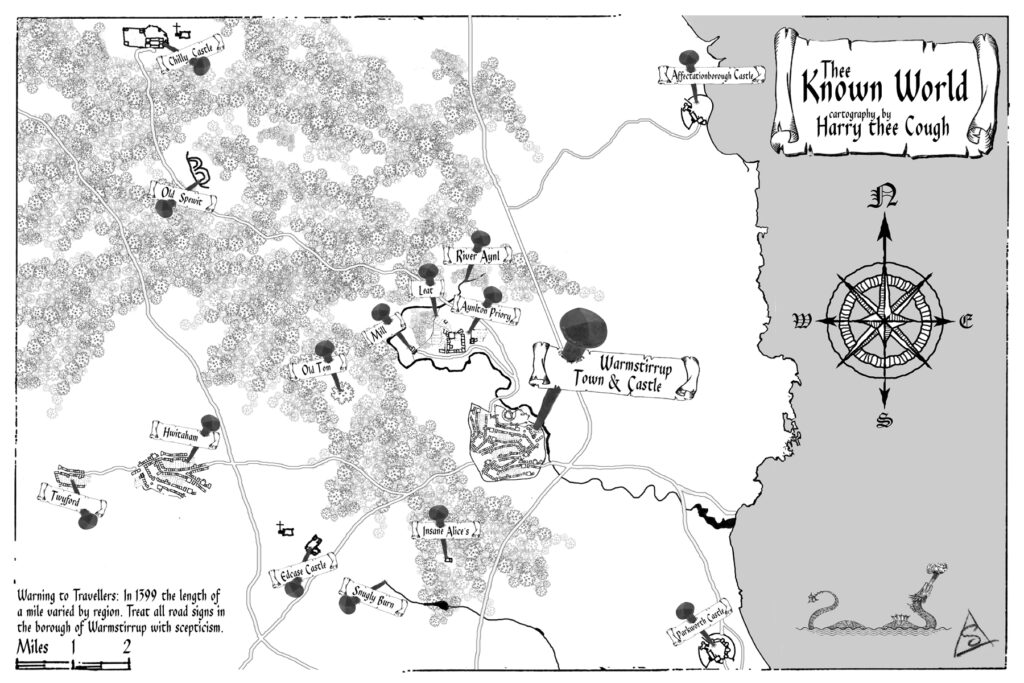
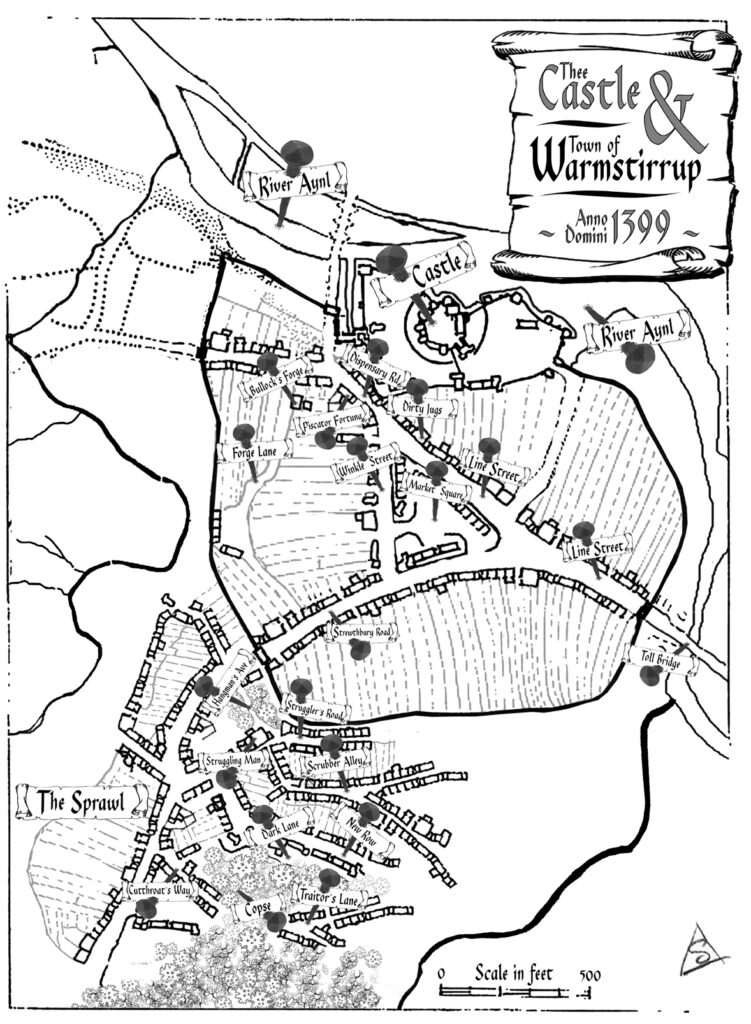
Harry Hotspur predeceased his father, the first Earl of Northumberland, who was also named Henry Percy, and so never actually became Earl of Northumberland. Unfortunately, the real Hotspur failed to receive the warning note from Insane Alice! He did indeed die in a field just outside Shrewsbury on the 21st of July, 1403, battling against King Henry IV (whom he helped to the throne) and his son, the future Henry V.
Like the Henry Warmstirrup in my story, one of Hotspur’s brothers was also called Sir Ralph, and they really were both captured by the Scots at the Battle of Otterburn in 1388.
The wedding tradition, Something Old, Something New, Something Borrowed, Something Blue, actually appeared much later in 19th century Lancashire, but the blue scarf Harry carried as a last link to his mother fitted nicely into the story for any romantics out there.
What’s in a name?
For anyone planning a trip, quite a lot, I would imagine…
I’ve played fast and loose with the place names in this story. As stated, most of my fantasy world is loosely based around real locations close to Alnwick and its castle (yes, the one where they shot the early Harry Potter films), but are not meant to be Alnwick. My reasoning was simple. The beginnings of the story came to me while standing outside Alnwick Castle gates. I’m very fond of Alnwick and its people, so it seemed a fitting tribute and thank you to use the old place as a template for the story it inspired. Before that moment, The Apothecaries was little more than a title and an elevator pitch. I’m not sure how long I stood gawping up at the impressive medieval gatehouse, but during that time Harry-the-Cough was born (the least of the famous Harrys!), as was the idea for his rags-to-riches ride against a backdrop of war, disease and perhaps even a little black magic. When visiting a county that boasts 8000 years of human habitation, and all the signs and structures they left behind, it’s easy for the imagination to run wild. Indeed, the entire region is a treasure trove stuffed with history, archaeology, palaeontology, natural beauty and, of course, stories. However, my initial fleshing out of the idea seemed rather grim, and writing a book takes several months. It therefore became a comedy of sorts, all on its own, because I lack the stamina to remain serious for that long.
The plans of Warmstirrup and Warmstirrup Castle are very broadly based on the medieval castle and walled town of Alnwick, though the town walls were in fact built slightly later, towards the end of the 1470s. Dispensary Street is actually located a little further away from the castle to the west than it is in the story. However, the opportunity to place The Apothecaries’ building on Dispensary Street was a gift. Weirdly, I didn’t realise there was a Dispensary Street in Alnwick until after I’d written the book, but it was simply too good to miss, so I had to go back and add it to the story and the maps. The oldest pub in Warmstirrup is known as The Dirty Jugs – this is a rather clumsy homage to The Dirty Bottles, a public house in Alnwick famous for its rather unusual window decoration. The window facing onto the road is sealed and contains several ‘dirty bottles’. The story has it that a previous owner, roughly two hundred years ago, tried to remove them and instantly dropped dead. Funnily enough, no one has dared touch them since – hence the dust and the dirt!
The other pub in Warmstirrup – that suffered Harry’s early and ill-conceived attempt to combine a drive-by with a drive-thru – I named The Struggling Man. This is the elephant in the room, in that it is not from Alnwick and is in fact a public house from my own childhood that sadly, like so many others, has now gone to make way for a rather less pretty row of house boxes. It was nicknamed ‘The Struggler’ by the locals, hence Struggler Road. Unfortunately, its total destruction was pre-Google and smartphones, so there are very few pictures remaining of the pub, bowling green and beer garden that overlooked what were then lovely parklands in the middle of the town. We used to play on that park, day and night, but sadly, many are afraid to walk there even in the daytime now. I hope The Struggling Man retains some small measure of immortality in print from this work.
Aynlton Priory (very definitely pronounced Ant’n!) was based on Hulne Priory and actually founded in the mid-13th century by the Carmelite Friars who decided that Brizlee Hill resembled a place in the Holy Land called Mount Carmel. There were many monastic orders across Europe in the Middle Ages; I decided to make them Benedictine for the story because that order is probably more familiar to most of us.
Warmstirrup Abbey was based on Alnwick Abbey, a Premonstratensian monastery built in 1147 and, like so many others, suppressed and mostly destroyed during Henry VIII’s dissolution of the monasteries in the late 1530s. Sadly, only an extremely impressive gatehouse remains.
The River Aynl is another clumsy play on the River Aln, as the River Foquet (pronounced Foh-ket, honestly!) refers to the locally famous River Coquet (Coh-ket).
In the bow of the Foquet is the castle and town of Parkworth (pronounced Porkworth by Sir Ralph). The real Percy castle and town of Warkworth is pronounced locally as workworth – actually that’s an awkward one, too easy to read as werkworth, so let’s try walkworth. I love these place names. They present a writer with endless possibilities for bad jokes! Warkworth, like my fictional Parkworth, has a hermitage, too, and it’s every bit as impressive as Sir Ralph laments in the story.
Edcase Castle, in the real world, is actually a wonderful ruin named Edlingham Castle, which shares a stunning landscape with an early Norman church and a beautiful Victorian viaduct, all built in stone. Were that not enough, it’s also a mere stone’s throw from Corby’s Crags – for my mind one of the finest viewpoints in the county, looking out towards the Great Cheviot Mountain itself.
Chilly Castle is, of course, the great Chillingham Castle – possibly my favourite of the many Northumbrian strongholds. The gorgeous castle and its medieval church, replete with one of the best medieval tombs you’ll see outside Westminster, is a must see.
Snugly Burn is actually Rugley Burn. A burn is a northern English/Scottish name for a small river or large stream.
Old Spewit is an ancient place, actually named Old Bewick. A small village now, but also near the site of some extraordinary early Bronze Age archaeology, including a cairn and some extremely rare cup and ring marks. The hill fort mentioned in my story really exists and was constructed during the later Iron Age and may still have been occupied into the Roman period.
Strewthbury may sound Australian, but – outside the crazy world of Harry-the-Cough – actually relates to the medieval market town of Rothbury.
Hwitaham and Twyford were small villages west of Alnwick. Hwitaham is now called Whittingham and once had two pele towers, of which only one remains, though other fine examples may be found in the area.
Scotch is an old term (in English) for the Scots, although it is rarely used any more, other than to describe scotch whisky.
I hope you enjoyed reading this comedy adventure, set in my spiritual home of Northumberland, as much as I enjoyed writing it.
Thank you so very much for reading. Until the next time…
Stephen
DINoSAUR
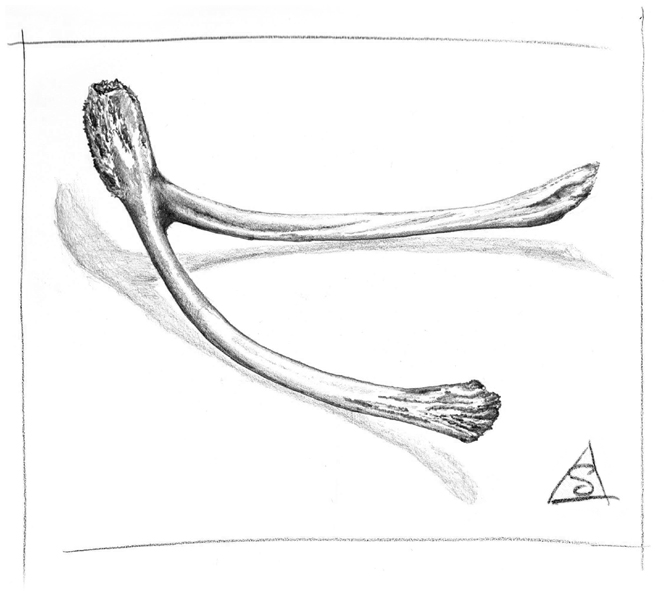
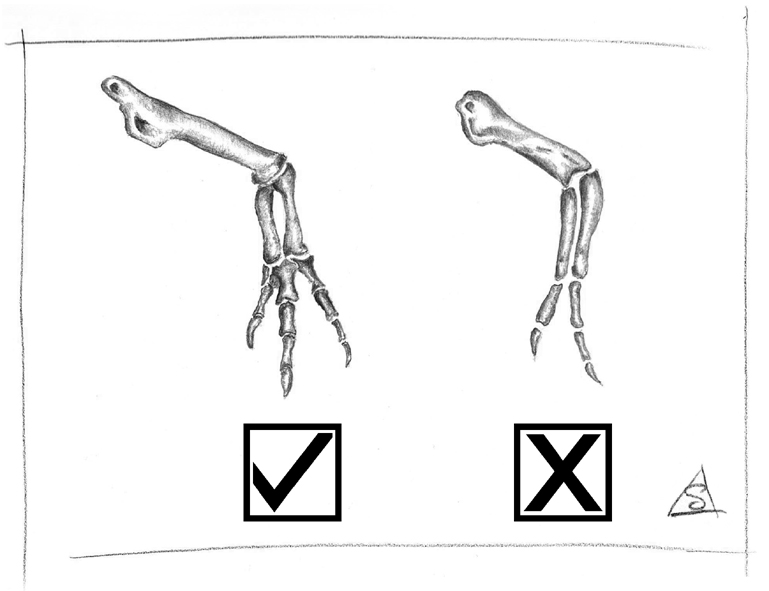
This has been described as a ‘golden age’ of dinosaur discovery and our knowledge and understanding seems to grow and change by the week. No matter how old and creaky I become, I will always be seven years old when anyone shows me a picture of a dinosaur – I thank you all!
The New World Series is obviously a story written solely for entertainment. I have loved dinosaurs almost all my life but am certainly no expert (liberties have been taken). My little knowledge may well be a dangerous thing, but if this work inspires a single reader to find out more about our planet’s remarkable history from the many true experts in the field, I will be delighted.
NAMES
Dinosaur names are typically italicised, with the genus name also given a capital letter. In order to identify them correctly, they should be written along with their species name, too. For example, Tyrannosaurus rex (note only the genus is capitalised, the species gets a lowercase first letter, rex being merely a type of Tyrannosaur – albeit the one everyone knows).
Within a novel, italics tend to be more commonly used to provide emphasis to the narrative (although I did stick with the tradition of italicising ship names because there are so few). There are so many recurring animal names within this story that I thought emphasising them all might confuse the narrative. Therefore, I gave each animal name a capital letter instead. I apologise to the purists but hope you will understand why I made this decision.
THE CREATURES
Buitreraptor gonzalezorum probably lived in the Cenomanian or even Turonian stages of the Cretaceous, a little later than the setting for DINOSAUR. The fossils found in South America came from rock strata laid down approximately 94 million years ago. Research continues, but there are as yet few known Dromaeosaurids from the southern hemisphere (at the time of publication). Some palaeontologists believe their ancestors may be traced all the way back to the early Jurassic, before the breakup of Pangaea and this would explain their worldwide dispersal in later times. Although my chronology is slightly off, I wanted to include at least one real animal from Earth’s past to fill this niche. This fast, intelligent, fighting little creature will more fully make its introduction later in the series.
TRAITS
The arctometatarsalian condition has, as far as I know, never actually been found amongst the carcharodontosaurids, although it is a feature that has evolved more than once, apparently. Tim speculates about the possibility of new animals that may have this trait, but also uses the potential speed and/or long distance running capability this condition was believed to imbue, to scare Woodsey into being quiet for a few moments.
LOCATIONS
The locations of fossilised Mapusaurus roseae remains suggest they may have lived in more northerly latitudes than Giganotosaurus carolinii. However, so comparatively few fossils of these magnificent dinosaurs exist that this might simply be lucky accident, as the land may well have been traversable. I included both animals within the region around the landing site of the New World to increase the peril faced by the crew.
Also, because each was such an extraordinary creature, how could I possibly choose between them? It is likely that their hunting territories would have been many miles apart, although every territory intersects somewhere, so it is possible they could have met. Naturally, the forest fire that threw them together in this story was merely a narrative device, but who knows, maybe a large-scale conflagration could have set them on a collision course, at least once, in those long-gone days. It seems more likely they would have avoided one another where at all possible in reality, of course, but such a clash of the titans is almost irresistible for an author.
When I wrote that passage, I hoped to ‘trap’ the reader in the cab of the stranded excavator and surround them with these terrifying predators. For this reason, I introduced the hapless driver very late in the narrative – however, the concept of ignoring an emergency recall in order to get a job finished, and thus avoid the necessity of going back to it, was simply me imprinting my past experience of working on building sites upon a fantasy world!
If a meteorite was going to smash into Birmingham at 7pm, at 5pm, someone on a scaffold somewhere would almost certainly be saying, “Yeah, but we can have this finished by six and get the money in!”
For all the people who have to work, through it all, no matter what – I salute you!
Thank you so very much for reading,
Stephen
RevEnge
FEATHERS
There is a huge amount of effort going into researching this subject at the moment. It seems likely that many species had at least some form of feathers. Perhaps all dinosaurs did; the final answer seems to be up for grabs at the moment. Even the reasons for having feathers may have differed wildly between the species – maybe even between a species, at differing points throughout the animals’ lives (for example, the larger the animal, the less its requirement for insulation – in fact, above a certain size, overheating would be more likely).
Although I have introduced a few species with feathers, notably Buitreraptor, I have largely hedged around the subject for two reasons. Firstly, information on the subject is being gathered and is changing at a prodigious rate – and I did not want something so obvious as the look of the dinosaurs to become immediately out of date (this is a major problem faced by anyone writing about dinosaurs at the moment. Most books have to be updated three or four times just in the time it takes to write them!). Secondly, many people have a cherished view of what a dinosaur, particularly the larger and more popular clades, should look like.
In terms of the story, this does not really matter or affect events, and as this work is purely for entertainment, I leave the subject open and hope that each reader will enjoy ‘clothing’ these incredible animals in the way they prefer. Feathers or scales – please imagine them as you will.
TIMELINE
As previously stated in my notes at the back of book one, Buitreraptor lived a little later than the setting for these stories, perhaps in the Cenomanian or even Turonian stages of the Cretaceous Period.
There are few dromaeosaurids yet known in Patagonia during this period, so I chose this little animal rather than make one up. Tyrannotitan lived a little earlier than the setting for REVENGE, possibly in the Aptian stage of the Cretaceous Period.
I included this great animal for three reasons: Firstly, to give the great Mapusaurus and Giganotosaurus a rest after their exhausting efforts following the stampede in book one; animals that size would probably have hunted vast territories, perhaps even hundreds of square miles, so this would seem logical.
Secondly, there is no conclusive evidence, as far as I am aware, to categorically prove or disprove the group behaviour of the large theropod carnivores. It may be that they grouped together at certain times of year, or to bring down great prey, but were otherwise solitary; or they may have grouped together for mutual benefit when young, only to become more solitary when grown. Research continues and it is truly fascinating. With regards to my story, as the mapusaurs and giganotosaurs worked in packs (possibly due to a springtime breeding cycle), I thought it would be nice to describe another, similar animal with a lifestyle at the opposite end of the spectrum – a ‘lone wolf’, if you will.
Thirdly, I am a writer of stories, and with a name like Tyrannotitan, how could I possibly resist?
Thank you so very much for reading,
Stephen
AlLEgiance
CREATURES
Ornithocheirus and Anhanguera were vast flying reptiles (pterosaurs), and related. Size estimates for Ornithocheirus are still disputed, but range anything up to 12m across the wing – although other researchers believe they may have been little more than half that size and very comparable to Anhanguera in that respect also. Both animals probably lived a little earlier than the setting for ‘Allegiance’ – perhaps as much as 10 million years further back, hence Tim’s comment, “Ornithocheirus, or one of his relatives.” Ornithocheirus remains have been found in Britain and Anhanguera in north-eastern Brazil (either side of the fictional island where our heroes discover them off the west coast of Africa).
For animals that fly and eat fish, it must be a palaeontologist’s nightmare to guess where they were actually from! I chose to feature Ornithocheirus because it is so well known from the BBC’s Walking With Dinosaurs series. Sometimes it’s nice to be able to provide an actual face to a name! Although a flying pair do feature on the cover of the next novel in the New World Series, ‘Reroute’ (Oops! Spoiler alert!).
Cronopio (the little critters that savaged Henry’s trousers) were small mammals. Probably no larger than terriers, one of the palaeontologists who discovered them described Cronopio as bearing a marked resemblance to ‘Scrat’ – the cute and immensely industrious little chap that chased the ever-elusive acorn in the film Ice Age.
The idea that they behaved in a very dog-like manner was a complete liberty on my part, for the sake of the story – but then, if those ancient mammals had come across a pack of wild humans, maybe they would have developed a symbiotic relationship and, dare I say it, become friends in an age of deadly reptiles?
STAND OFFS
I try to stay away from gladiatorial contests among the dinosaurs. As stated on previous occasions, large predators, then as now, may have made a lot of noise when defending their territories, but would most likely have avoided direct conflict with one another. Injury could so easily mean death. However, a few scraps must have happened down the years – what a tremendous piece of good fortune that one such occurred while a couple of our heroes just happened to be crossing the river, so we got to see it!
Ekrixinatosaurus was a relative of the much more widely known Carnotaurus sastrei. As depicted in my amateurish sketch at the head of chapter 8, its arms were almost completely vestigial and probably useless. Subsequently, not being able to reach to cover his ears was a really cheap gag, but sometimes you just have to go with the classics. However, what I really like about this animal is its size. Unlike the behemothic Mapusaurus or Oxalaia, Ekrixinatosaurus was small enough to easily follow you through a forest and would likely have had the stamina to go all day – nowhere to hide – shudder.
THE BAD GUYS
Talking of shudders, the fanatical Emilia Franke’s ship, the Heydrich, was named after Reinhard Heydrich, one of the main architects of the Holocaust. Considered one of the worst of a very rotten bunch within the Nazi leadership, it is fair to say that few have left such a trail of murder and chaos in their wake – millions dead. Even Hitler took this man very seriously, describing him as “the man with the iron heart”. Fortunately, in 1942 he got what he deserved. History crucially remembers these monsters in order to provide future generations with a chance at stopping the next one. In the past they have tended to rise from a world where the vast majority of people are afraid, or simply consider it wise or easier, to hide their real thoughts from view. Within his Cicero Trilogy, Robert Harris wrote a lovely little piece where Cicero says something to the effect of ‘we only have the knowledge of our own lives, but if we read history, we can call on the wisdom and knowledge of generations’.
The ‘Schutzstaffel’ was more commonly known as the infamous ‘SS’, a major paramilitary organisation under Adolf Hitler and the Nazi Party.
The Eisernes Kreuz (Iron Cross) was a medal for valour and service to one’s country (in Germany). Unfortunately, it is commonly tainted with association to the Nazi movement (the Nazi iron cross can be differentiated by the swastika emblem at its centre), but the honour goes back much further; in fact all the way to the Napoleonic era, and was awarded to some very courageous men and women who were most certainly not Nazis. The idea of Heinrich Schultz identifying himself with such an icon seemed entirely in keeping with the deluded self-importance of his character – the man was not even German!
The German people are, and have always been, clever and industrious. The Nazis are in no way synonymous with them. However, when it comes to writing ‘bad guys’ for the purpose of fiction, they don’t come much ‘badder’ than the Nazis, do they? After all, where would our much beloved Indiana Jones have been without them?
Thank you so very much for reading,
Stephen
REroute
To everyone working in the field of natural history, dinosaur research, historical research and archaeology, I once again send a massive thank you for your constant inspiration.
As always, a few liberties have been taken…
THE CREATURES AND THEIR LOCATIONS
There were several spinosaurids around during the Cretaceous, Spinosaurus aegyptiacus being, of course, the most well-known thanks to a very popular film franchise! (To everyone with any knowledge of Tyrannosaurs, I still feel your pain!) In Patagonia, we also met Oxalaia quilombensis and Irritator challengeri. Some palaeontologists have postulated that Oxalaia may actually have been the same species as Spinosaurus, despite the thousands of miles and the beginnings of the Atlantic Ocean between them. Others state differences in the skull and snout – even in the density of the bones and probable musculature. Some believe Oxalaia was probably bipedal, like the ‘old’ Spinosaurus from the JPIII film.
These animals certainly seem to be the subject of intense debate currently. This story describes them as separate species because they are incredibly exciting creatures to write (or wrong) about. With regards to the true identities and appearances of these wonderful animals – I’m not touching that with a ten-foot pole! Instead, I chicken-heartedly hide under the comfort blanket of ‘fiction’ – that way I can tell naysayers to get a life, while secretly agreeing with them!
On our trip to Cretaceous Britain, we also meet Sigilmassasaurus brevicollis, another spinosaurid. Smaller than Spinosaurus, this was still a very large predator – as Aito Nassaki had a hand in finding out… (I can hear everyone groaning at that one, sorry).
Although discovered in North Africa, I theorise that these creatures ‘island-hopped’ due to their aquatic nature, eventually finding themselves on the ‘tropical’ landmass that would one day be Britain (it seems some things do change).
Carcharodontosaurus saharicus gave its name to the family ‘Carcharodontosauridae’ which also includes South America’s mighty Giganotosaurus carolinii and Mapusaurus roseae. Carcharodontosaurus was another Tyrannosaurus rex sized predator from North Africa, and was also discovered by Ernst Stromer during his time in Egypt, along with the famous Spinosaurus aegyptiacus and another large theropod predator named Bahariasaurus ingens.
The Allied bombing of the Old Academy, Munich, during spring 1944, destroyed Stromer’s finds, along with the type specimen for Bahariasaurus. Since then, arguments have been made for its inclusion within the Carcharodontosauridae, Tyrannosauroidea, Ceratosauridae and Megaraptora families!
We await more research and more lucky finds to get to the heart of this – maybe someone will put forward an argument for it being a fish? In the meantime, I think that a 12m long, fast, comparatively lightweight killer (approx. 4 tons) could make a nice but deadly addition to this series in the future.
Rugops primus, like South America’s Ekrixinatosaurus, was an Abelisaurid and a relative of the better known, but much later, Carnotaurus sastrei. Thought to be a North African scavenger, Rugops lived around the same time as the giant Carcharodontosauridae named above. This chap was probably around 4-6m in length and 500-750kg in weight with a comparatively weak jaw. As if it didn’t have enough problems in a land of truly huge and vastly more powerful predators, its vestigial arms would also have been fairly useless, AND its name means ‘wrinkle face’ – poor sod! However, like its cousin, Ekrixinatosaurus, Rugops was small enough to follow you through the trees – so you probably wouldn’t call him that to his wrinkled face!
CHARACTER TRAITS & ACCENTS
I receive quite a few comments from readers who love the way the characters speak with their own accents (and some hate mail on the subject, as well!) Personally, I believe it brings them off the page a little, while often providing some in-built humour, too.
However, with the 16th century characters, I’ve taken a few liberties (once again). Although communication would not have been impossible, anyone who has ever read Shakespeare knows that the dialect can, at times, be very difficult to understand, so much has the English language changed.
To that end, I’ve gone for a ‘feel’ of antiquity with the English and Scots dialects, trying where possible to remain true to the period but hopefully without making the characters’ words indecipherable – I apologise to the purists and once again hide under my comfort blanket of fiction.
Here – have a smiley face :o)
As far as I know, Elizabeth Tudor (soon to be Elizabeth I) was not in Northumberland during 1558. Most likely she was still ensconced within Hatfield House in Hertfordshire. However, Mary was often advised to have her half-sister removed from the succession (and the world). Elizabeth’s life hung by a thread on several occasions, especially during her youth, when her continued existence was often at the whim of another. Choosing between family or faith would probably be easy for most of us now, but for Mary it must have been the sorest of trials. She had little affection for her sister, as Elizabeth’s mother, Anne Boleyn, had supplanted her own mother, Catherine of Aragon, leading to her downfall. Worse, Elizabeth was a healthy, robust, soberly dressed Protestant (in her youth) – at a glance, everything the dressy, Catholic queen was not.
However, one wonders whether Mary showed a side to her character at odds with her popular nickname ‘Bloody Mary’, by allowing her half-sister to live against her own interests. Especially at a time when state-sanctioned murder was not uncommon (though it was often known by other names, so as to pass muster according to the standards of Tudor political correctness). Her dilemma over bolstering the Catholic cause for the sake of England and her personal beliefs, or the sparing of her Protestant sister, must have been – to use an appropriate idiom – a heavy cross to bear. This fictional tale sees events altered by the arrival of the New World. However, I have tried to ingratiate my story within a semi-realistic framework of events from the period.
A BIT OF HISTORICAL CONTEXT
Historically, there was more than one Lord de Soulis. Sir William de Soulis (or Soules), the last, was actually Lord of Hermitage Castle in the Scottish Borders between 1318 and 1320. This was during the reign of Robert the Bruce and more than two centuries before the setting for this book. Regardless, I chose to include him because he was an extraordinary, ready-made ‘bad guy’.
Allegedly, he entered into a deal with Edward II of England to get rid of the Scottish King – he was certainly arrested for treason. However, the legend of Sir William de Soulis is probably more interesting than the reality. Either way, he seems to have been an extremely unpleasant fellow, even by medieval standards. Legend has it that William de Soulis was physically a large, powerful man, with prominent canine teeth and a predilection for extreme cruelty. He was almost universally loathed, or so the story goes, and talking of stories, many circulated that he was also a practitioner of the dark arts. His proclivity for taking young children from the countryside around Hermitage Castle and using them in evil rituals seems most unpleasant!
Apparently, De Soulis would summon his familiar, one ‘Robin Redcap’, during his rituals. According to British folklore, a redcap is a type of evil goblin, often tied to ruined castles in the borderlands. These chaps are known for the killing of travellers and local residents alike, so they can refresh the bloodstains on their hats – as the name Redcap suggests. The legend has it that if the bloodstains dry, the redcap dies. Redcaps were reputedly very quick and powerful. This series will always have dinosaurs at its heart, but even from inception, I always wanted to bring the story forward to include the 16th century borderlands and elements of the Hermitage Castle ‘horror story’. It seemed natural to write a dark spirit with a powerful attraction towards such a reputation – like the one created when Baines blew up a satellite in a Nazi pilot’s face – especially with a creature like De Soulis meddling with things he shouldn’t and opening the door.
Robin Rotmütze (redcap in German) tied in nicely with the legend of De Soulis and Hermitage Castle, and was too good to miss. Once summoned by De Soulis, the Robin Redcap of legend inspired terror in the lands around Hermitage, committing many atrocities. To escape a redcap, one must quote a passage from the Bible at it, whereupon it loses a tooth. (I wonder if Redcap regains his power if he remembers to put it under his pillow?)
Of course, it’s easy to mock superstition from the street-lit modern century, but William de Soulis seems to have been as dark as the thing he allegedly conjured. The story has it that in AD1320 he attempted to abduct a young woman belonging to the Armstrong clan. Her father tried to prevent it and De Soulis killed him where he stood. Alexander Armstrong, Laird of Mangerton, calmed the lynch mob poised to hang De Soulis, advising him to leave while he still could, but leave the girl behind. Alexander Armstrong was the social inferior, and being saved by such a personage clearly hurt De Soulis’ pride. Rather than show gratitude, he began to hate Armstrong, eventually inviting him to a feast at Hermitage Castle. Upon Armstrong’s arrival, De Soulis stabbed him in the back. As stated, De Soulis really died in the dungeons of Dumbarton Castle, later in AD1320, and after accusations of treason. However, his legend seems to have become entwined with the fate of his ancestor, Sir Ranulf de Soulis, more than a century earlier.
I won’t give away details of Sir William’s future here, as it will be revealed in Book 5, REMAINS. I will simply end by saying that the sketchy evidence regarding the 12th and 13th century family seems to sit, at least partially, where history meets legend. However, depraved cruelty, treason and black magic are all recorded. De Soulis did not live in the Tudor age, but he did exist, and his story is so incredible that I just couldn’t resist working him into a timeline, so innocently and apologetically screwed up by James Douglas et al.
Reiver families ruled the Scottish Borders at that time, engaging in cattle rustling, murder and slaving. They were legendarily tough, as were their ponies. The Maxwells really did feud with the Johnstones throughout the period. More of this in Book 5, but their stories became the stuff of song, literature, and of course, legend. The name of Natalie Pearson’s dog ‘Reiver’ was inspired by the Reivers, entwined with the Scottish Borders themselves – the original home of the border collie.
Moving forward through our ‘real’ history, Nazi Headquarters, ‘The Brown House’ (so named because of the colour of their early uniforms) in Munich, was destroyed by Allied bombing in October of 1943. The museum housing Ernst Stromer’s dinosaur fossils discovered in Egypt between 1911-14, ‘The Old Academy’, was also bombed by the Allies in April of 1944, and was indeed just a short walk from The Brown House.
Hitler really did live for a time at Prinzregentenplatz 16. Initially having the rent paid by his publisher, this was still a big step up from the much poorer circumstances he endured during the 1920s. His dream as a youth was to study fine art, but he was rejected by the Academy of Fine Arts, Venice, twice. However, he did eke out a meagre living between selling watercolours and general labouring. By 1939 he was in a position to buy Prinzregentenplatz 16 outright.
However, looking at his early life, it’s a little difficult to see the monster he became – the man who killed, or caused the deaths of, almost fifty million people.
The New World’s landing in the 16th century has clearly created some very worrying ripples in the timeline from the Schultzes’, shall we say, unique perspective. The man Heidi moved mountains to track through time, is a struggling artist and vegetarian, a nobody. Can history be forced to repeat itself? Or can she find a way to make things even worse?
Oh, and by the way “Alright or wha’?” means hello in Wales. Although technically more commonly used in South Wales, rather than Gwynedd in the north, a hundred years from now I postulate there will be less of a linguistic divide. In truth, I just love Jones’ (and Gleeson’s) penchant for saying irreverent things that are wildly out of context. Within a world of dinosaurs and science/historical fiction (or ‘sci-hi-fi’ – I’ll have to remember that one!) that actually makes sense to me.
Thank you so very much for reading,
Stephen
rEmains
To everyone working in the field of natural history, dinosaur research, historical research and archaeology, I once again send a massive thank you for your constant inspiration.
As always, a few liberties have been taken…
THE CREATURES & THEIR ORIGINS
Once again, I have included several dinosaurs within this book (shocker, I know), many of which I discussed briefly in previous notes. Like Carcharodontosaurus saharicus and the famous Spinosaurus aegyptiacus, some of them were also discovered by Ernst Stromer during his time in Egypt. I mentioned one of them in the notes at the back of the last book, another large theropod predator named Bahariasaurus ingens.
The Allied bombing of the Old Academy, Munich, during spring 1944, destroyed Stromer’s finds, along with the type specimen for Bahariasaurus. It is still unclear exactly which theropod family this animal belonged to. However, we can estimate that it grew to perhaps 12m in length and would have been a much lighter animal than Carcharodontosaurus saharicus, perhaps half the weight by similar length, and this fuels the imagination. How fast was it? How did it hunt?
While we wait for the science to catch up on these questions, I’ll look forward to writing more about Bahariasaurus ingens in the next book, CURSED.
The pack of Rugops primus, about to spring their trap on Devon, Aito and Jansen, were also mentioned in my notes for REROUTE; however, I’m not sure Sarcosuchus imperator got the paper and ink it deserved. Of the same family as the giant crocodile featured in some of the earlier books, Sarcosuchus imperator was one of the largest crocodiles known to science. With each jaw measuring at least 2m, it really did have a maw a grown man could walk into – if he’d really had enough!
Deltadromeus agilis was (possibly) yet another huge and terrifying theropod carnivore from North Africa. I add the ‘possibly’ only because some palaeontologists think the remains of this animal may actually have been a smaller Bahariasaurus. It seems entirely likely and believable that animals sharing a time and place might show similarities, even share ancestry, but as diggers are yet to find a head for either, the argument remains unresolved. For myself, Deltadromeus agilis was an irresistible force – an animal possibly the size of Allosaurus, but built more like a raptor – come on!
However, my personal exuberance aside, the hapless Ouranosaurus nigeriensis that crossed paths with Deltadromeus in the story, were understandably less enthusiastic. Ouranosaurus nigeriensis was a hadrosauriform, related to both the famous Iguanodon bernissartensis and the duck-billed dinosaurs. Despite being herbivorous, the row of neural spines along much of the ouranosaurs’ backs and tails created ‘sails’ similar in appearance to those of several of the predatory spinosaur family.
NAMES & ITALICS
Just a couple of editorial notes as I think of them: I stated previously about opting not to italicise the animal names in the main body of the story, hoping to avoid any confusing emphasis. Keeping all the capital letters in check is quite a job, too, as it happens – Tyrannosaurus vs. tyrannosaurs – see what I mean? (At this point, it would be remiss of me not to mention how hard my editor works to keep righting my wrong writing! Thank you.)
While on the subject of wrongs… in chapter 10, Video Nasty, Aito says, “The public records of everyone on this mission aren’t worth a damn.” This is such a common expression that I spelt damn after the original four-letter word. However, it is believed that the derivation actually comes from a small Indian coin called a ‘dam’ – I assume they weren’t worth very much. The phrase was possibly carried back to England by soldiers in the mid-18th century. ‘I don’t give a damn’ was an Americanism first recorded in the 1890s. Correcting this typo in the story made it look like a typo, ironically – so it was just a case of, ahem, damned if you do, damned if you don’t! (Sorry.) Mucking around with words leads us inevitably to Shakespeare.
As with REROUTE, I have once again tried to include a flavour of the Elizabethan era dialects, hopefully without the confusion. In reality, it’s fair to say that they would have been far more impenetrable to most of us moderners, as we would no doubt be to them. Can you imagine what they would make of emojis? Use of such glyphs would surely have been worthy of a burning at the very least! I remember one far-off day in English literature class, when the fourteen-year-old Stephen took his turn in reading Shakespeare to the class, including line numbers and all! I stopped reading when the rest of the class fell about laughing. I was completely baffled by this, until the teacher explained what I’d done. She was familiar with the condition where people walk in their sleep, but reading in one’s sleep was apparently all new to her! Unfortunately, that is all I recall about my introduction to the Bard. I’m sorry to admit that is a true story. I may also have poked a little fun at one of literature’s most important figures here, but most fourteen-year-olds probably feel the same. In any case, his reputation will far outlive my own, so he can get over himself! Here, have a smiley face, Shakey :o)
LEGENDS & LIBERTIES
For anyone interested in the story of Sir William de Soulis, legend has it that he was bound by specially crafted chains and taken off to Ninestane Rig, where he was wrapped in lead and boiled alive by the people under his ‘care’. The reason given for the chains was that his magic was so strong he could neither be bound by ropes nor cut by steel. The history tells it rather differently. As I mentioned in the last book, he was already long dead by Tudor times, but was such a beautifully crafted, semi-real villain, I just couldn’t resist! Anyone who has ever visited Hermitage Castle in the Scottish Borders will understand; such a dark, menacing place simply had to have an evil, black-magic-wielding lord in its past. Fleetingly back to the history, Sir William actually died in the dungeons of Dumbarton Castle.
It seems to have been common policy for the border lords of the time to consider whether their interests were best served by affiliation with the English or the Scots. In AD1320, it is believed that Sir William de Soulis (also spelt de Soules) was party to an English plot to kill Robert the Bruce, the Scots King. The scheme failed and he was rounded up with the other (presumably) guilty parties and taken to Dumbarton Castle where he died but, as far I can tell from the information available, was not executed. Dungeons were, after all, very unhealthy places to be, so this is probably not all that surprising. The legend that has stuck to him seems to come from a cross-pollination between Sir William’s own black reputation (even by medieval standards, he was a seriously bad man) and the sticky end suffered by his ancestor, Sir Ranulf de Soulis (or possibly Randolph), who was murdered by his servants in AD1207. The legend of De Soulis and his familiar, Robin Redcap, fit so perfectly into the Hermitage Castle story that I intend to write about them further, once the New World Series is complete.
I probably should have mentioned this in my notes at the end of the last book: Lord David Maxwell is a fictional character I invented to bring together the New World’s crew and the indigenous Scots. The Maxwell clan was real enough, however, although I believe they were still followers of the Catholic faith at the time when this story was set. They really didn’t get along with the Johnstones. Also around this time, the title of Lord Maxwell changed hands very quickly as several of the incumbents died in rapid succession. By 1558 it was the turn of John, the 8th Lord Maxwell who acceded at the age of two, following the death of his brother Robert at the age of four. Despite this, they were one of the most powerful families in southern Scotland during this time. David Lord Maxwell came to being because I needed a character who would be more radical and at odds with the Queen Regent – Mary of Guise – and of course, De Soulis.
To further foment confusion, there were also several Sir Walter Scotts, perhaps the most famous being the 18th century novelist so well known for Ivanhoe, Rob Roy, etc. The character in this story is loosely based on a young man who ended up being the first of the family elevated to the peerage – the 4th Baron of Buccleuch. The eldest son of Sir William Scott, he was the grandson of Sir Walter Scott, 1st of Branxholme, 3rd of Buccleuch. Our Sir Walter’s father predeceased his grandfather, making him the 4th of Buccleuch at the age of just three. A fighter from his childhood onwards, he grew up among the Border feuds and despite his youth played a prominent role in 16th century Scotland’s turbulent politics. In 1558 he was thirteen.
The Sir John Johnstone in this story was a largely fictional character, although there was a real John Johnstone alive at the time who would have been in his mid to late teens. However, that man was not knighted until 1584. Sadly, many of the Johnstone family records were destroyed in the burning of Lochwood Tower – courtesy of the Maxwells and the Armstrongs. When my fictional historian, Thomas Beckett, told the crew that the Scottish Borders of the 16th century were as dangerous as anywhere in the world at that time, he was probably correct.
HISTORICAL FIGURES
Elizabeth I needs little introduction the world over, I’m sure. In reality, she awaited the news of her sister Mary’s death at Hatfield House, roughly ten miles north of what is now known as Central London, on the 17th November 1558. Sir Nicholas Throckmorton did bring the news along with Mary’s ring. History took a left turn with the arrival of the USS New World, leaving me with two stories I wish to tie up outside the New World heptalogy. My intention is to include both in the coming title, REBIRTH, but we’ll see how the story develops – they may need a book each. Either way, I look forward to telling the story of how the infamous Geoff Lloyd inveigles his way into Elizabeth R’s inner circle – accidentally taking on the name of a famous adviser and turning the forever intriguing Tudor court upside down in the process.
Martin Bormann was head of Adolf Hitler’s Nazi Party Chancellery. He wielded immense power as private secretary to the Führer, not least by controlling the flow of information and access to Hitler himself. It is believed he fled the bunker after Hitler’s suicide, himself committing suicide soon after – possibly a preferable fate to being captured by the Russians. He was condemned to hang posthumously after the Nuremberg trials.
Fritz Todt was a construction engineer and senior Nazi Party member who directed the construction of the German autobahns and later became the Reich Minister for Armaments and Ammunition. From that position, he directed the entire German wartime military economy. Earlier in the war he was a general in the Luftwaffe, having earned an Iron Cross in the Luftstreitkräfte during the First World War. He died in a plane crash in 1942, possibly on Hitler’s orders, after trying to talk the Führer out of continuing the war with Russia.
The party members in this story are a softer bunch (possibly) because of Douglas’ meddling with historical events during the 16th century. Without the terror and destruction of the First and Second World Wars, what might such men have become? Would they still have tended towards evil? I have tried to portray them as men who had the potential to go either way, though of course, for Heidi Schultz that would never do.
I hope you enjoyed this episode of the New World Series. It was always my intention for dinosaurs to provide the main set dressing and a continuous theme for this series, but with books 4 and 5 providing an interval, and taking the USS New World on a different course through time, in order to change the future.
Now that stage is set, I look forward to taking you on the next leg of our heroes’ travels in book 6, CURSED, where poor Tim Norris seems to be having another roarfully bad time, as he finds himself with it all to do over again…
Thank you so very much for reading,
Stephen
cuRsed
DISCOVERIES IN EGYPT
Carcharodontosaurus saharicus, suffice to say, was another of the large theropod carnivores discovered by Ernst Stromer during his remarkable Egyptian excavations of 1911-14. Just to give a basic mind’s eye picture, it was broadly shaped and sized comparably to Tyrannosaurus rex, although not directly related. T rex joined the fossil record more than thirty million years later and was, overall, a stronger, more advanced and dangerous animal.
Rugops primus – it is perhaps worthy of note that no actual evidence exists to prove that they were social or moved about in packs – at least, not at the time of publishing. As Rugops was comparatively weak in the jaw, I took a liberty and made them hunt, or scavenge, in numbers. From a fictional storytelling perspective, I think this makes them a scarier proposition, too. If they really did go about in groups a dozen strong, they would have been a right handful!
Spinosaurus aegyptiacus, a dinosaur that probably requires little introduction these days. Apologies if it seemed like ‘icon mashing’, but I just couldn’t resist draping one across a pyramid – two ancient fascinations for the price of one, with a later nod to Agatha Christie’s Death on the Nile, for good measure!
TITANOSAURS
Paralititan stromeri were large sauropod dinosaurs – sauropods were the long neck, long tail varieties. They were titanosaurs related to Argentinosaurus, and others, from earlier books in the series. They were probably a little smaller than Argentinosaurus, but still huge. Only fragmentary evidence exists for this once extraordinary species, so estimates vary wildly between 20-60 tons in weight and 20-32 metres in length. Hopefully a more complete specimen will be found in the future to fill in the gaps. Dispersed over several continents, the titanosaurs presumably shared common ancestors from before the breakup of Pangaea into the continents we recognise today. A process that began back in the Triassic Period, a hundred million years or more before the Cretaceous setting for this story. Again, as the name suggests, they were discovered and named by Ernst Stromer. He must have won the dino-lottery during those brief years of the early 20th century. Sadly, the majority of his finds, including the most complete remains yet discovered of the mighty Spinosaurus aegyptiacus, were destroyed in the Allied bombing of 1944. As the song says, ‘War – what is it good for? Absolutely nothing!’ Well, at least it stopped Hitler, eventually. Pity it didn’t end there.
Afromimus tenerensis, small and ostrich-like, this little creature was an ideal choice for a dinosaur-mimicking robot spy. Extremely fast and a relative minnow in the age of giants, it would have been easy to overlook. Afromimus was an earlier North African relative of the more famous Ornithomimus velox. They must have been graceful, bird-like creatures, as implied by the name.
Ouranosaurus nigeriensis I also mentioned in a previous book. However, aside from being an ancestor to the hugely successful duck-billed dinosaurs, who mainly came later, I find these creatures interesting in that they share such a similar (at least, superficially) sail on their backs with Spinosaurus. Ouranosaurus was herbivorous. (As you will no doubt have gleaned from this book, Spinosaurus wasn’t!) That both had a similar body plan and were from the same area raises the question of perhaps another common ancestor. Perhaps divergence came as a necessity of lifestyle – although Spinosaurus aegyptiacus was far larger and a whole lot meaner! The dorsal sail has long been pondered by experts, some believing it functioned as a thermoregulator for heating or cooling the blood – dogs use a similar process, instead passing blood through the pads in their paws to cool themselves down. (Quite often, the little darlings get too excited to drink cool water, even when they should, so cooling their paws on a cold surface or in a stream is a good idea if they’re overheating. Health and Safety Notice: DO NOT TRY THIS WITH A SPINOSAURUS!) Other scientists have suggested that such a skeletal construct may have supported a hump of muscle or fat rather than a sail, and like a camel, it might have been used for energy or fluid storage in times of scarcity or drought. There’s still just so much to learn about dinosaurs. We’ve barely scratched the surface, and I think that’s a large part of the fascination for so many of us – once you recover from how vast and dangerous some of the dinosauria were.
Sarcosuchus imperator. Again, closely related and contemporaneous with South America’s Sarcosuchus hartti from earlier books in the series, suggesting common ancestry. These giant crocodiles were easily large enough to dispatch an unsuspecting carnivorous Rugops, or herbivorous Ouranosaurus. Each prey animal growing to roughly seven metres long, the deadly Sarcosuchus would have possibly preyed on both – quite probably when they needed to drink, as crocodiles do today. Imagine, if you will, Sarcosuchus imperator hiding just below the surface, or maybe looking like a log floating downstream. Well over twice the length and many times the size of even the largest modern-day saltwater crocodile (Crocodylus porosus), they would have guaranteed that no one ever wasted time on idle chatter around the water cooler in Cretaceous Africa! It’s believed that the comparatively slender nature of the Sarcosuchus jaw would have made it impossible to ‘death roll’ its prey, as modern crocodiles do. Rather, the jaw structure leads palaeontologists to believe that Sarcosuchus hunted large prey, such as dinosaurs, killing with brute force rather than shaking them apart, like their modern descendants.
HISTORIC EVENTS & LOCATIONS
Geek alert: Name change from São Paulo to New World – São Paulo was the original name for the second Defiant, in Star Trek: Deep Space Nine – my homage (Starfleet’s famous engineer, Chief Miles O’Brien, hated the new carpets, too).
On the subject of ships, the 800-ton Spanish galleon, San Juan de Sicilia, really did explode and sink on November 5th, AD1588. (It’s unrelated, but perhaps ironic, that we celebrate Guy Fawkes Night [Bonfire Night] on November 5th in Britain, to commemorate the Gunpowder Plot of 1605, which didn’t actually go off!) The late 16th century, and especially 1588, was marked by turbulent North Atlantic storms. They’re believed to have been an effect associated with a period that has become known as the ‘Little Ice Age’. Despite the purposes of the Armada, far more sailors were killed by the weather than enemy action. Near the end of September 1588, the San Juan de Sicilia anchored off the west coast of Scotland, near the Isle of Mull, in Tobermory Bay. Though she was as yet undamaged, her crew were short of water and supplies. Her senior officer, Diego Tellez Enríquez, made a deal with a local Scottish lord, Lachlan MacLean of Duart. MacLean would provide the supplies the San Juan de Sicilia badly needed and Enríquez would provide armed men to help settle MacLean’s feuds with his neighbours. Enríquez was no fool – unwilling to trust a man who attacks his neighbours, he insisted on hostages to guarantee the Scottish lord’s good faith. The San Juan de Sicilia remained in Tobermory Bay for a little over a month, during which time Enríquez’s Spanish troops attacked and ravaged the islands of Rùm, Eigg, Canna and Muck, going on to lay siege to Mingary Castle on the mainland. At some point during this period, it was discovered, or assumed, that one of the merchants charged with the reprovisioning, John Smollet, was actually in the pay of Sir Francis Walsingham – Elizabeth I’s ‘spymaster’. The San Juan de Sicilia never actually set back to sea, for on November 5th she exploded while still at anchor, killing almost everyone aboard, including the hostages. The fifty or so survivors continued in service to MacLean until he finally had them shipped back to Spain a year later. Details of the ship’s destruction are sketchy, its actual reason, unknown – though the wreck still intrigues marine archaeologists to this day.
The Old Academy, Munich was destroyed by Allied bombing, as mentioned above. It was actually destroyed in the April of 1944, rather than the June explosion described in this story – it would have been nice to tie in exactly, but it just didn’t quite work with the timeline for the rest of the story.
The Nazis did indeed invade the Netherlands on May 10th, 1940, despite the Netherlands being neutral at the time. The occupation began comparatively softly, with trade deals from the hand wearing the velvet glove, but deteriorated throughout the war to a point where the population were starving by 1945. 70% of the Netherlands’ Jews were killed during the Second World War. Active resistance, which began with just a handful of fighters, grew throughout the occupation – perhaps unsurprisingly. From this came the idea for my ‘Order of the Silver Cross’ Nazi hunters, to honour the courage of those concerned. The Order in my books was not real, just a device I used to tie various characters to an overall thread throughout the story, but there certainly were real heroic groups who fought with whatever they had, to free their people from tyranny.
Reinhard Heydrich was one of the principal architects of the Holocaust. As previously discussed, he was a monster, arguably the worst of Hitler’s entire regime. Mortally wounded in Prague on May 27th, 1942, he was ambushed by Czech and Slovak soldiers sent by the Czechoslovakian government-in-exile, whose troops were trained by the British Special Operations Executive. Heydrich died from his injuries a week later, but the Nazi response, wreaked erroneously on villages thought to be linked to the attack, and a wider resistance, was terrible. Indeed, Heydrich probably deserves more ‘infamy’ than he actually receives. Hitler, looking for a pretext to invade Poland in 1939, tasked Heydrich, Himmler and Heinrich Müller with designing a false flag operation. The dastardly scheme they cooked up involved a fake attack on a German radio station at Gleiwitz on August 31st, 1939. Wearing Polish uniforms, 150 German troops carried out several attacks along the border with Poland. Heydrich masterminded the plan, giving Hitler his excuse to invade Poland and the rest, as they say, is history – although you might be forgiven for thinking it sounds familiar.
Josef Mengele is a name most will already be familiar with, I’m sure. He is also remembered under the quaint moniker of the ‘Angel of Death’ – more than just a Slayer song. His penchant for carrying out genetic experimentation on twins was revealed in a recent documentary that followed the life of a Holocaust survivor. He would use one for his sick experiments until that twin died – and these were often children – whereupon he would murder the other twin to compare their anatomies as part of his ‘research’.
Briefly following on from that, it’s so difficult to imagine such atrocities and yet… with war crimes practically accompanying our TV dinners right now, almost a century later, the original plot I had noted for this part of the story arc fast became unpleasant to write. It was just too ‘close’, as I mentioned in the preface at the beginning of this book.
That said, some people simply found themselves on the ‘wrong side’ because of where they were born. During the Second World War, Erich Alfred Hartmann, or ‘Bubi’ (roughly translated, ‘The Kid’), was a German pilot and the most successful fighter ace to date. History remembers him as a skilled pilot and an honourable serviceman, unlike the Nazis shamed above. A master of stalk-and-ambush tactics, he honed the technique of ambushing and firing at close range, rather than dogfighting. “Fly with your head, not with your muscles,” was the famous advice he passed on to new recruits, after a rude awakening which would have gotten him killed had he not been confined to barracks. During his time with the Luftwaffe, he flew 1,404 combat missions and engaged the Allies in aerial combat 825 times. He was credited with 352 kills: 345 Soviet and 7 American. Hartmann survived 16 crash landings, the causes being mechanical in nature, or damage due to impacts with flying debris from aircraft he himself had shot down. He was never brought down by direct enemy action. He was highly decorated and by 25th August, 1944, Hartmann had earned the coveted Knight’s Cross of the Iron Cross with Oak Leaves, Swords and Diamonds for 301 aerial victories – at that time, Germany’s highest military decoration. As discussed within this story, he was tried by Russia for war crimes against civilian targets, which he denied all his life. He seems to have been convicted for the costs to Russia in ‘expensive’ aircraft and for what must have been quite a dent to Russian pride – after all, he had shot down a lot of their planes. Apparently, the judge at his trial said his attempts to defend himself were “a waste of time.” He was initially sentenced to 20 years’ imprisonment, later increased to 25. He actually served 10 of those years, in various Soviet prisons and Gulags until his release in 1955. In 1997, the Russian Federation exonerated him of all charges during the democratic Yeltsin years. Sadly, this was a posthumous admission as Hartmann died in 1993. Of all his accomplishments, he was most proud of the fact that he never lost a wingman – although, technically, he did lose Major Günther Capito in 1943, who nevertheless lived on to fly again, until the end of the war. Now Erich Hartmann is cut off from his native 1944 Germany and ensconced aboard the New World, it will be interesting to see where he ‘flies’ next.
Thank you so very much for reading,
Stephen
coLlisIon

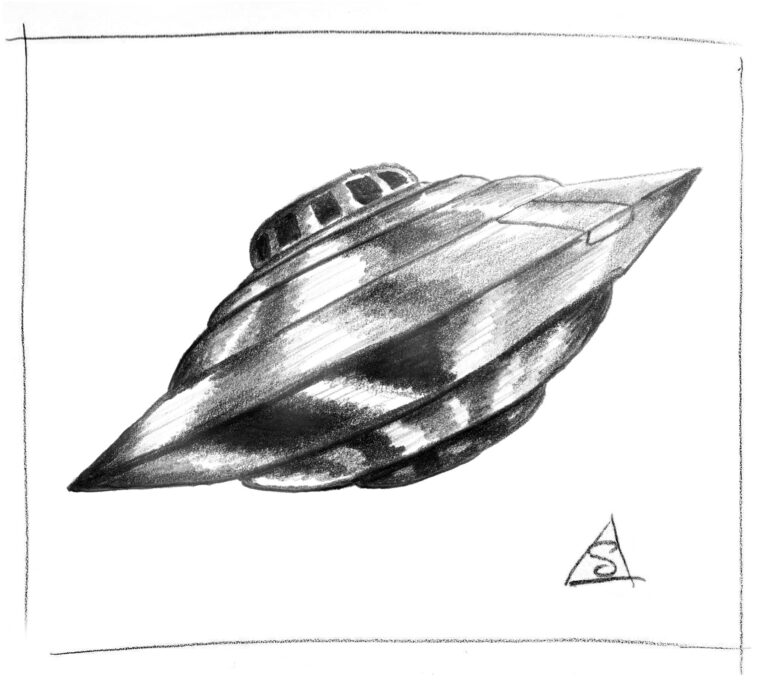
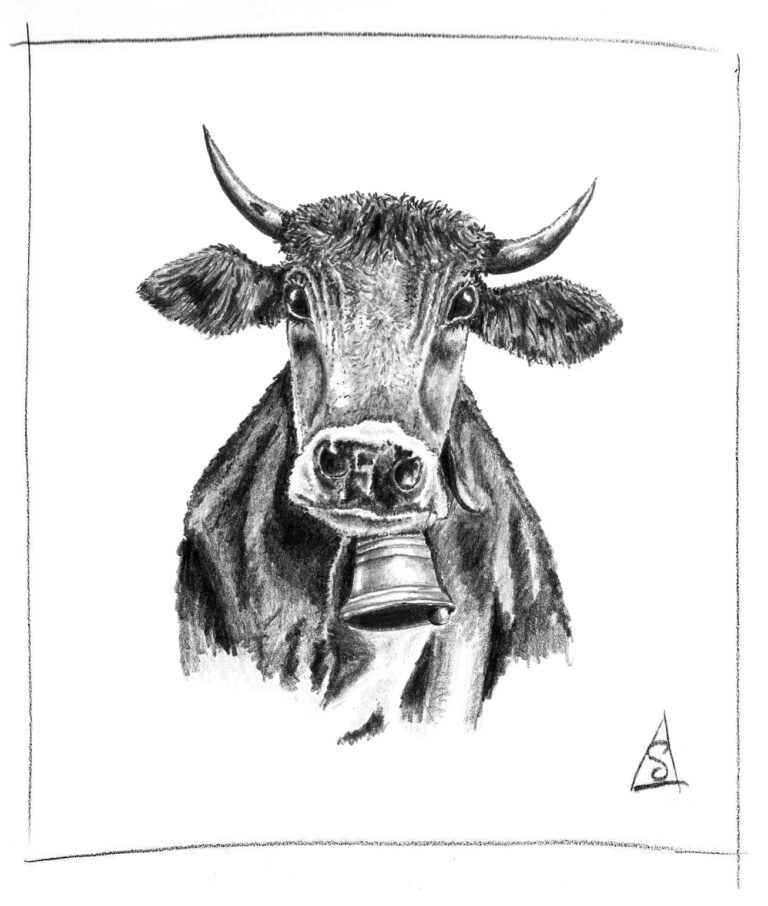
Firstly, Geoff Lloyd used the phrase ‘deaf as Drake’s gunner’, my respectful homage to the late, great Richard Carpenter, who wrote some of my favourite shows from the 70s and 80s. It’s remarkable how some things can influence and stick with you. I actually wrote that line thinking it was my own but something about it gnawed at me and then I realised where I’d heard it before. I could have changed it, of course, but I thought I’d explain it in my notes instead, so that anyone reading this might look into some of Carpenter’s work for themselves and maybe enjoy it as much as I did.
Secondly, I heartily recommend When Life Nearly Died by Michael J. Benton – a wonderful history of palaeontology from the 18th century onwards, which also seeks to establish the reasons for the end-of-Permian-Era extinction, 252 million years ago, and the greatest mass extinction of the Phanerozoic Eon of complex life on Earth (the last 542 million years, give or take a day or two). An excellent read for all those interested in the story of life (and death) on Earth. The Permian–Triassic boundary extinction probably took place over a protracted period, possibly even as long as 200,000 years. I had almost exactly 199,999.4 years less than that to write this book, so I hope readers will forgive any omissions or contractions on my part.
My last shout out, rather immodestly, is to my own Medieval Northumbria series. Inside Book 1, The Apothecaries (mentioned within my preface), you can read the other side of Heidi’s and Reid’s encounter with Harry-the-Cough and Matty in the darkened, wintry woods of medieval England. If you enjoy British comedy and/or historic fiction/fantasy, please give it a try. There will be at least two more books in that series to follow.
Right! THE DINOSAURS
This being the final instalment, I just had to bring back my favourites from the series – the active, sometimes nurturing, often vicious, always fascinating terrors of the mid-Cretaceous, Mapusaurus roseae, Carcharodontosaurus saharicus, Tyrannotitan chubutensis (Matilda), Spinosaurus aegyptiacus, Oxalaia quilombensis, and the petite nightmares, Buitreraptor gonzalezorum. I’ve explained a little about these magnificent creatures within the author’s notes sections of earlier books and hope their deadly reprises got the blood pumping for you again. Each became characters in their own right throughout the series, so there was little room to introduce new animals at this stage (although, for any dinosaur enthusiasts out there, my upcoming NEWFOUNDLAND will be full of similar creatures as well as many new ones). Obviously, in an action series we often imagine such animals at their very worst to work the plot, but I believe the important word there is ‘animals’ – not ‘monsters’. So often dinosaurs are portrayed that way. Some may have behaved in ways that would terrify us, almost certainly, but they were no more monsters than a tiger, or a cow for that matter, both of whom also have the capacity to dispatch a man easily – and do. I try to write opposing philosophies in my characters to reflect humanity, and hopefully to avoid tiresome single agendas, but it’s probably no secret that I’ve a deep respect for animals – may even have written about a few! I believe we can learn much from their behaviour, and if I occasionally anthropomorphise them, here and there, to aid the narrative or work out a piece of comedy, my aim has always been to show them simply doing their best to survive good days and bad, just like the rest of us.
Talking of animals, sometimes, when I offer one of my own furry friends a little treat or reward for being good, I often suspect they understand full well that by sharing such moments they’re rewarding me, too – also for being good, in their eyes. It’s so often true that it’s better to give than to receive, and we humans do like to feel important! They occasionally drive me up the wall, too, but the only time any have ever hurt me is when I’ve lost them, and those are scars I’ll never forget. They remind me what a damned good job they did, every day of their lives, making my life better. I’d hate to live in a world without animals.
Not that I’d want to be a dino-snack! Again, it’s a matter of respect, and returning to dinosaurs, I did manage to cameo Rebbachisaurus garasbae this time. Barrel-bodied, Rebbachisaurus was a diplodocid – twenty metres and twenty tons of long-necked, long-tailed sauropod majesty, related to the even longer but lighter, and far more famous Diplodocus longus (any who have visited the Natural History Museum in London may be familiar with ‘Dippy’, the full-sized reproduction of the late-Jurassic herbivore who lived fifty million years before Rebbachisaurus). Rebbachisaurus were specifically differentiated by unusually tall dorsal vertebrae along their high backs, giving them pronounced ridges that set them apart from most other sauropods, and even from other diplodocidae cousins. The idea of Rebbachisaurus and the relatively tiny, three-ton Ouranosaurus nigeriensis joining forces to survive the nuclear wasteland was sweet, if sad. For all my fellow animal-lovers out there, fear not! Both made it safely back to their herds in the north, after Heidi and Captain Bessel rudely broke into the narrative and whisked us away to 1940s Germany, taking the granddaddy of all carcharodontosauridae with them!
NOT A DINOSAUR!
The other animal I introduced to this story was an outlier, living many millions of years before the mid-Cretaceous and even the dinosaurs themselves in the late Permian Period, 259-252 million years ago. Inostrancevia latifrons was the largest gorgonopsian to live in Laurasia (the northern half of the supercontinent, Pangaea). They must have been truly frightening predators. Larger than Bengal tigers, with massive heads and wickedly large sabre-teeth in their powerful jaws, Inostrancevia, and gorgonopsians generally, were part of the synapsid clade, a major group of the tetrapods that include mammals. Consequently, they were far more mammal-like than the later dinosaurs, and are believed to be part of our own very distant mammalian ancestry. Whether they did indeed have any fur is as yet unclear, but to give an idea of what it would be like to meet one, I suggest watching the very first episode of the British TV show, Primeval, with Douglas Henshall (2007). The writers called the creature Gorgonopsid, but it’s essentially the same beast. You really wouldn’t want to bump into one while taking a stroll one day!
That’s almost it for the animals – just my last old favourite to mention: Sigilmassasaurus brevicollis the spinosaur, and terror of Crater Lake. I had the idea of a throughline between that bad-tempered beastie in Cretaceous Britain and Nessie, several books ago. The idea of an animal surviving untold millions of years in a Scottish loch, a mere 10,000 years old (created by the last ice age) is, of course, perfectly ridiculous – and you could argue that my idea about a time-travelling interloper, laying eggs and raising her progeny to survive a couple of thousand years, isn’t much better, but I couldn’t resist! (NB: I’m not currently sponsored by VisitScotland, but remain open to a retrospective bribe). Naturally, if someone produces convincing new evidence proving the existence of the Loch Ness Monster after this book goes to press, I reserve the right to retract my ‘perfectly ridiculous’ comment and take on an air of smugness, while pretending that I knew all along – please arrange interviews through my publisher and agent; I have history in making up stories 🙂
BRITAIN IN THE TUDOR AGE…
There’s so much back and forth in this book, that I thought I’d try to go through the notes semi-chronologically where possible, and so, moving forward (a long way) to England’s Tudor period, we meet some interesting new characters beginning with the Cout of Kielder…
The heath-bell blows where Keeldar flows,
By Tyne the primrose pale;
But now we ride on the Scottish side,
To hunt in Liddesdale.
Gin you will ride on the Scottish side,
Sore must thy Margaret mourn;
For Soulis abhorr’d is Lydall’s lord,
And I fear you’ll ne’er return.
(excerpt from The Cout of Keeldar, by John Leyden)
That cheery little snippet just about sums up the fate of Sir William de Soulis’ enemies, of whom the Cout o’ Kielder was reckoned one of the greatest of many (as the legend goes). A giant Englishman and Tynedale baron, who allegedly died in the early years of the 14th century – possibly late 13th. As mentioned in previous author’s notes, I brought De Soulis forward to the middle 16th century so that I could include such an authentically historic supervillain within my tale of Hermitage Castle and the Borders (I write a little more about De Soulis and Geoff Lloyd, and their Yuletide antics, in GHOST – part of my New World Extra series).
Information about the cout is sketchy and often contradictory, but it seems he was lauded as a brave young hero type, much admired for his physical size and prowess. While out with a group of friends on a hunt, and who knows what sort of larks, he ignored the local legend about tempting fate when riding anticlockwise, or widdershins, around the Kielder stone (probably the medieval equivalent of reading from the book of the dead in a basement, or repeatedly saying Beetlejuice).
Protected by magic armour (stay with me) he did indeed tempt fate. The rest is history, or more probably, legend. The friends were caught trespassing by De Soulis and invited to Hermitage Castle. Despite De Soulis treating the nobles respectfully, offering them Border hospitality, they began to suspect that he actually intended murder – that seemed to be just how he rolled. Strong and powerful, the cout fought off De Soulis and escaped with his comrades on horseback. De Soulis must have found that irritating, because he and his men pursued them immediately. Enter our friend Robin Redcap. De Soulis’ tame demon helpfully explained that the Cout’s magic armour would not in fact protect him in running water. Doubtless this was sage advice; after all, very few swimmers favour doing the breaststroke in mail! While trying to cross Hermitage Water – the river that ran through Liddesdale and alongside Hermitage Castle itself, and still does to this day – the cout stumbled and fell into a place where the river pooled (a place now known as Drowning Pool). Unable to climb out, the cout was held down by De Soulis’ men with their ‘lang spears’ until he drowned. There’s a grave just outside the small chapel a short walk from Hermitage Castle, marked The Cout o’ Kielder (spelt Keilder on the marker). Against that backdrop, I hope Douglas’ burial of a Mapusaurus thigh bone so that it could be found two millennia later sounds almost plausible. However, modern cynicism aside, these Border tales are a wonderful part of British history and legend, and are not so different from the historic/horror/fantasy fiction we write and consume today. I love them.
FUNNY? WEIRD? IRONIC? IT’S ALL JUST HISTORY!
Moving on, I briefly introduced a chap named Captain Fear-God Barebone into this story (we’ll hear more of him in REBIRTH – or a longhand title might be Geoff Lloyd Saves the World – coming soon). My character is not to be confused with the real ‘Fear-God Barebone’, a minor 17th century poet and brother to Anabaptist** preacher ‘Praise-God Barebone’, who became a London councillor and member of Oliver Cromwell’s Appointed Assembly – a body that became known as Barebone’s Parliament (probably ironically) – almost a century later, after the civil war. He was imprisoned after the Restoration (the return of Charles II), but was later released to live into old age. The only connection between my character and the man is his name – and what a name. It almost paints a thousand pictures! Ideal for the type of chap I had in mind. The reason I mention this curiosity in my notes is because the Barebone family penchant for uniquely descriptive names didn’t stop with Fear-God. His brother, Praise-God Barebone, had at least two children. Are you ready for these? Jesus-Christ-Came-Into-The-World-To-Save Barebone and If-Christ-Had-Not-Died-for-Thee-Thou-Hadst-Been-Damned Barebone – I kid you not. Unfortunately, the latter became known simply as ‘Damned Barebone’. For some reason, he wasn’t fond of that moniker, and went by Nicholas instead – parents, honestly! Still, he must have taken the fear of hellfire seriously enough, because he went on to found London’s first fire insurance company and fire brigade. Having read about these men, I simply had to have a Barebone for my story. Isn’t history wild and wonderful?
**In the broadest of strokes, Anabaptists believe that baptism by water should take place when one is old enough to choose one’s faith. Even when baptised as an infant, they are re-baptised upon reaching an age of maturity, if not actually majority. In Reformation England, such beliefs could be dangerous, dependent on the prevailing orthodoxy of the time and who happened to be on the throne. Most notably, during the Reformation of the 16th century, common folk were encouraged to read the word of God for themselves. Up until then, literacy had been mostly an elite privilege; even many churchmen were illiterate. Whatever anyone’s views about religion, it’s hard to overstate the importance of being encouraged to read – a truly pivotal moment in human history sadly, and yet thankfully, so often taken for granted today.
FUTURE TECHNOLOGY, OR SOMETHING ELSE?
While on the subject of wild and wonderful, this book alludes to a hearing with Congress on the subject of UFOs – or UAPs, as they’re often termed (unidentified anomalous phenomena) – and the existence of alien technologies that may be in the possession of the US military at Area 53 (I went with Area 51 because it’s more widely known and so required no explanation). Once again, I feel the need to repeat: I kid you not. What I found astonishing, possibly even more so than the discussion itself, was how little the world seemed to care. Have things really become so bizarre over the last few years that real-life aliens are now humdrum? I have no answer to that, but here is a transcript from the news channel that broadcasted it live on the 26th July, 2023.
The U.S. House Committee on Oversight and Accountability heard explosive testimony Wednesday, not only about the mysterious craft that was beyond any known technological capabilities but also eyewitness accounts by former US military personnel.[/caption]
The hearing entitled ‘Unidentified Anomalous Phenomena: Implications on National Security, Public Safety, and Government Transparency’ heard from: Ryan Graves, Executive Director of Americans for Safe Aerospace; Commander David Fravor (Ret.), Former Commanding Officer United States Navy; and David Grusch, Former National Reconnaissance Officer Representative, Unidentified Anomalous Phenomena Task Force, Department of Defense.
Grusch testified that both he and his wife witnessed ‘non-human**’ entities doing harm to humans that he described as ‘very disturbing’.
Graves testified that he had a pilot tell him he almost hit a UAP during take-off: ‘One of these objects was completely stationary… It was right where all the jets were going on the eastern seaboard. The two aircraft flew within 50 feet of the object.’
Upon talking to the pilot after he landed, Graves said he found him with his ‘mouth open’ and that the pilot told him that ‘he almost hit one of those darn things’. Graves said the pilot described the object as a ‘dark cube inside of a clear sphere’.
Source: Global News
Is any of that real? Or true? Can it be true? Is it a hoax? Who knows? It all sounds rather surreal, and that’s putting it mildly. Whether ‘the truth is out there’ remains uncertain, but the full hearing is out there on the Internet – you decide.
** I assume they didn’t mean animals.
VOLCANISM
Finally, I come to something a little more tangible – volcanoes. The events here straddle some of the time periods described above, so I thought I’d just tag it on the end. Apologies if the chronology makes anyone twitch. The enormous volcanic event during the Oligocene Epoch of the Palaeogene Period, roughly thirty million years ago, really did happen and really did spew billions of tons of magnetite up from the mantle to create the strongly magnetic Bermuda Triangle – so we can hang on to that. Although, as I type the name ‘Bermuda Triangle’ after discussing UFOs, I feel like I’m disappearing down an entirely different but strangely similar rabbit hole! (Author’s Notes is where I usually attempt to tie the story to real facts and events and discuss any deviances; however, on this occasion, I think reality may have upstaged my fiction.) I’ll try again. The Permian–Triassic extinction, 252 million years ago, definitely happened. Almost everything on Earth died, therefore please note: creating a link between that event and the Oligocene eruption, the way Hiro Nassaki did, would probably not be a good thing… so with that, I’ll end by saying ‘don’t try any of this at home’ and most importantly of all, thank you so much for reading the New World series. It’s been a wonderful journey for me as an author and I hope you’ve enjoyed it.
Until the next time…
Thank you so very much for reading,
Stephen
Rookstone

I hope FOR KEEPS | ROOKSTONE made you smile. Rookstone itself is inspired by one of Northumberland’s many gems, the beautiful Chillingham Castle, owned by Sir Humphry Wakefield. I heartily recommend a visit to anyone travelling that part of the world.
Readers of my stories will have spotted that I love castles and ancient places, I’m sure, but Chillingham will always be one of my favourites. Stuffed with memorabilia from all over the world, there’s always something you didn’t notice the last time you visited, but my personal fascination is with the castle itself. So many of its rooms feel like its ancient owners have just popped out for something and might return at any minute. Perhaps I’m being fanciful, but it’s almost as though they’re still there, in the air.
Its place in British border history cannot be doubted, but Chillingham is also a favourite haunt for ghost hunters, no pun intended, and people interested in the supernatural. Most Haunted visited there on their first investigation (after the pilot episode). That was also the first time I saw Chillingham, and I just had to visit. In this story, Stan the cameraman’s idea to ditch Brandon Porkpie and move into paranormal investigations, while fictitious, is my little homage to Karl Beattie and the Most Haunted team who brought ghost hunting to the mainstream. Regardless of any controversy, I thought they were great shows and perfect Halloween fare. You have to love anyone willing to terrify themselves witless, while you sit in a comfy chair in front of the television with the lights low, eating pizza.Obviously, this story is a work of fiction, and all the characters within it are also purely fictitious, but I did borrow some of the history from Chillingham Castle’s long heritage to flesh out the plot – dates of construction, crenellation, etc. Needless to say, my Greys of Rookstone bear no factual resemblance to Chillingham’s residents, other than by name. Although Chillingham does have spiral stairs, as I described in the story, some of the towers’ main staircases are in straight flights with a quarter-turn at each corner. They’re beautifully constructed and impressive. I made them all spirals in the story to reduce confusion with the already complex layout of the castle. The south tower may actually be the oldest – and possibly most haunted – the one named for Edward I. Again, I changed the oldest part of the castle to the north tower within my story to better fit the plot, and to give Gary’s accommodation a spookier history. Although the existing castle has a decidedly square stance on the ground, it was built on a more or less north-north-westerly heading, giving it a rhomboid layout when viewed on a map. The west tower, where Sir Henry lives in my story, was converted to holiday suites some years ago by the current owner, Sir Humphry Wakefield. I once stayed there myself during the Christmas period, in the early 00s – a proper winter wonderland under its blanket of snow! The castle only became the four-tower construction we now see, many decades after Edward I’s visit, under the reign of his grandson, Edward III. The decorative mullioned window I mentioned in the story is real and was installed specifically for Edward’s visit, and is to this day an oddity in that austere elevation (to my eyes, at least) – the other windows on that side being a later addition when the castle became a grand home. Despite being the King of England, Edward, like many of the aristocracy, spoke mostly Norman French, though he could speak and read English and Latin, too. Inga’s reaction to hearing it spoken aloud would probably have been natural to anyone walking the Earth during the Harrying of the North, AD1069-70 (even in spirit). That awful event in English history, and what the Normans did to the Saxon people, from York up to Durham, would almost certainly be considered genocide now, as Gary noted. However, back then, it was simply how war was done – although a particularly vicious and egregious example, even by the standards of the day. The risings in the north threatened William I (the Conqueror)’s grip on England, possibly even threatening to reverse his conquest, so there was almost certainly an element of vengeance driving his actions, over and above his desire to quell the insurrection.Spinning forward to Edward I’s reign again (1272-1307), I also borrowed the reprehensible torturer, John Sage, from Chillingham’s lengthy and fascinating story. It’s quite difficult to find detailed history about the real John Sage, (soap box alert) but I believe it’s important to remember that such monsters existed and continue to exist to this day. Many physical descriptions of the locations within the story are also based around the castle and grounds. Chillingham is a truly beautiful and intriguing place. I hope my attempts to describe it will inspire readers to visit.
The second worst man in my story was Scott – of no surname. I hope my Scottish friends will forgive me here, but after writing for years about the heroic exploits of Captain James Douglas from Hawick in my New World series, it was time for balance :o)
Most of the measurements used in this book are imperial and this was deliberate. Feet and inches have always been used widely in the British construction industry and only very recently have they begun to fade out with the latest generation of builders. I grew up with metric but the generation before me used imperial, so knowledge of both was essential. Personally, I found metric better for critical accuracy, but in most instances imperial measurement was easier for construction. For example, you could ask for a piece of timber stud to be cut to 2133mm or you could simply request 84”, so imperial died hard, regardless of legislation on the sales of materials. I mention this because some readers will rightly note that Britain was metric by 1994. However, I wanted this story to better reflect the time, when the older men would have used, almost exclusively, good old imperial feet and inches.
I set the story in the ’90s purely for the sentimental value; after all, what’s wrong with a little nostalgia? To many of us, we look back to the ’80s and ’90s as a golden age now, when things were taken so much less seriously – and arguably for granted. Certainly, no one was above being mocked. I’ve heard those times described as the apex of western civilisation and culture (though others hold that the apex was actually a century earlier). Whatever your views, it could be argued that we enjoyed optimum levels of freedom, but still largely within a framework of respect, and with just enough tech and cool stuff to be interesting, but not so much that it enslaved or stifled us, as some feel that it does today. Although I hope anyone might enjoy these stories for their entertainment value alone, my upcoming FOR KEEPS series is dedicated to any who remember those times fondly. To help further foster memories of that time, I chose chapter titles that were corruptions of songs from popular culture between 1980 and 1994 – recent history when the book was set. Obviously, there was an exhaustive list to choose from and some were more famous than others, but I simply chose titles for no other reason than they fitted with each chapter’s theme. You may have guessed a few of them, but here’s a list for anyone who’s interested:
1 | Smells Like Mean Spirits – a fairly obvious take on Nirvana’s 1991 hit, Smells Like Teen Spirit. This story was set in late spring of 1994, just after Kurt Cobain’s passing.
2 | Sweet Dreams (Aren’t Made of This) – again, an obvious one. The 1983 Eurythmics hit, Sweet Dreams (Are Made of This).
3 | Dead of the Night – less obvious, perhaps, and deliberately so. Given the theme and the location of the story, it would have been all too predictable to go with Thin Lizzy’s The Boys Are Back in Town, so I went with another Newcastle band instead, and with Venom’s 1985 single, Dead of the Night. It fitted the scary goings-on in that part of the story far better.
4 | Boredinary World – my title is a damning indictment on the humdrum day-to-day of working life, perhaps, and a play on Duran Duran’s 1992 classic, Ordinary World. It’s always difficult to write about the ordinary, though often important, tasks we all undertake each day and make them interesting. I try to throw in a few of those ‘ordinary world’ touches, here and there, to make the characters feel real. Whenever I visit an ancient building or monument, I always place a hand to an ordinary block of stone, or piece of timber. Once a builder myself, I know that the man who laid them was unlikely to be thinking about all the visitors that would admire his work over many centuries to come – he was more likely thinking ‘Is it time for dinner yet?’ I love that connection to a real person, so long ago.
5 | Hollow Man – Entombed’s 1993 classic. I kept the original title, Hollow Man, as its meaning – someone with no morals or values – fitted well with the apparent treachery taking place in the chapter and Richard’s introspective feelings of guilt.
6 | From Out of Nowhere – Faith No More’s first single from their 1989 The Real Thing album. Again, I kept the original title, From Out of Nowhere, because it fitted exactly with the catastrophe about to strike Gary Stone’s life.
7 | Cashes to Ashes – a corruption of David Bowie’s 1980 number one single, Ashes to Ashes. I’m sure you guessed that one, but Hammer certainly didn’t see what was coming when he opened the bag to find fake emeralds!
8 | What’s Up – the 1993 hit single by 4 Non Blondes. Again, I kept the original title, What’s Up. Considering Worzel’s run-in with a wild bull during that chapter, and what followed, it would have been rude not to.
9 | 999 Emergency! – based on Motörhead’s 1980 belter, Emergency. 999 is the British number for the emergency services, equivalent to America’s 911. I was quite pleased it landed on chapter 9, too. God bless Lemmy!
10 | Under Siege (Regnum Trullae) – based on Sepultura’s 1991 single, Under Siege (Regnum Irae), meaning Under Siege (Kingdom of Wrath). My version means Under Siege (Kingdom of the Shovel) – or possibly the trowel; translations vary, but I think both work. I felt very smug about that one.
11 | When Will I Be Famous? – the 1987 hit from Bros. When Will I Be Famous? seemed the perfect chapter title to herald the arrival of Brandon Porkpie, of Whopper TV, to chronicle Gary Stone’s ever-worsening predicament for mass consumption.
12 | Things Can Only Get Better? – D:Ream’s 1993 hit single, Things Can Only Get Better, made UK number one in early 1994. Recycled by one of our political parties, it’s viewed with some irony by many in Britain thirty years later, at the time of writing in 2024. Perhaps the question mark on the end is surplus, and might just as easily have been implied, or dare I say it, inferred, but it fitted with the decline in fortunes of my characters.
13 | What a Fall – borrowed from the widely regarded Stone Roses single, Waterfall, from 1991. Needless to say, that chapter charted Gary’s swan dive from Rookstone’s north tower and his unlikely salvation.
14 | Losing My Derision – as that chapter took place in Rookstone’s chapel and was probably the most serious part of the book, I took inspiration for the title from REM’s Losing My Religion. No surprise, I’m sure.
15 | Cars (and Vans) – title inspired by Gary Numan’s classic, Cars. Technically, the song was released in 1979, but the song and video in so many ways set the tone for the early ’80s that I had to cheat.
16 | My Friend of Misery – from the mighty Metallica, back in 1991. Originally written as an instrumental, My Friend of Misery was never a single, but it fitted nicely with the direction of travel the story was taking at that point.
17 | Always the Son – original named Always the Sun, by The Stranglers, released in 1986. It marked a point in the story where the younger members of the For Keeps team played more prominent roles.
18 | Barklife – inspired by the title of Blur’s hit single, Parklife. Certainly iconic of the early ’90s Britpop sound, the name was a gift for Poppy’s adventure outside to call in the big guns. Although my in-head OCD companion forces me to ’fess up and admit that it wasn’t released until August 1994 – after the setting for this story. What a cheat I am!
19 | Sabotage – The Beastie Boys’ 1994 Sabotage has made its way into films and all sorts of popular culture – even Star Trek, somewhat bizarrely – and this one was out in January ’94, so I can relax! It fitted with the wilful damage our heroes inflicted when they weaponised Rookstone’s fragile electrics and plumbing.
20 | I’ve Got the Power! – inspired by the well-known chorus to 1990’s The Power, by Snap!
21 | The Size of a Crown – not sure if this one made it across the pond, but the chapter title was inspired by The Size of a Cow, a 1991 hit by The Wonder Stuff. The characters within this story were certainly ‘building up their problems’ by that point.
22 | Bird Up – a take on Word Up, popular again in 1994 after the cover by Gun in July, the track hit the airwaves just in time for the end of this story. An iconic song of the period, the gag in the title made me chuckle, especially after Gary’s unintended ‘alteration’ to the photograph that began our story, so I used it.
To expand on the subject of popular culture, I have to mention another timeline cheat, and make a shout-out to the 2011 internet sensation, and modern-day deer stalker, Fenton the dog – can’t remember how many times I watched that hilarious clip, back in the day. He may have been a naughty boy that afternoon, but what a legend!
Thank you for reading. Until the next time…
Stephen Llewelyn
Thank you so very much for reading. Until the next time…
Stephen
the apothEcaries
I enjoy including a little history in my stories because I believe it gives a grounding in reality – even when history beggars belief! AD1399 was chosen so that my story fit within the lifetime of one of Northumberland’s greatest heroes, Sir Henry Percy, more widely known as the great Harry Hotspur – so named because of his penchant for ‘hotspurring’, that is, riding fast and furious into battle. His courage won him renown among friends and foes alike, and what can I say, I’m a fan.
However, this story was about another Harry, Harry-the-Cough, a fictional peasant with poor prospects but a good mind and an unusually good education, by the standards of the day; someone who would have viewed the ruling aristocracy with great suspicion, including Lord Henry Warmstirrup. Lord Henry, inspired by Harry Hotspur, does not always come over well within my story. That’s purely because he’s seen through the eyes of the medieval poor, and is not a commentary on my own part.
Harry Hotspur predeceased his father, the first Earl of Northumberland, who was also named Henry Percy, and so never actually became Earl of Northumberland. Unfortunately, the real Hotspur failed to receive the warning note from Insane Alice! He did indeed die in a field just outside Shrewsbury on the 21st of July, 1403, battling against King Henry IV (whom he helped to the throne) and his son, the future Henry V.
Like the Henry Warmstirrup in my story, one of Hotspur’s brothers was also called Sir Ralph, and they really were both captured by the Scots at the Battle of Otterburn in 1388.
The wedding tradition, Something Old, Something New, Something Borrowed, Something Blue, actually appeared much later in 19th century Lancashire, but the blue scarf Harry carried as a last link to his mother fitted nicely into the story for any romantics out there.
WHAT’S IN A NAME?
For anyone planning a trip, quite a lot, I would imagine…
I’ve played fast and loose with the place names in this story. As stated, most of my fantasy world is loosely based around real locations close to Alnwick and its castle (yes, the one where they shot the early Harry Potter films), but are not meant to be Alnwick. My reasoning was simple. The beginnings of the story came to me while standing outside Alnwick Castle gates. I’m very fond of Alnwick and its people, so it seemed a fitting tribute and thank you to use the old place as a template for the story it inspired. Before that moment, The Apothecaries was little more than a title and an elevator pitch. I’m not sure how long I stood gawping up at the impressive medieval gatehouse, but during that time Harry-the-Cough was born (the least of the famous Harrys!), as was the idea for his rags-to-riches ride against a backdrop of war, disease and perhaps even a little black magic. When visiting a county that boasts 8000 years of human habitation, and all the signs and structures they left behind, it’s easy for the imagination to run wild. Indeed, the entire region is a treasure trove stuffed with history, archaeology, palaeontology, natural beauty and, of course, stories. However, my initial fleshing out of the idea seemed rather grim, and writing a book takes several months. It therefore became a comedy of sorts, all on its own, because I lack the stamina to remain serious for that long.
The plans of Warmstirrup and Warmstirrup Castle are very broadly based on the medieval castle and walled town of Alnwick, though the town walls were in fact built slightly later, towards the end of the 1470s. Dispensary Street is actually located a little further away from the castle to the west than it is in the story. However, the opportunity to place The Apothecaries’ building on Dispensary Street was a gift. Weirdly, I didn’t realise there was a Dispensary Street in Alnwick until after I’d written the book, but it was simply too good to miss, so I had to go back and add it to the story and the maps. The oldest pub in Warmstirrup is known as The Dirty Jugs – this is a rather clumsy homage to The Dirty Bottles, a public house in Alnwick famous for its rather unusual window decoration. The window facing onto the road is sealed and contains several ‘dirty bottles’. The story has it that a previous owner, roughly two hundred years ago, tried to remove them and instantly dropped dead. Funnily enough, no one has dared touch them since – hence the dust and the dirt!
The other pub in Warmstirrup – that suffered Harry’s early and ill-conceived attempt to combine a drive-by with a drive-thru – I named The Struggling Man. This is the elephant in the room, in that it is not from Alnwick and is in fact a public house from my own childhood that sadly, like so many others, has now gone to make way for a rather less pretty row of house boxes. It was nicknamed ‘The Struggler’ by the locals, hence Struggler Road. Unfortunately, its total destruction was pre-Google and smartphones, so there are very few pictures remaining of the pub, bowling green and beer garden that overlooked what were then lovely parklands in the middle of the town. We used to play on that park, day and night, but sadly, many are afraid to walk there even in the daytime now. I hope The Struggling Man retains some small measure of immortality in print from this work.
Aynlton Priory (very definitely pronounced Ant’n!) was based on Hulne Priory and actually founded in the mid-13th century by the Carmelite Friars who decided that Brizlee Hill resembled a place in the Holy Land called Mount Carmel. There were many monastic orders across Europe in the Middle Ages; I decided to make them Benedictine for the story because that order is probably more familiar to most of us.
Warmstirrup Abbey was based on Alnwick Abbey, a Premonstratensian monastery built in 1147 and, like so many others, suppressed and mostly destroyed during Henry VIII’s dissolution of the monasteries in the late 1530s. Sadly, only an extremely impressive gatehouse remains.
The River Aynl is another clumsy play on the River Aln, as the River Foquet (pronounced Foh-ket, honestly!) refers to the locally famous River Coquet (Coh-ket).
In the bow of the Foquet is the castle and town of Parkworth (pronounced Porkworth by Sir Ralph). The real Percy castle and town of Warkworth is pronounced locally as workworth – actually that’s an awkward one, too easy to read as werkworth, so let’s try walkworth. I love these place names. They present a writer with endless possibilities for bad jokes! Warkworth, like my fictional Parkworth, has a hermitage, too, and it’s every bit as impressive as Sir Ralph laments in the story.
Edcase Castle, in the real world, is actually a wonderful ruin named Edlingham Castle, which shares a stunning landscape with an early Norman church and a beautiful Victorian viaduct, all built in stone. Were that not enough, it’s also a mere stone’s throw from Corby’s Crags – for my mind one of the finest viewpoints in the county, looking out towards the Great Cheviot Mountain itself.
Chilly Castle is, of course, the great Chillingham Castle – possibly my favourite of the many Northumbrian strongholds. The gorgeous castle and its medieval church, replete with one of the best medieval tombs you’ll see outside Westminster, is a must see.
Snugly Burn is actually Rugley Burn. A burn is a northern English/Scottish name for a small river or large stream.
Old Spewit is an ancient place, actually named Old Bewick. A small village now, but also near the site of some extraordinary early Bronze Age archaeology, including a cairn and some extremely rare cup and ring marks. The hill fort mentioned in my story really exists and was constructed during the later Iron Age and may still have been occupied into the Roman period.
Strewthbury may sound Australian, but – outside the crazy world of Harry-the-Cough – actually relates to the medieval market town of Rothbury.
Hwitaham and Twyford were small villages west of Alnwick. Hwitaham is now called Whittingham and once had two pele towers, of which only one remains, though other fine examples may be found in the area.
Scotch is an old term (in English) for the Scots, although it is rarely used any more, other than to describe scotch whisky.
I hope you enjoyed reading this comedy adventure, set in my spiritual home of Northumberland, as much as I enjoyed writing it.
Thank you so very much for reading. Until the next time…
Stephen
DINoSAUR
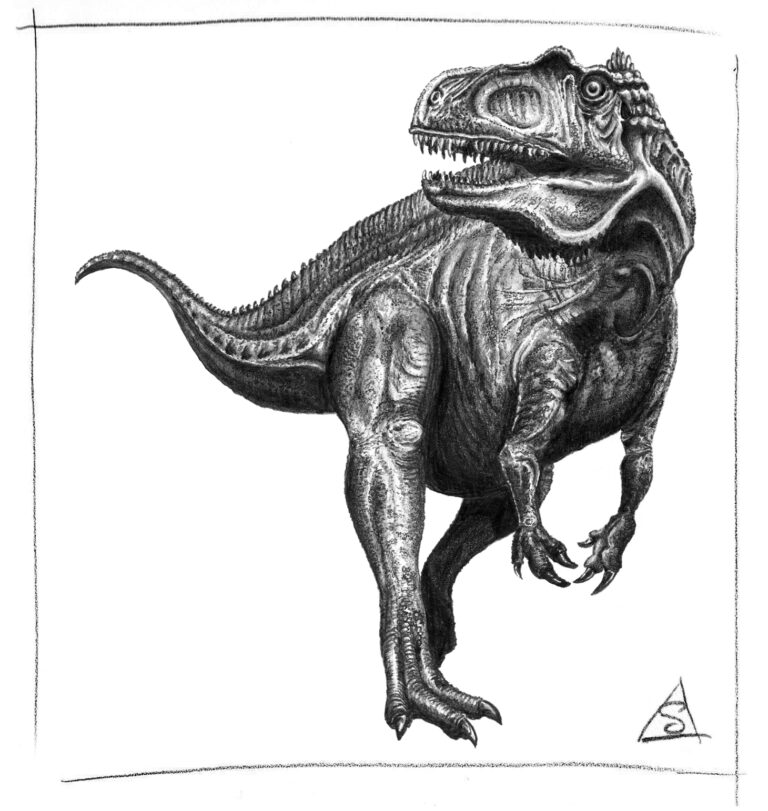
NAMES
Dinosaur names are typically italicised, with the genus name also given a capital letter. In order to identify them correctly, they should be written along with their species name, too. For example, Tyrannosaurus rex (note only the genus is capitalised, the species gets a lowercase first letter, rex being merely a type of Tyrannosaur – albeit the one everyone knows).
Within a novel, italics tend to be more commonly used to provide emphasis to the narrative (although I did stick with the tradition of italicising ship names because there are so few). There are so many recurring animal names within this story that I thought emphasising them all might confuse the narrative. Therefore, I gave each animal name a capital letter instead. I apologise to the purists but hope you will understand why I made this decision.
THE CREATURES
Buitreraptor gonzalezorum probably lived in the Cenomanian or even Turonian stages of the Cretaceous, a little later than the setting for DINOSAUR. The fossils found in South America came from rock strata laid down approximately 94 million years ago. Research continues, but there are as yet few known Dromaeosaurids from the southern hemisphere (at the time of publication). Some palaeontologists believe their ancestors may be traced all the way back to the early Jurassic, before the breakup of Pangaea and this would explain their worldwide dispersal in later times. Although my chronology is slightly off, I wanted to include at least one real animal from Earth’s past to fill this niche. This fast, intelligent, fighting little creature will more fully make its introduction later in the series.
TRAITS
The arctometatarsalian condition has, as far as I know, never actually been found amongst the carcharodontosaurids, although it is a feature that has evolved more than once, apparently. Tim speculates about the possibility of new animals that may have this trait, but also uses the potential speed and/or long distance running capability this condition was believed to imbue, to scare Woodsey into being quiet for a few moments.
LOCATIONS
The locations of fossilised Mapusaurus roseae remains suggest they may have lived in more northerly latitudes than Giganotosaurus carolinii. However, so comparatively few fossils of these magnificent dinosaurs exist that this might simply be lucky accident, as the land may well have been traversable. I included both animals within the region around the landing site of the New World to increase the peril faced by the crew.
Also, because each was such an extraordinary creature, how could I possibly choose between them? It is likely that their hunting territories would have been many miles apart, although every territory intersects somewhere, so it is possible they could have met. Naturally, the forest fire that threw them together in this story was merely a narrative device, but who knows, maybe a large-scale conflagration could have set them on a collision course, at least once, in those long-gone days. It seems more likely they would have avoided one another where at all possible in reality, of course, but such a clash of the titans is almost irresistible for an author.
When I wrote that passage, I hoped to ‘trap’ the reader in the cab of the stranded excavator and surround them with these terrifying predators. For this reason, I introduced the hapless driver very late in the narrative – however, the concept of ignoring an emergency recall in order to get a job finished, and thus avoid the necessity of going back to it, was simply me imprinting my past experience of working on building sites upon a fantasy world!
If a meteorite was going to smash into Birmingham at 7pm, at 5pm, someone on a scaffold somewhere would almost certainly be saying, “Yeah, but we can have this finished by six and get the money in!”
For all the people who have to work, through it all, no matter what – I salute you!
Thank you so very much for reading,
Stephen
RevEnge
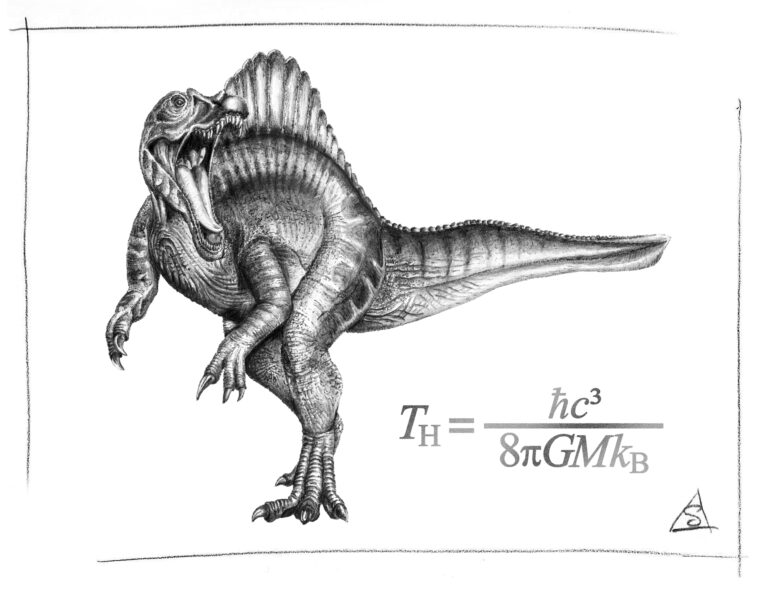
FEATHERS
There is a huge amount of effort going into researching this subject at the moment. It seems likely that many species had at least some form of feathers. Perhaps all dinosaurs did; the final answer seems to be up for grabs at the moment. Even the reasons for having feathers may have differed wildly between the species – maybe even between a species, at differing points throughout the animals’ lives (for example, the larger the animal, the less its requirement for insulation – in fact, above a certain size, overheating would be more likely).
Although I have introduced a few species with feathers, notably Buitreraptor, I have largely hedged around the subject for two reasons. Firstly, information on the subject is being gathered and is changing at a prodigious rate – and I did not want something so obvious as the look of the dinosaurs to become immediately out of date (this is a major problem faced by anyone writing about dinosaurs at the moment. Most books have to be updated three or four times just in the time it takes to write them!). Secondly, many people have a cherished view of what a dinosaur, particularly the larger and more popular clades, should look like.
In terms of the story, this does not really matter or affect events, and as this work is purely for entertainment, I leave the subject open and hope that each reader will enjoy ‘clothing’ these incredible animals in the way they prefer. Feathers or scales – please imagine them as you will.
TIMELINE
As previously stated in my notes at the back of book one, Buitreraptor lived a little later than the setting for these stories, perhaps in the Cenomanian or even Turonian stages of the Cretaceous Period.
There are few dromaeosaurids yet known in Patagonia during this period, so I chose this little animal rather than make one up. Tyrannotitan lived a little earlier than the setting for REVENGE, possibly in the Aptian stage of the Cretaceous Period.
I included this great animal for three reasons: Firstly, to give the great Mapusaurus and Giganotosaurus a rest after their exhausting efforts following the stampede in book one; animals that size would probably have hunted vast territories, perhaps even hundreds of square miles, so this would seem logical.
Secondly, there is no conclusive evidence, as far as I am aware, to categorically prove or disprove the group behaviour of the large theropod carnivores. It may be that they grouped together at certain times of year, or to bring down great prey, but were otherwise solitary; or they may have grouped together for mutual benefit when young, only to become more solitary when grown. Research continues and it is truly fascinating. With regards to my story, as the mapusaurs and giganotosaurs worked in packs (possibly due to a springtime breeding cycle), I thought it would be nice to describe another, similar animal with a lifestyle at the opposite end of the spectrum – a ‘lone wolf’, if you will.
Thirdly, I am a writer of stories, and with a name like Tyrannotitan, how could I possibly resist?
Thank you so very much for reading,
Stephen
AlLEgiance
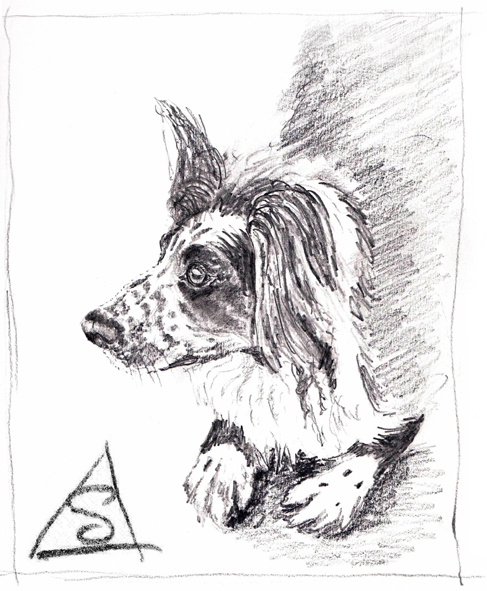
CREATURES
Ornithocheirus and Anhanguera were vast flying reptiles (pterosaurs), and related. Size estimates for Ornithocheirus are still disputed, but range anything up to 12m across the wing – although other researchers believe they may have been little more than half that size and very comparable to Anhanguera in that respect also. Both animals probably lived a little earlier than the setting for ‘Allegiance’ – perhaps as much as 10 million years further back, hence Tim’s comment, “Ornithocheirus, or one of his relatives.” Ornithocheirus remains have been found in Britain and Anhanguera in north-eastern Brazil (either side of the fictional island where our heroes discover them off the west coast of Africa).
For animals that fly and eat fish, it must be a palaeontologist’s nightmare to guess where they were actually from! I chose to feature Ornithocheirus because it is so well known from the BBC’s Walking With Dinosaurs series. Sometimes it’s nice to be able to provide an actual face to a name! Although a flying pair do feature on the cover of the next novel in the New World Series, ‘Reroute’ (Oops! Spoiler alert!).
Cronopio (the little critters that savaged Henry’s trousers) were small mammals. Probably no larger than terriers, one of the palaeontologists who discovered them described Cronopio as bearing a marked resemblance to ‘Scrat’ – the cute and immensely industrious little chap that chased the ever-elusive acorn in the film Ice Age.
The idea that they behaved in a very dog-like manner was a complete liberty on my part, for the sake of the story – but then, if those ancient mammals had come across a pack of wild humans, maybe they would have developed a symbiotic relationship and, dare I say it, become friends in an age of deadly reptiles?
STAND-OFFS
I try to stay away from gladiatorial contests among the dinosaurs. As stated on previous occasions, large predators, then as now, may have made a lot of noise when defending their territories, but would most likely have avoided direct conflict with one another. Injury could so easily mean death. However, a few scraps must have happened down the years – what a tremendous piece of good fortune that one such occurred while a couple of our heroes just happened to be crossing the river, so we got to see it!
Ekrixinatosaurus was a relative of the much more widely known Carnotaurus sastrei. As depicted in my amateurish sketch at the head of chapter 8, its arms were almost completely vestigial and probably useless. Subsequently, not being able to reach to cover his ears was a really cheap gag, but sometimes you just have to go with the classics. However, what I really like about this animal is its size. Unlike the behemothic Mapusaurus or Oxalaia, Ekrixinatosaurus was small enough to easily follow you through a forest and would likely have had the stamina to go all day – nowhere to hide – shudder.
THE BAD GUYS
Talking of shudders, the fanatical Emilia Franke’s ship, the Heydrich, was named after Reinhard Heydrich, one of the main architects of the Holocaust. Considered one of the worst of a very rotten bunch within the Nazi leadership, it is fair to say that few have left such a trail of murder and chaos in their wake – millions dead. Even Hitler took this man very seriously, describing him as “the man with the iron heart”. Fortunately, in 1942 he got what he deserved. History crucially remembers these monsters in order to provide future generations with a chance at stopping the next one. In the past they have tended to rise from a world where the vast majority of people are afraid, or simply consider it wise or easier, to hide their real thoughts from view. Within his Cicero Trilogy, Robert Harris wrote a lovely little piece where Cicero says something to the effect of ‘we only have the knowledge of our own lives, but if we read history, we can call on the wisdom and knowledge of generations’.
The ‘Schutzstaffel’ was more commonly known as the infamous ‘SS’, a major paramilitary organisation under Adolf Hitler and the Nazi Party.
The Eisernes Kreuz (Iron Cross) was a medal for valour and service to one’s country (in Germany). Unfortunately, it is commonly tainted with association to the Nazi movement (the Nazi iron cross can be differentiated by the swastika emblem at its centre), but the honour goes back much further; in fact all the way to the Napoleonic era, and was awarded to some very courageous men and women who were most certainly not Nazis. The idea of Heinrich Schultz identifying himself with such an icon seemed entirely in keeping with the deluded self-importance of his character – the man was not even German!
The German people are, and have always been, clever and industrious. The Nazis are in no way synonymous with them. However, when it comes to writing ‘bad guys’ for the purpose of fiction, they don’t come much ‘badder’ than the Nazis, do they? After all, where would our much beloved Indiana Jones have been without them?
Thank you so very much for reading,
Stephen
REroute
 CHARACTER TRAITS AND
ACCENTS
I receive quite a few comments from readers who love the way the characters speak with their own accents (and some hate mail on the subject, as well!) Personally, I believe it brings them off the page a little, while often providing some in-built humour, too.
However, with the 16th century characters, I’ve taken a few liberties (once again). Although communication would not have been impossible, anyone who has ever read Shakespeare knows that the dialect can, at times, be very difficult to understand, so much has the English language changed.
To that end, I’ve gone for a ‘feel’ of antiquity with the English and Scots dialects, trying where possible to remain true to the period but hopefully without making the characters’ words indecipherable – I apologise to the purists and once again hide under my comfort blanket of fiction.
Here – have a smiley face :o)
As far as I know, Elizabeth Tudor (soon to be Elizabeth I) was not in Northumberland during 1558. Most likely she was still ensconced within Hatfield House in Hertfordshire. However, Mary was often advised to have her half-sister removed from the succession (and the world). Elizabeth’s life hung by a thread on several occasions, especially during her youth, when her continued existence was often at the whim of another. Choosing between family or faith would probably be easy for most of us now, but for Mary it must have been the sorest of trials. She had little affection for her sister, as Elizabeth’s mother, Anne Boleyn, had supplanted her own mother, Catherine of Aragon, leading to her downfall. Worse, Elizabeth was a healthy, robust, soberly dressed Protestant (in her youth) – at a glance, everything the dressy, Catholic queen was not.
However, one wonders whether Mary showed a side to her character at odds with her popular nickname ‘Bloody Mary’, by allowing her half-sister to live against her own interests. Especially at a time when state-sanctioned murder was not uncommon (though it was often known by other names, so as to pass muster according to the standards of Tudor political correctness). Her dilemma over bolstering the Catholic cause for the sake of England and her personal beliefs, or the sparing of her Protestant sister, must have been – to use an appropriate idiom – a heavy cross to bear. This fictional tale sees events altered by the arrival of the New World. However, I have tried to ingratiate my story within a semi-realistic framework of events from the period.
A BIT OF HISTORICAL CONTEXT
Historically, there was more than one Lord de Soulis. Sir William de Soulis (or Soules), the last, was actually Lord of Hermitage Castle in the Scottish Borders between 1318 and 1320. This was during the reign of Robert the Bruce and more than two centuries before the setting for this book. Regardless, I chose to include him because he was an extraordinary, ready-made ‘bad guy’.
Allegedly, he entered into a deal with Edward II of England to get rid of the Scottish King – he was certainly arrested for treason. However, the legend of Sir William de Soulis is probably more interesting than the reality. Either way, he seems to have been an extremely unpleasant fellow, even by medieval standards. Legend has it that William de Soulis was physically a large, powerful man, with prominent canine teeth and a predilection for extreme cruelty. He was almost universally loathed, or so the story goes, and talking of stories, many circulated that he was also a practitioner of the dark arts. His proclivity for taking young children from the countryside around Hermitage Castle and using them in evil rituals seems most unpleasant!
Apparently, De Soulis would summon his familiar, one ‘Robin Redcap’, during his rituals. According to British folklore, a redcap is a type of evil goblin, often tied to ruined castles in the borderlands. These chaps are known for the killing of travellers and local residents alike, so they can refresh the bloodstains on their hats – as the name Redcap suggests. The legend has it that if the bloodstains dry, the redcap dies. Redcaps were reputedly very quick and powerful. This series will always have dinosaurs at its heart, but even from inception, I always wanted to bring the story forward to include the 16th century borderlands and elements of the Hermitage Castle ‘horror story’. It seemed natural to write a dark spirit with a powerful attraction towards such a reputation – like the one created when Baines blew up a satellite in a Nazi pilot’s face – especially with a creature like De Soulis meddling with things he shouldn’t and opening the door.
Robin Rotmütze (redcap in German) tied in nicely with the legend of De Soulis and Hermitage Castle, and was too good to miss. Once summoned by De Soulis, the Robin Redcap of legend inspired terror in the lands around Hermitage, committing many atrocities. To escape a redcap, one must quote a passage from the Bible at it, whereupon it loses a tooth. (I wonder if Redcap regains his power if he remembers to put it under his pillow?)
Of course, it’s easy to mock superstition from the street-lit modern century, but William de Soulis seems to have been as dark as the thing he allegedly conjured. The story has it that in AD1320 he attempted to abduct a young woman belonging to the Armstrong clan. Her father tried to prevent it and De Soulis killed him where he stood. Alexander Armstrong, Laird of Mangerton, calmed the lynch mob poised to hang De Soulis, advising him to leave while he still could, but leave the girl behind. Alexander Armstrong was the social inferior, and being saved by such a personage clearly hurt De Soulis’ pride. Rather than show gratitude, he began to hate Armstrong, eventually inviting him to a feast at Hermitage Castle. Upon Armstrong’s arrival, De Soulis stabbed him in the back. As stated, De Soulis really died in the dungeons of Dumbarton Castle, later in AD1320, and after accusations of treason. However, his legend seems to have become entwined with the fate of his ancestor, Sir Ranulf de Soulis, more than a century earlier.
I won’t give away details of Sir William’s future here, as it will be revealed in Book 5, REMAINS. I will simply end by saying that the sketchy evidence regarding the 12th and 13th century family seems to sit, at least partially, where history meets legend. However, depraved cruelty, treason and black magic are all recorded. De Soulis did not live in the Tudor age, but he did exist, and his story is so incredible that I just couldn’t resist working him into a timeline, so innocently and apologetically screwed up by James Douglas et al.
Reiver families ruled the Scottish Borders at that time, engaging in cattle rustling, murder and slaving. They were legendarily tough, as were their ponies. The Maxwells really did feud with the Johnstones throughout the period. More of this in Book 5, but their stories became the stuff of song, literature, and of course, legend. The name of Natalie Pearson’s dog ‘Reiver’ was inspired by the Reivers, entwined with the Scottish Borders themselves – the original home of the border collie.
Moving forward through our ‘real’ history, Nazi Headquarters, ‘The Brown House’ (so named because of the colour of their early uniforms) in Munich, was destroyed by Allied bombing in October of 1943. The museum housing Ernst Stromer’s dinosaur fossils discovered in Egypt between 1911-14, ‘The Old Academy’, was also bombed by the Allies in April of 1944, and was indeed just a short walk from The Brown House.
Hitler really did live for a time at Prinzregentenplatz 16. Initially having the rent paid by his publisher, this was still a big step up from the much poorer circumstances he endured during the 1920s. His dream as a youth was to study fine art, but he was rejected by the Academy of Fine Arts, Venice, twice. However, he did eke out a meagre living between selling watercolours and general labouring. By 1939 he was in a position to buy Prinzregentenplatz 16 outright.
However, looking at his early life, it’s a little difficult to see the monster he became – the man who killed, or caused the deaths of, almost fifty million people.
The New World’s landing in the 16th century has clearly created some very worrying ripples in the timeline from the Schultzes’, shall we say, unique perspective. The man Heidi moved mountains to track through time, is a struggling artist and vegetarian, a nobody. Can history be forced to repeat itself? Or can she find a way to make things even worse?
Oh, and by the way “Alright or wha’?” means hello in Wales. Although technically more commonly used in South Wales, rather than Gwynedd in the north, a hundred years from now I postulate there will be less of a linguistic divide. In truth, I just love Jones’ (and Gleeson’s) penchant for saying irreverent things that are wildly out of context. Within a world of dinosaurs and science/historical fiction (or ‘sci-hi-fi’ – I’ll have to remember that one!) that actually makes sense to me.
Thank you so very much for reading,
Stephen
rEmains
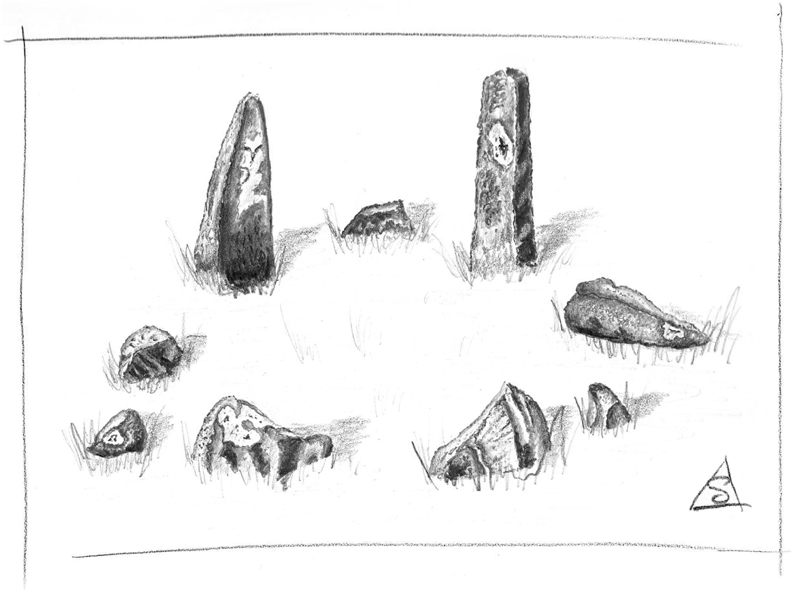
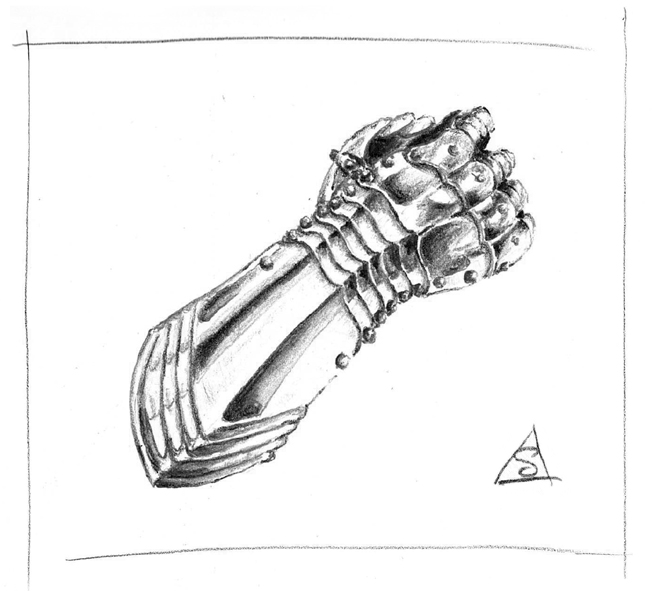
THE CREATURES AND
THEIR ORIGINS
Once again, I have included several dinosaurs within this book (shocker, I know), many of which I discussed briefly in previous notes. Like Carcharodontosaurus saharicus and the famous Spinosaurus aegyptiacus, some of them were also discovered by Ernst Stromer during his time in Egypt. I mentioned one of them in the notes at the back of the last book, another large theropod predator named Bahariasaurus ingens.
The Allied bombing of the Old Academy, Munich, during spring 1944, destroyed Stromer’s finds, along with the type specimen for Bahariasaurus. It is still unclear exactly which theropod family this animal belonged to. However, we can estimate that it grew to perhaps 12m in length and would have been a much lighter animal than Carcharodontosaurus saharicus, perhaps half the weight by similar length, and this fuels the imagination. How fast was it? How did it hunt?
While we wait for the science to catch up on these questions, I’ll look forward to writing more about Bahariasaurus ingens in the next book, CURSED.
The pack of Rugops primus, about to spring their trap on Devon, Aito and Jansen, were also mentioned in my notes for REROUTE; however, I’m not sure Sarcosuchus imperator got the paper and ink it deserved. Of the same family as the giant crocodile featured in some of the earlier books, Sarcosuchus imperator was one of the largest crocodiles known to science. With each jaw measuring at least 2m, it really did have a maw a grown man could walk into – if he’d really had enough!
Deltadromeus agilis was (possibly) yet another huge and terrifying theropod carnivore from North Africa. I add the ‘possibly’ only because some palaeontologists think the remains of this animal may actually have been a smaller Bahariasaurus. It seems entirely likely and believable that animals sharing a time and place might show similarities, even share ancestry, but as diggers are yet to find a head for either, the argument remains unresolved. For myself, Deltadromeus agilis was an irresistible force – an animal possibly the size of Allosaurus, but built more like a raptor – come on!
However, my personal exuberance aside, the hapless Ouranosaurus nigeriensis that crossed paths with Deltadromeus in the story, were understandably less enthusiastic. Ouranosaurus nigeriensis was a hadrosauriform, related to both the famous Iguanodon bernissartensis and the duck-billed dinosaurs. Despite being herbivorous, the row of neural spines along much of the ouranosaurs’ backs and tails created ‘sails’ similar in appearance to those of several of the predatory spinosaur family.
NAMES & ITALICS
Just a couple of editorial notes as I think of them: I stated previously about opting not to italicise the animal names in the main body of the story, hoping to avoid any confusing emphasis. Keeping all the capital letters in check is quite a job, too, as it happens – Tyrannosaurus vs. tyrannosaurs – see what I mean? (At this point, it would be remiss of me not to mention how hard my editor works to keep righting my wrong writing! Thank you.)
While on the subject of wrongs… in chapter 10, Video Nasty, Aito says, “The public records of everyone on this mission aren’t worth a damn.” This is such a common expression that I spelt damn after the original four-letter word. However, it is believed that the derivation actually comes from a small Indian coin called a ‘dam’ – I assume they weren’t worth very much. The phrase was possibly carried back to England by soldiers in the mid-18th century. ‘I don’t give a damn’ was an Americanism first recorded in the 1890s. Correcting this typo in the story made it look like a typo, ironically – so it was just a case of, ahem, damned if you do, damned if you don’t! (Sorry.) Mucking around with words leads us inevitably to Shakespeare.
As with REROUTE, I have once again tried to include a flavour of the Elizabethan era dialects, hopefully without the confusion. In reality, it’s fair to say that they would have been far more impenetrable to most of us moderners, as we would no doubt be to them. Can you imagine what they would make of emojis? Use of such glyphs would surely have been worthy of a burning at the very least! I remember one far-off day in English literature class, when the fourteen-year-old Stephen took his turn in reading Shakespeare to the class, including line numbers and all! I stopped reading when the rest of the class fell about laughing. I was completely baffled by this, until the teacher explained what I’d done. She was familiar with the condition where people walk in their sleep, but reading in one’s sleep was apparently all new to her! Unfortunately, that is all I recall about my introduction to the Bard. I’m sorry to admit that is a true story. I may also have poked a little fun at one of literature’s most important figures here, but most fourteen-year-olds probably feel the same. In any case, his reputation will far outlive my own, so he can get over himself! Here, have a smiley face, Shakey :o)
LEGENDS & LIBERTIES
For anyone interested in the story of Sir William de Soulis, legend has it that he was bound by specially crafted chains and taken off to Ninestane Rig, where he was wrapped in lead and boiled alive by the people under his ‘care’. The reason given for the chains was that his magic was so strong he could neither be bound by ropes nor cut by steel. The history tells it rather differently. As I mentioned in the last book, he was already long dead by Tudor times, but was such a beautifully crafted, semi-real villain, I just couldn’t resist! Anyone who has ever visited Hermitage Castle in the Scottish Borders will understand; such a dark, menacing place simply had to have an evil, black-magic-wielding lord in its past. Fleetingly back to the history, Sir William actually died in the dungeons of Dumbarton Castle.
It seems to have been common policy for the border lords of the time to consider whether their interests were best served by affiliation with the English or the Scots. In AD1320, it is believed that Sir William de Soulis (also spelt de Soules) was party to an English plot to kill Robert the Bruce, the Scots King. The scheme failed and he was rounded up with the other (presumably) guilty parties and taken to Dumbarton Castle where he died but, as far I can tell from the information available, was not executed. Dungeons were, after all, very unhealthy places to be, so this is probably not all that surprising. The legend that has stuck to him seems to come from a cross-pollination between Sir William’s own black reputation (even by medieval standards, he was a seriously bad man) and the sticky end suffered by his ancestor, Sir Ranulf de Soulis (or possibly Randolph), who was murdered by his servants in AD1207. The legend of De Soulis and his familiar, Robin Redcap, fit so perfectly into the Hermitage Castle story that I intend to write about them further, once the New World Series is complete.
I probably should have mentioned this in my notes at the end of the last book: Lord David Maxwell is a fictional character I invented to bring together the New World’s crew and the indigenous Scots. The Maxwell clan was real enough, however, although I believe they were still followers of the Catholic faith at the time when this story was set. They really didn’t get along with the Johnstones. Also around this time, the title of Lord Maxwell changed hands very quickly as several of the incumbents died in rapid succession. By 1558 it was the turn of John, the 8th Lord Maxwell who acceded at the age of two, following the death of his brother Robert at the age of four. Despite this, they were one of the most powerful families in southern Scotland during this time. David Lord Maxwell came to being because I needed a character who would be more radical and at odds with the Queen Regent – Mary of Guise – and of course, De Soulis.
To further foment confusion, there were also several Sir Walter Scotts, perhaps the most famous being the 18th century novelist so well known for Ivanhoe, Rob Roy, etc. The character in this story is loosely based on a young man who ended up being the first of the family elevated to the peerage – the 4th Baron of Buccleuch. The eldest son of Sir William Scott, he was the grandson of Sir Walter Scott, 1st of Branxholme, 3rd of Buccleuch. Our Sir Walter’s father predeceased his grandfather, making him the 4th of Buccleuch at the age of just three. A fighter from his childhood onwards, he grew up among the Border feuds and despite his youth played a prominent role in 16th century Scotland’s turbulent politics. In 1558 he was thirteen.
The Sir John Johnstone in this story was a largely fictional character, although there was a real John Johnstone alive at the time who would have been in his mid to late teens. However, that man was not knighted until 1584. Sadly, many of the Johnstone family records were destroyed in the burning of Lochwood Tower – courtesy of the Maxwells and the Armstrongs. When my fictional historian, Thomas Beckett, told the crew that the Scottish Borders of the 16th century were as dangerous as anywhere in the world at that time, he was probably correct.
HISTORICAL FIGURES
Elizabeth I needs little introduction the world over, I’m sure. In reality, she awaited the news of her sister Mary’s death at Hatfield House, roughly ten miles north of what is now known as Central London, on the 17th November 1558. Sir Nicholas Throckmorton did bring the news along with Mary’s ring. History took a left turn with the arrival of the USS New World, leaving me with two stories I wish to tie up outside the New World heptalogy. My intention is to include both in the coming title, REBIRTH, but we’ll see how the story develops – they may need a book each. Either way, I look forward to telling the story of how the infamous Geoff Lloyd inveigles his way into Elizabeth R’s inner circle – accidentally taking on the name of a famous adviser and turning the forever intriguing Tudor court upside down in the process.
Martin Bormann was head of Adolf Hitler’s Nazi Party Chancellery. He wielded immense power as private secretary to the Führer, not least by controlling the flow of information and access to Hitler himself. It is believed he fled the bunker after Hitler’s suicide, himself committing suicide soon after – possibly a preferable fate to being captured by the Russians. He was condemned to hang posthumously after the Nuremberg trials.
Fritz Todt was a construction engineer and senior Nazi Party member who directed the construction of the German autobahns and later became the Reich Minister for Armaments and Ammunition. From that position, he directed the entire German wartime military economy. Earlier in the war he was a general in the Luftwaffe, having earned an Iron Cross in the Luftstreitkräfte during the First World War. He died in a plane crash in 1942, possibly on Hitler’s orders, after trying to talk the Führer out of continuing the war with Russia.
The party members in this story are a softer bunch (possibly) because of Douglas’ meddling with historical events during the 16th century. Without the terror and destruction of the First and Second World Wars, what might such men have become? Would they still have tended towards evil? I have tried to portray them as men who had the potential to go either way, though of course, for Heidi Schultz that would never do.
I hope you enjoyed this episode of the New World Series. It was always my intention for dinosaurs to provide the main set dressing and a continuous theme for this series, but with books 4 and 5 providing an interval, and taking the USS New World on a different course through time, in order to change the future.
Now that stage is set, I look forward to taking you on the next leg of our heroes’ travels in book 6, CURSED, where poor Tim Norris seems to be having another roarfully bad time, as he finds himself with it all to do over again…
Thank you so very much for reading,
Stephen
cuRsed
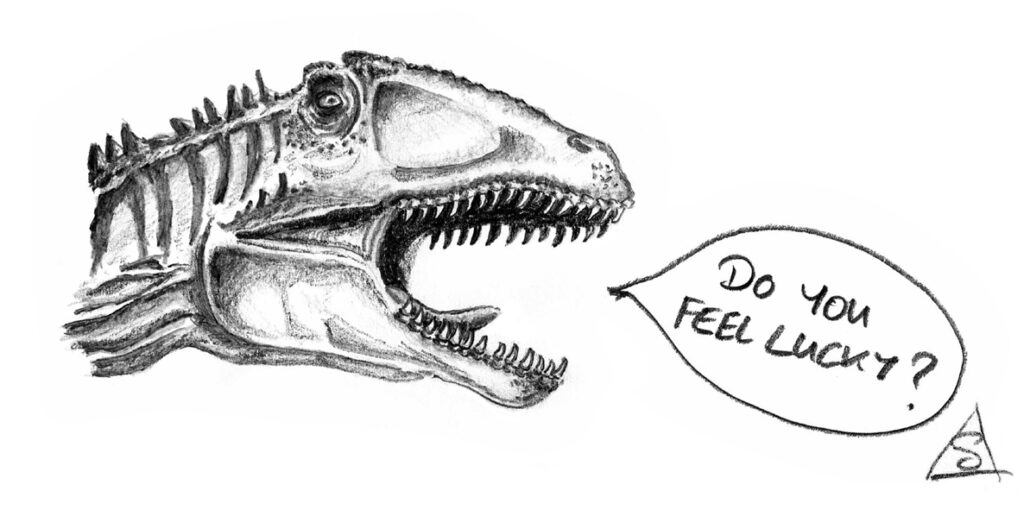
DISCOVERIES IN EGYPT
Carcharodontosaurus saharicus, suffice to say, was another of the large theropod carnivores discovered by Ernst Stromer during his remarkable Egyptian excavations of 1911-14. Just to give a basic mind’s eye picture, it was broadly shaped and sized comparably to Tyrannosaurus rex, although not directly related. T rex joined the fossil record more than thirty million years later and was, overall, a stronger, more advanced and dangerous animal.
Rugops primus – it is perhaps worthy of note that no actual evidence exists to prove that they were social or moved about in packs – at least, not at the time of publishing. As Rugops was comparatively weak in the jaw, I took a liberty and made them hunt, or scavenge, in numbers. From a fictional storytelling perspective, I think this makes them a scarier proposition, too. If they really did go about in groups a dozen strong, they would have been a right handful!
Spinosaurus aegyptiacus, a dinosaur that probably requires little introduction these days. Apologies if it seemed like ‘icon mashing’, but I just couldn’t resist draping one across a pyramid – two ancient fascinations for the price of one, with a later nod to Agatha Christie’s Death on the Nile, for good measure!
TITANOSAURS
Paralititan stromeri were large sauropod dinosaurs – sauropods were the long neck, long tail varieties. They were titanosaurs related to Argentinosaurus, and others, from earlier books in the series. They were probably a little smaller than Argentinosaurus, but still huge. Only fragmentary evidence exists for this once extraordinary species, so estimates vary wildly between 20-60 tons in weight and 20-32 metres in length. Hopefully a more complete specimen will be found in the future to fill in the gaps. Dispersed over several continents, the titanosaurs presumably shared common ancestors from before the breakup of Pangaea into the continents we recognise today. A process that began back in the Triassic Period, a hundred million years or more before the Cretaceous setting for this story. Again, as the name suggests, they were discovered and named by Ernst Stromer. He must have won the dino-lottery during those brief years of the early 20th century. Sadly, the majority of his finds, including the most complete remains yet discovered of the mighty Spinosaurus aegyptiacus, were destroyed in the Allied bombing of 1944. As the song says, ‘War – what is it good for? Absolutely nothing!’ Well, at least it stopped Hitler, eventually. Pity it didn’t end there.
Afromimus tenerensis, small and ostrich-like, this little creature was an ideal choice for a dinosaur-mimicking robot spy. Extremely fast and a relative minnow in the age of giants, it would have been easy to overlook. Afromimus was an earlier North African relative of the more famous Ornithomimus velox. They must have been graceful, bird-like creatures, as implied by the name.
Ouranosaurus nigeriensis I also mentioned in a previous book. However, aside from being an ancestor to the hugely successful duck-billed dinosaurs, who mainly came later, I find these creatures interesting in that they share such a similar (at least, superficially) sail on their backs with Spinosaurus. Ouranosaurus was herbivorous. (As you will no doubt have gleaned from this book, Spinosaurus wasn’t!) That both had a similar body plan and were from the same area raises the question of perhaps another common ancestor. Perhaps divergence came as a necessity of lifestyle – although Spinosaurus aegyptiacus was far larger and a whole lot meaner! The dorsal sail has long been pondered by experts, some believing it functioned as a thermoregulator for heating or cooling the blood – dogs use a similar process, instead passing blood through the pads in their paws to cool themselves down. (Quite often, the little darlings get too excited to drink cool water, even when they should, so cooling their paws on a cold surface or in a stream is a good idea if they’re overheating. Health and Safety Notice: DO NOT TRY THIS WITH A SPINOSAURUS!) Other scientists have suggested that such a skeletal construct may have supported a hump of muscle or fat rather than a sail, and like a camel, it might have been used for energy or fluid storage in times of scarcity or drought. There’s still just so much to learn about dinosaurs. We’ve barely scratched the surface, and I think that’s a large part of the fascination for so many of us – once you recover from how vast and dangerous some of the dinosauria were.
Sarcosuchus imperator. Again, closely related and contemporaneous with South America’s Sarcosuchus hartti from earlier books in the series, suggesting common ancestry. These giant crocodiles were easily large enough to dispatch an unsuspecting carnivorous Rugops, or herbivorous Ouranosaurus. Each prey animal growing to roughly seven metres long, the deadly Sarcosuchus would have possibly preyed on both – quite probably when they needed to drink, as crocodiles do today. Imagine, if you will, Sarcosuchus imperator hiding just below the surface, or maybe looking like a log floating downstream. Well over twice the length and many times the size of even the largest modern-day saltwater crocodile (Crocodylus porosus), they would have guaranteed that no one ever wasted time on idle chatter around the water cooler in Cretaceous Africa! It’s believed that the comparatively slender nature of the Sarcosuchus jaw would have made it impossible to ‘death roll’ its prey, as modern crocodiles do. Rather, the jaw structure leads palaeontologists to believe that Sarcosuchus hunted large prey, such as dinosaurs, killing with brute force rather than shaking them apart, like their modern descendants.
HISTORIC EVENTS AND
LOCATIONS
Geek alert: Name change from São Paulo to New World – São Paulo was the original name for the second Defiant, in Star Trek: Deep Space Nine – my homage (Starfleet’s famous engineer, Chief Miles O’Brien, hated the new carpets, too).
On the subject of ships, the 800-ton Spanish galleon, San Juan de Sicilia, really did explode and sink on November 5th, AD1588. (It’s unrelated, but perhaps ironic, that we celebrate Guy Fawkes Night [Bonfire Night] on November 5th in Britain, to commemorate the Gunpowder Plot of 1605, which didn’t actually go off!) The late 16th century, and especially 1588, was marked by turbulent North Atlantic storms. They’re believed to have been an effect associated with a period that has become known as the ‘Little Ice Age’. Despite the purposes of the Armada, far more sailors were killed by the weather than enemy action. Near the end of September 1588, the San Juan de Sicilia anchored off the west coast of Scotland, near the Isle of Mull, in Tobermory Bay. Though she was as yet undamaged, her crew were short of water and supplies. Her senior officer, Diego Tellez Enríquez, made a deal with a local Scottish lord, Lachlan MacLean of Duart. MacLean would provide the supplies the San Juan de Sicilia badly needed and Enríquez would provide armed men to help settle MacLean’s feuds with his neighbours. Enríquez was no fool – unwilling to trust a man who attacks his neighbours, he insisted on hostages to guarantee the Scottish lord’s good faith. The San Juan de Sicilia remained in Tobermory Bay for a little over a month, during which time Enríquez’s Spanish troops attacked and ravaged the islands of Rùm, Eigg, Canna and Muck, going on to lay siege to Mingary Castle on the mainland. At some point during this period, it was discovered, or assumed, that one of the merchants charged with the reprovisioning, John Smollet, was actually in the pay of Sir Francis Walsingham – Elizabeth I’s ‘spymaster’. The San Juan de Sicilia never actually set back to sea, for on November 5th she exploded while still at anchor, killing almost everyone aboard, including the hostages. The fifty or so survivors continued in service to MacLean until he finally had them shipped back to Spain a year later. Details of the ship’s destruction are sketchy, its actual reason, unknown – though the wreck still intrigues marine archaeologists to this day.
The Old Academy, Munich was destroyed by Allied bombing, as mentioned above. It was actually destroyed in the April of 1944, rather than the June explosion described in this story – it would have been nice to tie in exactly, but it just didn’t quite work with the timeline for the rest of the story.
The Nazis did indeed invade the Netherlands on May 10th, 1940, despite the Netherlands being neutral at the time. The occupation began comparatively softly, with trade deals from the hand wearing the velvet glove, but deteriorated throughout the war to a point where the population were starving by 1945. 70% of the Netherlands’ Jews were killed during the Second World War. Active resistance, which began with just a handful of fighters, grew throughout the occupation – perhaps unsurprisingly. From this came the idea for my ‘Order of the Silver Cross’ Nazi hunters, to honour the courage of those concerned. The Order in my books was not real, just a device I used to tie various characters to an overall thread throughout the story, but there certainly were real heroic groups who fought with whatever they had, to free their people from tyranny.
Reinhard Heydrich was one of the principal architects of the Holocaust. As previously discussed, he was a monster, arguably the worst of Hitler’s entire regime. Mortally wounded in Prague on May 27th, 1942, he was ambushed by Czech and Slovak soldiers sent by the Czechoslovakian government-in-exile, whose troops were trained by the British Special Operations Executive. Heydrich died from his injuries a week later, but the Nazi response, wreaked erroneously on villages thought to be linked to the attack, and a wider resistance, was terrible. Indeed, Heydrich probably deserves more ‘infamy’ than he actually receives. Hitler, looking for a pretext to invade Poland in 1939, tasked Heydrich, Himmler and Heinrich Müller with designing a false flag operation. The dastardly scheme they cooked up involved a fake attack on a German radio station at Gleiwitz on August 31st, 1939. Wearing Polish uniforms, 150 German troops carried out several attacks along the border with Poland. Heydrich masterminded the plan, giving Hitler his excuse to invade Poland and the rest, as they say, is history – although you might be forgiven for thinking it sounds familiar.
Josef Mengele is a name most will already be familiar with, I’m sure. He is also remembered under the quaint moniker of the ‘Angel of Death’ – more than just a Slayer song. His penchant for carrying out genetic experimentation on twins was revealed in a recent documentary that followed the life of a Holocaust survivor. He would use one for his sick experiments until that twin died – and these were often children – whereupon he would murder the other twin to compare their anatomies as part of his ‘research’.
Briefly following on from that, it’s so difficult to imagine such atrocities and yet… with war crimes practically accompanying our TV dinners right now, almost a century later, the original plot I had noted for this part of the story arc fast became unpleasant to write. It was just too ‘close’, as I mentioned in the preface at the beginning of this book.
That said, some people simply found themselves on the ‘wrong side’ because of where they were born. During the Second World War, Erich Alfred Hartmann, or ‘Bubi’ (roughly translated, ‘The Kid’), was a German pilot and the most successful fighter ace to date. History remembers him as a skilled pilot and an honourable serviceman, unlike the Nazis shamed above. A master of stalk-and-ambush tactics, he honed the technique of ambushing and firing at close range, rather than dogfighting. “Fly with your head, not with your muscles,” was the famous advice he passed on to new recruits, after a rude awakening which would have gotten him killed had he not been confined to barracks. During his time with the Luftwaffe, he flew 1,404 combat missions and engaged the Allies in aerial combat 825 times. He was credited with 352 kills: 345 Soviet and 7 American. Hartmann survived 16 crash landings, the causes being mechanical in nature, or damage due to impacts with flying debris from aircraft he himself had shot down. He was never brought down by direct enemy action. He was highly decorated and by 25th August, 1944, Hartmann had earned the coveted Knight’s Cross of the Iron Cross with Oak Leaves, Swords and Diamonds for 301 aerial victories – at that time, Germany’s highest military decoration. As discussed within this story, he was tried by Russia for war crimes against civilian targets, which he denied all his life. He seems to have been convicted for the costs to Russia in ‘expensive’ aircraft and for what must have been quite a dent to Russian pride – after all, he had shot down a lot of their planes. Apparently, the judge at his trial said his attempts to defend himself were “a waste of time.” He was initially sentenced to 20 years’ imprisonment, later increased to 25. He actually served 10 of those years, in various Soviet prisons and Gulags until his release in 1955. In 1997, the Russian Federation exonerated him of all charges during the democratic Yeltsin years. Sadly, this was a posthumous admission as Hartmann died in 1993. Of all his accomplishments, he was most proud of the fact that he never lost a wingman – although, technically, he did lose Major Günther Capito in 1943, who nevertheless lived on to fly again, until the end of the war. Now Erich Hartmann is cut off from his native 1944 Germany and ensconced aboard the New World, it will be interesting to see where he ‘flies’ next.
Thank you so very much for reading,
Stephen
coLlisIon
Firstly, Geoff Lloyd used the phrase ‘deaf as Drake’s gunner’, my respectful homage to the late, great Richard Carpenter, who wrote some of my favourite shows from the 70s and 80s. It’s remarkable how some things can influence and stick with you. I actually wrote that line thinking it was my own but something about it gnawed at me and then I realised where I’d heard it before. I could have changed it, of course, but I thought I’d explain it in my notes instead, so that anyone reading this might look into some of Carpenter’s work for themselves and maybe enjoy it as much as I did.
Secondly, I heartily recommend When Life Nearly Died by Michael J. Benton – a wonderful history of palaeontology from the 18th century onwards, which also seeks to establish the reasons for the end-of-Permian-Era extinction, 252 million years ago, and the greatest mass extinction of the Phanerozoic Eon of complex life on Earth (the last 542 million years, give or take a day or two). An excellent read for all those interested in the story of life (and death) on Earth. The Permian–Triassic boundary extinction probably took place over a protracted period, possibly even as long as 200,000 years. I had almost exactly 199,999.4 years less than that to write this book, so I hope readers will forgive any omissions or contractions on my part.
My last shout out, rather immodestly, is to my own Medieval Northumbria series. Inside Book 1, The Apothecaries (mentioned within my preface), you can read the other side of Heidi’s and Reid’s encounter with Harry-the-Cough and Matty in the darkened, wintry woods of medieval England. If you enjoy British comedy and/or historic fiction/fantasy, please give it a try. There will be at least two more books in that series to follow.
RIGHT! THE DINOSAURS
This being the final instalment, I just had to bring back my favourites from the series – the active, sometimes nurturing, often vicious, always fascinating terrors of the mid-Cretaceous, Mapusaurus roseae, Carcharodontosaurus saharicus, Tyrannotitan chubutensis (Matilda), Spinosaurus aegyptiacus, Oxalaia quilombensis, and the petite nightmares, Buitreraptor gonzalezorum. I’ve explained a little about these magnificent creatures within the author’s notes sections of earlier books and hope their deadly reprises got the blood pumping for you again. Each became characters in their own right throughout the series, so there was little room to introduce new animals at this stage (although, for any dinosaur enthusiasts out there, my upcoming NEWFOUNDLAND will be full of similar creatures as well as many new ones). Obviously, in an action series we often imagine such animals at their very worst to work the plot, but I believe the important word there is ‘animals’ – not ‘monsters’. So often dinosaurs are portrayed that way. Some may have behaved in ways that would terrify us, almost certainly, but they were no more monsters than a tiger, or a cow for that matter, both of whom also have the capacity to dispatch a man easily – and do. I try to write opposing philosophies in my characters to reflect humanity, and hopefully to avoid tiresome single agendas, but it’s probably no secret that I’ve a deep respect for animals – may even have written about a few! I believe we can learn much from their behaviour, and if I occasionally anthropomorphise them, here and there, to aid the narrative or work out a piece of comedy, my aim has always been to show them simply doing their best to survive good days and bad, just like the rest of us.
Talking of animals, sometimes, when I offer one of my own furry friends a little treat or reward for being good, I often suspect they understand full well that by sharing such moments they’re rewarding me, too – also for being good, in their eyes. It’s so often true that it’s better to give than to receive, and we humans do like to feel important! They occasionally drive me up the wall, too, but the only time any have ever hurt me is when I’ve lost them, and those are scars I’ll never forget. They remind me what a damned good job they did, every day of their lives, making my life better. I’d hate to live in a world without animals.
Not that I’d want to be a dino-snack! Again, it’s a matter of respect, and returning to dinosaurs, I did manage to cameo Rebbachisaurus garasbae this time. Barrel-bodied, Rebbachisaurus was a diplodocid – twenty metres and twenty tons of long-necked, long-tailed sauropod majesty, related to the even longer but lighter, and far more famous Diplodocus longus (any who have visited the Natural History Museum in London may be familiar with ‘Dippy’, the full-sized reproduction of the late-Jurassic herbivore who lived fifty million years before Rebbachisaurus). Rebbachisaurus were specifically differentiated by unusually tall dorsal vertebrae along their high backs, giving them pronounced ridges that set them apart from most other sauropods, and even from other diplodocidae cousins. The idea of Rebbachisaurus and the relatively tiny, three-ton Ouranosaurus nigeriensis joining forces to survive the nuclear wasteland was sweet, if sad. For all my fellow animal-lovers out there, fear not! Both made it safely back to their herds in the north, after Heidi and Captain Bessel rudely broke into the narrative and whisked us away to 1940s Germany, taking the granddaddy of all carcharodontosauridae with them!
NOT A DINOSAUR!
The other animal I introduced to this story was an outlier, living many millions of years before the mid-Cretaceous and even the dinosaurs themselves in the late Permian Period, 259-252 million years ago. Inostrancevia latifrons was the largest gorgonopsian to live in Laurasia (the northern half of the supercontinent, Pangaea). They must have been truly frightening predators. Larger than Bengal tigers, with massive heads and wickedly large sabre-teeth in their powerful jaws, Inostrancevia, and gorgonopsians generally, were part of the synapsid clade, a major group of the tetrapods that include mammals. Consequently, they were far more mammal-like than the later dinosaurs, and are believed to be part of our own very distant mammalian ancestry. Whether they did indeed have any fur is as yet unclear, but to give an idea of what it would be like to meet one, I suggest watching the very first episode of the British TV show, Primeval, with Douglas Henshall (2007). The writers called the creature Gorgonopsid, but it’s essentially the same beast. You really wouldn’t want to bump into one while taking a stroll one day!
That’s almost it for the animals – just my last old favourite to mention: Sigilmassasaurus brevicollis the spinosaur, and terror of Crater Lake. I had the idea of a throughline between that bad-tempered beastie in Cretaceous Britain and Nessie, several books ago. The idea of an animal surviving untold millions of years in a Scottish loch, a mere 10,000 years old (created by the last ice age) is, of course, perfectly ridiculous – and you could argue that my idea about a time-travelling interloper, laying eggs and raising her progeny to survive a couple of thousand years, isn’t much better, but I couldn’t resist! (NB: I’m not currently sponsored by VisitScotland, but remain open to a retrospective bribe). Naturally, if someone produces convincing new evidence proving the existence of the Loch Ness Monster after this book goes to press, I reserve the right to retract my ‘perfectly ridiculous’ comment and take on an air of smugness, while pretending that I knew all along – please arrange interviews through my publisher and agent; I have history in making up stories 🙂
BRITAIN IN THE TUDOR AGE…
There’s so much back and forth in this book, that I thought I’d try to go through the notes semi-chronologically where possible, and so, moving forward (a long way) to England’s Tudor period, we meet some interesting new characters beginning with the Cout of Kielder…
The heath-bell blows where Keeldar flows,
By Tyne the primrose pale;
But now we ride on the Scottish side,
To hunt in Liddesdale.
Gin you will ride on the Scottish side,
Sore must thy Margaret mourn;
For Soulis abhorr’d is Lydall’s lord,
And I fear you’ll ne’er return.
(excerpt from The Cout of Keeldar, by John Leyden)
That cheery little snippet just about sums up the fate of Sir William de Soulis’ enemies, of whom the Cout o’ Kielder was reckoned one of the greatest of many (as the legend goes). A giant Englishman and Tynedale baron, who allegedly died in the early years of the 14th century – possibly late 13th. As mentioned in previous author’s notes, I brought De Soulis forward to the middle 16th century so that I could include such an authentically historic supervillain within my tale of Hermitage Castle and the Borders (I write a little more about De Soulis and Geoff Lloyd, and their Yuletide antics, in GHOST – part of my New World Extra series).
Information about the cout is sketchy and often contradictory, but it seems he was lauded as a brave young hero type, much admired for his physical size and prowess. While out with a group of friends on a hunt, and who knows what sort of larks, he ignored the local legend about tempting fate when riding anticlockwise, or widdershins, around the Kielder stone (probably the medieval equivalent of reading from the book of the dead in a basement, or repeatedly saying Beetlejuice).
Protected by magic armour (stay with me) he did indeed tempt fate. The rest is history, or more probably, legend. The friends were caught trespassing by De Soulis and invited to Hermitage Castle. Despite De Soulis treating the nobles respectfully, offering them Border hospitality, they began to suspect that he actually intended murder – that seemed to be just how he rolled. Strong and powerful, the cout fought off De Soulis and escaped with his comrades on horseback. De Soulis must have found that irritating, because he and his men pursued them immediately. Enter our friend Robin Redcap. De Soulis’ tame demon helpfully explained that the Cout’s magic armour would not in fact protect him in running water. Doubtless this was sage advice; after all, very few swimmers favour doing the breaststroke in mail! While trying to cross Hermitage Water – the river that ran through Liddesdale and alongside Hermitage Castle itself, and still does to this day – the cout stumbled and fell into a place where the river pooled (a place now known as Drowning Pool). Unable to climb out, the cout was held down by De Soulis’ men with their ‘lang spears’ until he drowned. There’s a grave just outside the small chapel a short walk from Hermitage Castle, marked The Cout o’ Kielder (spelt Keilder on the marker). Against that backdrop, I hope Douglas’ burial of a Mapusaurus thigh bone so that it could be found two millennia later sounds almost plausible. However, modern cynicism aside, these Border tales are a wonderful part of British history and legend, and are not so different from the historic/horror/fantasy fiction we write and consume today. I love them.
FUNNY? WEIRD? IRONIC? IT’S ALL JUST HISTORY!
Moving on, I briefly introduced a chap named Captain Fear-God Barebone into this story (we’ll hear more of him in REBIRTH – or a longhand title might be Geoff Lloyd Saves the World – coming soon). My character is not to be confused with the real ‘Fear-God Barebone’, a minor 17th century poet and brother to Anabaptist** preacher ‘Praise-God Barebone’, who became a London councillor and member of Oliver Cromwell’s Appointed Assembly – a body that became known as Barebone’s Parliament (probably ironically) – almost a century later, after the civil war. He was imprisoned after the Restoration (the return of Charles II), but was later released to live into old age. The only connection between my character and the man is his name – and what a name. It almost paints a thousand pictures! Ideal for the type of chap I had in mind. The reason I mention this curiosity in my notes is because the Barebone family penchant for uniquely descriptive names didn’t stop with Fear-God. His brother, Praise-God Barebone, had at least two children. Are you ready for these? Jesus-Christ-Came-Into-The-World-To-Save Barebone and If-Christ-Had-Not-Died-for-Thee-Thou-Hadst-Been-Damned Barebone – I kid you not. Unfortunately, the latter became known simply as ‘Damned Barebone’. For some reason, he wasn’t fond of that moniker, and went by Nicholas instead – parents, honestly! Still, he must have taken the fear of hellfire seriously enough, because he went on to found London’s first fire insurance company and fire brigade. Having read about these men, I simply had to have a Barebone for my story. Isn’t history wild and wonderful?
**In the broadest of strokes, Anabaptists believe that baptism by water should take place when one is old enough to choose one’s faith. Even when baptised as an infant, they are re-baptised upon reaching an age of maturity, if not actually majority. In Reformation England, such beliefs could be dangerous, dependent on the prevailing orthodoxy of the time and who happened to be on the throne. Most notably, during the Reformation of the 16th century, common folk were encouraged to read the word of God for themselves. Up until then, literacy had been mostly an elite privilege; even many churchmen were illiterate. Whatever anyone’s views about religion, it’s hard to overstate the importance of being encouraged to read – a truly pivotal moment in human history sadly, and yet thankfully, so often taken for granted today.
FUTURE TECHNOLOGY,
OR SOMETHING ELSE?
While on the subject of wild and wonderful, this book alludes to a hearing with Congress on the subject of UFOs – or UAPs, as they’re often termed (unidentified anomalous phenomena) – and the existence of alien technologies that may be in the possession of the US military at Area 53 (I went with Area 51 because it’s more widely known and so required no explanation). Once again, I feel the need to repeat: I kid you not. What I found astonishing, possibly even more so than the discussion itself, was how little the world seemed to care. Have things really become so bizarre over the last few years that real-life aliens are now humdrum? I have no answer to that, but here is a transcript from the news channel that broadcasted it live on the 26th July, 2023.
The U.S. House Committee on Oversight and Accountability heard explosive testimony Wednesday, not only about the mysterious craft that was beyond any known technological capabilities but also eyewitness accounts by former US military personnel.
The hearing entitled ‘Unidentified Anomalous Phenomena: Implications on National Security, Public Safety, and Government Transparency’ heard from: Ryan Graves, Executive Director of Americans for Safe Aerospace; Commander David Fravor (Ret.), Former Commanding Officer United States Navy; and David Grusch, Former National Reconnaissance Officer Representative, Unidentified Anomalous Phenomena Task Force, Department of Defense.
Grusch testified that both he and his wife witnessed ‘non-human**’ entities doing harm to humans that he described as ‘very disturbing’.
Graves testified that he had a pilot tell him he almost hit a UAP during take-off: ‘One of these objects was completely stationary… It was right where all the jets were going on the eastern seaboard. The two aircraft flew within 50 feet of the object.’
Upon talking to the pilot after he landed, Graves said he found him with his ‘mouth open’ and that the pilot told him that ‘he almost hit one of those darn things’. Graves said the pilot described the object as a ‘dark cube inside of a clear sphere’.
Source: Global News
Is any of that real? Or true? Can it be true? Is it a hoax? Who knows? It all sounds rather surreal, and that’s putting it mildly. Whether ‘the truth is out there’ remains uncertain, but the full hearing is out there on the Internet – you decide.
** I assume they didn’t mean animals.
VOLCANISM
Finally, I come to something a little more tangible – volcanoes. The events here straddle some of the time periods described above, so I thought I’d just tag it on the end. Apologies if the chronology makes anyone twitch. The enormous volcanic event during the Oligocene Epoch of the Palaeogene Period, roughly thirty million years ago, really did happen and really did spew billions of tons of magnetite up from the mantle to create the strongly magnetic Bermuda Triangle – so we can hang on to that. Although, as I type the name ‘Bermuda Triangle’ after discussing UFOs, I feel like I’m disappearing down an entirely different but strangely similar rabbit hole! (Author’s Notes is where I usually attempt to tie the story to real facts and events and discuss any deviances; however, on this occasion, I think reality may have upstaged my fiction.) I’ll try again. The Permian–Triassic extinction, 252 million years ago, definitely happened. Almost everything on Earth died, therefore please note: creating a link between that event and the Oligocene eruption, the way Hiro Nassaki did, would probably not be a good thing… so with that, I’ll end by saying ‘don’t try any of this at home’ and most importantly of all, thank you so much for reading the New World series. It’s been a wonderful journey for me as an author and I hope you’ve enjoyed it.
Until the next time…
Thank you so very much for reading,
Stephen
Rookstone
Readers of my stories will have spotted that I love castles and ancient places, I’m sure, but Chillingham will always be one of my favourites. Stuffed with memorabilia from all over the world, there’s always something you didn’t notice the last time you visited, but my personal fascination is with the castle itself. So many of its rooms feel like its ancient owners have just popped out for something and might return at any minute. Perhaps I’m being fanciful, but it’s almost as though they’re still there, in the air.
Its place in British border history cannot be doubted, but Chillingham is also a favourite haunt for ghost hunters, no pun intended, and people interested in the supernatural. Most Haunted visited there on their first investigation (after the pilot episode). That was also the first time I saw Chillingham, and I just had to visit. In this story, Stan the cameraman’s idea to ditch Brandon Porkpie and move into paranormal investigations, while fictitious, is my little homage to Karl Beattie and the Most Haunted team who brought ghost hunting to the mainstream. Regardless of any controversy, I thought they were great shows and perfect Halloween fare. You have to love anyone willing to terrify themselves witless, while you sit in a comfy chair in front of the television with the lights low, eating pizza.Obviously, this story is a work of fiction, and all the characters within it are also purely fictitious, but I did borrow some of the history from Chillingham Castle’s long heritage to flesh out the plot – dates of construction, crenellation, etc. Needless to say, my Greys of Rookstone bear no factual resemblance to Chillingham’s residents, other than by name. Although Chillingham does have spiral stairs, as I described in the story, some of the towers’ main staircases are in straight flights with a quarter-turn at each corner. They’re beautifully constructed and impressive. I made them all spirals in the story to reduce confusion with the already complex layout of the castle. The south tower may actually be the oldest – and possibly most haunted – the one named for Edward I. Again, I changed the oldest part of the castle to the north tower within my story to better fit the plot, and to give Gary’s accommodation a spookier history. Although the existing castle has a decidedly square stance on the ground, it was built on a more or less north-north-westerly heading, giving it a rhomboid layout when viewed on a map. The west tower, where Sir Henry lives in my story, was converted to holiday suites some years ago by the current owner, Sir Humphry Wakefield. I once stayed there myself during the Christmas period, in the early 00s – a proper winter wonderland under its blanket of snow! The castle only became the four-tower construction we now see, many decades after Edward I’s visit, under the reign of his grandson, Edward III. The decorative mullioned window I mentioned in the story is real and was installed specifically for Edward’s visit, and is to this day an oddity in that austere elevation (to my eyes, at least) – the other windows on that side being a later addition when the castle became a grand home. Despite being the King of England, Edward, like many of the aristocracy, spoke mostly Norman French, though he could speak and read English and Latin, too. Inga’s reaction to hearing it spoken aloud would probably have been natural to anyone walking the Earth during the Harrying of the North, AD1069-70 (even in spirit). That awful event in English history, and what the Normans did to the Saxon people, from York up to Durham, would almost certainly be considered genocide now, as Gary noted. However, back then, it was simply how war was done – although a particularly vicious and egregious example, even by the standards of the day. The risings in the north threatened William I (the Conqueror)’s grip on England, possibly even threatening to reverse his conquest, so there was almost certainly an element of vengeance driving his actions, over and above his desire to quell the insurrection.Spinning forward to Edward I’s reign again (1272-1307), I also borrowed the reprehensible torturer, John Sage, from Chillingham’s lengthy and fascinating story. It’s quite difficult to find detailed history about the real John Sage, (soap box alert) but I believe it’s important to remember that such monsters existed and continue to exist to this day. Many physical descriptions of the locations within the story are also based around the castle and grounds. Chillingham is a truly beautiful and intriguing place. I hope my attempts to describe it will inspire readers to visit.
The second worst man in my story was Scott – of no surname. I hope my Scottish friends will forgive me here, but after writing for years about the heroic exploits of Captain James Douglas from Hawick in my New World series, it was time for balance :o)
Most of the measurements used in this book are imperial and this was deliberate. Feet and inches have always been used widely in the British construction industry and only very recently have they begun to fade out with the latest generation of builders. I grew up with metric but the generation before me used imperial, so knowledge of both was essential. Personally, I found metric better for critical accuracy, but in most instances imperial measurement was easier for construction. For example, you could ask for a piece of timber stud to be cut to 2133mm or you could simply request 84”, so imperial died hard, regardless of legislation on the sales of materials. I mention this because some readers will rightly note that Britain was metric by 1994. However, I wanted this story to better reflect the time, when the older men would have used, almost exclusively, good old imperial feet and inches.
I set the story in the ’90s purely for the sentimental value; after all, what’s wrong with a little nostalgia? To many of us, we look back to the ’80s and ’90s as a golden age now, when things were taken so much less seriously – and arguably for granted. Certainly, no one was above being mocked. I’ve heard those times described as the apex of western civilisation and culture (though others hold that the apex was actually a century earlier). Whatever your views, it could be argued that we enjoyed optimum levels of freedom, but still largely within a framework of respect, and with just enough tech and cool stuff to be interesting, but not so much that it enslaved or stifled us, as some feel that it does today. Although I hope anyone might enjoy these stories for their entertainment value alone, my upcoming FOR KEEPS series is dedicated to any who remember those times fondly. To help further foster memories of that time, I chose chapter titles that were corruptions of songs from popular culture between 1980 and 1994 – recent history when the book was set. Obviously, there was an exhaustive list to choose from and some were more famous than others, but I simply chose titles for no other reason than they fitted with each chapter’s theme. You may have guessed a few of them, but here’s a list for anyone who’s interested:
1 | Smells Like Mean Spirits – a fairly obvious take on Nirvana’s 1991 hit, Smells Like Teen Spirit. This story was set in late spring of 1994, just after Kurt Cobain’s passing.
2 | Sweet Dreams (Aren’t Made of This) – again, an obvious one. The 1983 Eurythmics hit, Sweet Dreams (Are Made of This).
3 | Dead of the Night – less obvious, perhaps, and deliberately so. Given the theme and the location of the story, it would have been all too predictable to go with Thin Lizzy’s The Boys Are Back in Town, so I went with another Newcastle band instead, and with Venom’s 1985 single, Dead of the Night. It fitted the scary goings-on in that part of the story far better.
4 | Boredinary World – my title is a damning indictment on the humdrum day-to-day of working life, perhaps, and a play on Duran Duran’s 1992 classic, Ordinary World. It’s always difficult to write about the ordinary, though often important, tasks we all undertake each day and make them interesting. I try to throw in a few of those ‘ordinary world’ touches, here and there, to make the characters feel real. Whenever I visit an ancient building or monument, I always place a hand to an ordinary block of stone, or piece of timber. Once a builder myself, I know that the man who laid them was unlikely to be thinking about all the visitors that would admire his work over many centuries to come – he was more likely thinking ‘Is it time for dinner yet?’ I love that connection to a real person, so long ago.
5 | Hollow Man – Entombed’s 1993 classic. I kept the original title, Hollow Man, as its meaning – someone with no morals or values – fitted well with the apparent treachery taking place in the chapter and Richard’s introspective feelings of guilt.
6 | From Out of Nowhere – Faith No More’s first single from their 1989 The Real Thing album. Again, I kept the original title, From Out of Nowhere, because it fitted exactly with the catastrophe about to strike Gary Stone’s life.
7 | Cashes to Ashes – a corruption of David Bowie’s 1980 number one single, Ashes to Ashes. I’m sure you guessed that one, but Hammer certainly didn’t see what was coming when he opened the bag to find fake emeralds!
8 | What’s Up – the 1993 hit single by 4 Non Blondes. Again, I kept the original title, What’s Up. Considering Worzel’s run-in with a wild bull during that chapter, and what followed, it would have been rude not to.
9 | 999 Emergency! – based on Motörhead’s 1980 belter, Emergency. 999 is the British number for the emergency services, equivalent to America’s 911. I was quite pleased it landed on chapter 9, too. God bless Lemmy!
10 | Under Siege (Regnum Trullae) – based on Sepultura’s 1991 single, Under Siege (Regnum Irae), meaning Under Siege (Kingdom of Wrath). My version means Under Siege (Kingdom of the Shovel) – or possibly the trowel; translations vary, but I think both work. I felt very smug about that one.
11 | When Will I Be Famous? – the 1987 hit from Bros. When Will I Be Famous? seemed the perfect chapter title to herald the arrival of Brandon Porkpie, of Whopper TV, to chronicle Gary Stone’s ever-worsening predicament for mass consumption.
12 | Things Can Only Get Better? – D:Ream’s 1993 hit single, Things Can Only Get Better, made UK number one in early 1994. Recycled by one of our political parties, it’s viewed with some irony by many in Britain thirty years later, at the time of writing in 2024. Perhaps the question mark on the end is surplus, and might just as easily have been implied, or dare I say it, inferred, but it fitted with the decline in fortunes of my characters.
13 | What a Fall – borrowed from the widely regarded Stone Roses single, Waterfall, from 1991. Needless to say, that chapter charted Gary’s swan dive from Rookstone’s north tower and his unlikely salvation.
14 | Losing My Derision – as that chapter took place in Rookstone’s chapel and was probably the most serious part of the book, I took inspiration for the title from REM’s Losing My Religion. No surprise, I’m sure.
15 | Cars (and Vans) – title inspired by Gary Numan’s classic, Cars. Technically, the song was released in 1979, but the song and video in so many ways set the tone for the early ’80s that I had to cheat.
16 | My Friend of Misery – from the mighty Metallica, back in 1991. Originally written as an instrumental, My Friend of Misery was never a single, but it fitted nicely with the direction of travel the story was taking at that point.
17 | Always the Son – original named Always the Sun, by The Stranglers, released in 1986. It marked a point in the story where the younger members of the For Keeps team played more prominent roles.
18 | Barklife – inspired by the title of Blur’s hit single, Parklife. Certainly iconic of the early ’90s Britpop sound, the name was a gift for Poppy’s adventure outside to call in the big guns. Although my in-head OCD companion forces me to ’fess up and admit that it wasn’t released until August 1994 – after the setting for this story. What a cheat I am!
19 | Sabotage – The Beastie Boys’ 1994 Sabotage has made its way into films and all sorts of popular culture – even Star Trek, somewhat bizarrely – and this one was out in January ’94, so I can relax! It fitted with the wilful damage our heroes inflicted when they weaponised Rookstone’s fragile electrics and plumbing.
20 | I’ve Got the Power! – inspired by the well-known chorus to 1990’s The Power, by Snap!
21 | The Size of a Crown – not sure if this one made it across the pond, but the chapter title was inspired by The Size of a Cow, a 1991 hit by The Wonder Stuff. The characters within this story were certainly ‘building up their problems’ by that point.
22 | Bird Up – a take on Word Up, popular again in 1994 after the cover by Gun in July, the track hit the airwaves just in time for the end of this story. An iconic song of the period, the gag in the title made me chuckle, especially after Gary’s unintended ‘alteration’ to the photograph that began our story, so I used it.
To expand on the subject of popular culture, I have to mention another timeline cheat, and make a shout-out to the 2011 internet sensation, and modern-day deer stalker, Fenton the dog – can’t remember how many times I watched that hilarious clip, back in the day. He may have been a naughty boy that afternoon, but what a legend!
Thank you so very much for reading. Until the next time…
Stephen
the apothEcaries
I enjoy including a little history in my stories because I believe it gives a grounding in reality – even when history beggars belief! AD1399 was chosen so that my story fit within the lifetime of one of Northumberland’s greatest heroes, Sir Henry Percy, more widely known as the great Harry Hotspur – so named because of his penchant for ‘hotspurring’, that is, riding fast and furious into battle. His courage won him renown among friends and foes alike, and what can I say, I’m a fan.
However, this story was about another Harry, Harry-the-Cough, a fictional peasant with poor prospects but a good mind and an unusually good education, by the standards of the day; someone who would have viewed the ruling aristocracy with great suspicion, including Lord Henry Warmstirrup. Lord Henry, inspired by Harry Hotspur, does not always come over well within my story. That’s purely because he’s seen through the eyes of the medieval poor, and is not a commentary on my own part.
Harry Hotspur predeceased his father, the first Earl of Northumberland, who was also named Henry Percy, and so never actually became Earl of Northumberland. Unfortunately, the real Hotspur failed to receive the warning note from Insane Alice! He did indeed die in a field just outside Shrewsbury on the 21st of July, 1403, battling against King Henry IV (whom he helped to the throne) and his son, the future Henry V.
Like the Henry Warmstirrup in my story, one of Hotspur’s brothers was also called Sir Ralph, and they really were both captured by the Scots at the Battle of Otterburn in 1388.
The wedding tradition, Something Old, Something New, Something Borrowed, Something Blue, actually appeared much later in 19th century Lancashire, but the blue scarf Harry carried as a last link to his mother fitted nicely into the story for any romantics out there.
WHAT’S IN A NAME?
For anyone planning a trip, quite a lot, I would imagine…
I’ve played fast and loose with the place names in this story. As stated, most of my fantasy world is loosely based around real locations close to Alnwick and its castle (yes, the one where they shot the early Harry Potter films), but are not meant to be Alnwick. My reasoning was simple. The beginnings of the story came to me while standing outside Alnwick Castle gates. I’m very fond of Alnwick and its people, so it seemed a fitting tribute and thank you to use the old place as a template for the story it inspired. Before that moment, The Apothecaries was little more than a title and an elevator pitch. I’m not sure how long I stood gawping up at the impressive medieval gatehouse, but during that time Harry-the-Cough was born (the least of the famous Harrys!), as was the idea for his rags-to-riches ride against a backdrop of war, disease and perhaps even a little black magic. When visiting a county that boasts 8000 years of human habitation, and all the signs and structures they left behind, it’s easy for the imagination to run wild. Indeed, the entire region is a treasure trove stuffed with history, archaeology, palaeontology, natural beauty and, of course, stories. However, my initial fleshing out of the idea seemed rather grim, and writing a book takes several months. It therefore became a comedy of sorts, all on its own, because I lack the stamina to remain serious for that long.
The plans of Warmstirrup and Warmstirrup Castle are very broadly based on the medieval castle and walled town of Alnwick, though the town walls were in fact built slightly later, towards the end of the 1470s. Dispensary Street is actually located a little further away from the castle to the west than it is in the story. However, the opportunity to place The Apothecaries’ building on Dispensary Street was a gift. Weirdly, I didn’t realise there was a Dispensary Street in Alnwick until after I’d written the book, but it was simply too good to miss, so I had to go back and add it to the story and the maps. The oldest pub in Warmstirrup is known as The Dirty Jugs – this is a rather clumsy homage to The Dirty Bottles, a public house in Alnwick famous for its rather unusual window decoration. The window facing onto the road is sealed and contains several ‘dirty bottles’. The story has it that a previous owner, roughly two hundred years ago, tried to remove them and instantly dropped dead. Funnily enough, no one has dared touch them since – hence the dust and the dirt!
The other pub in Warmstirrup – that suffered Harry’s early and ill-conceived attempt to combine a drive-by with a drive-thru – I named The Struggling Man. This is the elephant in the room, in that it is not from Alnwick and is in fact a public house from my own childhood that sadly, like so many others, has now gone to make way for a rather less pretty row of house boxes. It was nicknamed ‘The Struggler’ by the locals, hence Struggler Road. Unfortunately, its total destruction was pre-Google and smartphones, so there are very few pictures remaining of the pub, bowling green and beer garden that overlooked what were then lovely parklands in the middle of the town. We used to play on that park, day and night, but sadly, many are afraid to walk there even in the daytime now. I hope The Struggling Man retains some small measure of immortality in print from this work.
Aynlton Priory (very definitely pronounced Ant’n!) was based on Hulne Priory and actually founded in the mid-13th century by the Carmelite Friars who decided that Brizlee Hill resembled a place in the Holy Land called Mount Carmel. There were many monastic orders across Europe in the Middle Ages; I decided to make them Benedictine for the story because that order is probably more familiar to most of us.
Warmstirrup Abbey was based on Alnwick Abbey, a Premonstratensian monastery built in 1147 and, like so many others, suppressed and mostly destroyed during Henry VIII’s dissolution of the monasteries in the late 1530s. Sadly, only an extremely impressive gatehouse remains.
The River Aynl is another clumsy play on the River Aln, as the River Foquet (pronounced Foh-ket, honestly!) refers to the locally famous River Coquet (Coh-ket).
In the bow of the Foquet is the castle and town of Parkworth (pronounced Porkworth by Sir Ralph). The real Percy castle and town of Warkworth is pronounced locally as workworth – actually that’s an awkward one, too easy to read as werkworth, so let’s try walkworth. I love these place names. They present a writer with endless possibilities for bad jokes! Warkworth, like my fictional Parkworth, has a hermitage, too, and it’s every bit as impressive as Sir Ralph laments in the story.
Edcase Castle, in the real world, is actually a wonderful ruin named Edlingham Castle, which shares a stunning landscape with an early Norman church and a beautiful Victorian viaduct, all built in stone. Were that not enough, it’s also a mere stone’s throw from Corby’s Crags – for my mind one of the finest viewpoints in the county, looking out towards the Great Cheviot Mountain itself.
Chilly Castle is, of course, the great Chillingham Castle – possibly my favourite of the many Northumbrian strongholds. The gorgeous castle and its medieval church, replete with one of the best medieval tombs you’ll see outside Westminster, is a must see.
Snugly Burn is actually Rugley Burn. A burn is a northern English/Scottish name for a small river or large stream.
Old Spewit is an ancient place, actually named Old Bewick. A small village now, but also near the site of some extraordinary early Bronze Age archaeology, including a cairn and some extremely rare cup and ring marks. The hill fort mentioned in my story really exists and was constructed during the later Iron Age and may still have been occupied into the Roman period.
Strewthbury may sound Australian, but – outside the crazy world of Harry-the-Cough – actually relates to the medieval market town of Rothbury.
Hwitaham and Twyford were small villages west of Alnwick. Hwitaham is now called Whittingham and once had two pele towers, of which only one remains, though other fine examples may be found in the area.
Scotch is an old term (in English) for the Scots, although it is rarely used any more, other than to describe scotch whisky.
I hope you enjoyed reading this comedy adventure, set in my spiritual home of Northumberland, as much as I enjoyed writing it.
Thank you so very much for reading. Until the next time…
Stephen